This page contains affiliate links. If you purchase through them we may earn a small commission at no extra cost to you. Learn more
Future Homes Standard 2027: Solar Panels on Every New Home

From March 2027, solar panels become a legal requirement on virtually all new homes built in England. The Future Homes Standard — published on 24 March 2026 — moves solar from a common compliance option to a non-negotiable minimum. Here is what the rules actually say, what they mean for new-build buyers, and what you should check when you purchase.
What the Future Homes Standard requires
The Future Homes Standard (FHS) updates Part L (conservation of fuel and power) of the Building Regulations in England and introduces a new Part 6 covering energy efficiency and carbon performance for new dwellings.
The solar mandate within the FHS works as follows:
- Solar PV is required on virtually all new homes. The standard specifies that panels with a combined output equivalent to 40% of the home's ground-floor area must be installed.
- It is a non-tradeable requirement. This is significant. Under previous Part L rules, developers could in theory offset a weak solar contribution by improving insulation or other fabric measures. Under the FHS, the solar PV requirement must be met on its own merits — it cannot be traded away against better walls or windows.
- The requirement sits in SAP. SAP (Standard Assessment Procedure), the government's energy rating methodology, must include the PV contribution in its calculations. Homes that do not meet the PV threshold will fail compliance, regardless of how good the rest of the specification is.
- Developers install and fund this. The panels are part of the house as built. This is not a buyer-funded optional extra — it is a regulatory requirement on the developer, in the same way that smoke alarms or adequate insulation are.
The FHS applies to new residential dwellings where planning permission is granted on or after the commencement date in March 2027. Homes already under construction or with planning in place before that date continue under existing rules.
Part L and Part 6: What Changed
Before the FHS, Part L of the Building Regulations required new homes to meet a Target Emissions Rate — a carbon reduction target compared to a reference building. Solar PV was one tool among many to meet it. The FHS introduces Part 6 with a fabric energy efficiency standard alongside Part L, and makes the solar requirement non-tradeable. Both the fabric and the PV requirement must be satisfied independently.
What does 40% of ground-floor area mean in practice?
The 40% rule is the clearest way to understand what will actually appear on rooftops.
Take a common semi-detached new build:
These figures assume modern N-type TOPCon panels running at roughly 22–23% efficiency, with each panel occupying around 1.7m². Panel counts will vary with the specific product a developer specifies.
To put the 80m² example in context: a system of around 8 kWp will generate approximately 7,000–8,000 kWh per year in most parts of England. The average UK home uses roughly 3,500 kWh per year. A well-sized FHS-compliant system on a typical new build will cover a substantial share of household electricity demand during daylight hours.
This is a meaningful step up from the 2–3 kWp systems that developers commonly installed under the previous Part L regime. Those were sized to hit a SAP score. Systems installed under the FHS must actually meet a defined physical minimum.
South-Facing Is Not Guaranteed
The FHS requirement is expressed in terms of panel area, not guaranteed output. A developer who installs the required panel area on an east-west split or a partially shaded roof will be compliant on paper, but the system will generate significantly less than a south-facing equivalent. When viewing new builds, check which roof slopes the panels are actually on — orientation matters more than raw panel count.
What this means for new-build buyers
If you are buying a home built to the Future Homes Standard, solar panels come as part of the property. A few practical points:
The cost is built in, not added on. Developers will factor the panel cost into the house price. There is no separate solar line item you negotiate or opt out of. You are buying a home that happens to include a meaningful solar installation as a legal minimum.
The system is yours from day one. Once you complete on the property, the solar installation belongs to you. This includes all manufacturer warranties on panels and inverter, and the MCS (Microgeneration Certification Scheme) certificate for the installation.
You can start exporting immediately. To receive payments for surplus electricity exported to the grid, you need to register under the Smart Export Guarantee (SEG) with an energy supplier. You will need your MCS certificate to do this. Apply as soon as you move in — SEG payments run from your registration date, not from when the panels were installed.
The system generates useful electricity regardless of your habits. Unlike a battery or a smart tariff, the panels simply generate whenever the sun shines. Your first priority is to shift your electricity-intensive tasks (dishwasher, washing machine, tumble dryer) to daytime hours to use as much solar electricity directly as possible.
What is NOT included
The Future Homes Standard mandates solar PV. It does not mandate:
Battery storage. No battery is required under the FHS. If you want to store daytime generation for evening use — which significantly increases self-consumption — you will need to arrange and pay for this yourself as a retrofit after purchase. Battery costs in 2026 run from roughly £3,000–4,500 for a 5 kWh installed system, and £4,500–6,500 for 10 kWh. See our battery storage guide for current pricing.
EV charging. The FHS solar mandate is separate from EV charging requirements. The government's separate requirement for EV charger provision in new builds (introduced earlier under Building Regulations Part S) continues to apply, but is a distinct obligation.
Smart tariff setup. Your developer will not set up a smart electricity tariff for you. Tariffs such as Octopus Go (with a cheap overnight rate of 5.5p/kWh as of April 2026) can work very effectively alongside solar, but signing up is your responsibility once you move in.
Monitoring and optimisation equipment. The FHS requires panels and an inverter — it does not specify that a solar diverter, smart home integration, or consumption monitoring must be included. Check with your developer what monitoring provision is built in.
The Battery Decision Is Yours
With a 5–8 kWp system generating far more electricity than you can use in real time, battery storage becomes a genuinely worthwhile addition for most FHS homes. A 10 kWh battery on a system this size could allow self-consumption rates above 80% during spring and summer. Consider getting battery quotes once you have lived in the home for one full season and can see your actual usage patterns in the monitoring app.
Self-builders and the FHS
The Future Homes Standard applies equally to self-build projects where planning permission is granted after March 2027. If you are commissioning a new home to your own specification, you must meet the same 40% ground-floor area solar PV requirement as a volume developer.
For self-builders, this creates an opportunity rather than just a constraint. The minimum is exactly that — a minimum. You are free to specify a larger system, choose higher-efficiency panels, specify a hybrid inverter for battery-ready installation, or integrate solar design into the architectural concept from the outset. Doing this at build stage is substantially cheaper than retrofitting later.
Self-builders who exceed the minimum PV requirement will also achieve a better SAP score, which feeds through to a higher EPC rating. An EPC A-rated self-build has advantages for green mortgage eligibility, resale value, and running costs.
Exemptions
Not every new building triggers the solar mandate. The FHS identifies two main exemption categories:
Buildings over 18 metres tall. High-rise residential buildings — broadly, those over six storeys — are exempt from the PV requirement. This reflects the practical reality that roof area on a tall building cannot support a meaningful solar installation relative to the total number of dwellings below it.
Sites where 720 kWh/year cannot be achieved. If a specific site is oriented or obstructed in such a way that a solar installation cannot generate at least 720 kWh per year, the requirement does not apply. This exemption addresses sites with severe shading from adjacent buildings, topography, or other structures. It is intended as a genuine technical threshold, not a route for developers to avoid the obligation on inconvenient but viable sites.
Outside these two categories, the expectation is that solar is installed. Developers cannot claim exemption on grounds of cost, roof complexity, or aesthetic preference.
Does this apply in Scotland and Wales?
No. The Future Homes Standard is an England-only instrument. Building regulations are a devolved matter, and Scotland and Wales have their own frameworks.
Scotland operates under Scottish Building Standards. Scotland has had strong fabric energy standards for new homes for some years and has its own trajectory toward near-zero-carbon new buildings. Scottish building standards already require heat pumps in most new builds and strong insulation performance. The Scottish Government's position on mandatory solar PV for new homes is separate from the FHS and has not been confirmed at the same timescale as England.
Wales operates under Technical Guidance to the Building Regulations in Wales. The Welsh Government has committed to its own Future Homes Standard, with consultation separate from England's process. Welsh requirements may diverge from England's in both timing and specific metrics.
If you are buying a new build in Scotland or Wales, check the energy specification with your developer against the applicable national standards rather than assuming the FHS applies.
What to check when buying a new-build with solar
Whether you are buying from a national housebuilder or a smaller developer, there are specific documents and details worth confirming before you exchange contracts:
1. The MCS certificate. Every solar installation must be carried out by an MCS-accredited installer and come with an MCS certificate. This document confirms the system was installed to required standards and is essential for SEG registration. Ask your solicitor to obtain this as a condition of exchange.
2. Inverter brand and model. The inverter is the system's control unit and is most likely to need attention during the home's life. Ask for the brand and model. Established brands with good UK support include Solis, GivEnergy, Fox ESS, SolarEdge, and Growatt. Also check whether it is a string inverter or a hybrid inverter — hybrid inverters allow DC-coupled battery addition later, which is a meaningful advantage if you plan to add storage.
3. Panel brand, wattage, and warranties. Ask for the panel manufacturer and model. Modern panels from established manufacturers (JA Solar, Trina, LONGi, Canadian Solar) carry a 25-year performance warranty. Check that this warranty document will be formally assigned to you on completion.
4. Warranty assignment in writing. Panel manufacturer warranties, inverter warranties, and workmanship warranties must transfer to you as the new owner. Ask your solicitor to confirm this is documented in the transfer of title.
5. DNO notification. Any solar installation over 3.68 kW on a single-phase connection requires notification to the local Distribution Network Operator (DNO). For FHS-sized systems of 5 kWp or more, this is almost certain to apply. Ask the developer to confirm DNO notification has been completed (the relevant form is G99 for larger systems). If it has not, the system may technically be generating without DNO knowledge, which can create issues later.
6. Monitoring access. Ask how you access the generation monitoring for the system — which app, what the login process is, and whether you receive the inverter's monitoring dongle or access credentials.
7. Battery compatibility. Even if you do not plan to add a battery immediately, ask whether the inverter is battery-ready and which battery models it supports. Getting this information now costs nothing; finding out later that the developer-specified inverter has limited battery compatibility is frustrating.
8. Obtain quotes for battery addition. If the developer offers a battery add-on at build stage, get the price and specification in writing. Build-stage battery installations are substantially cheaper than post-purchase retrofits because scaffolding, cable routes, and wall access are all already in play.
Timeline
The Future Homes Standard has moved through a defined sequence:
Homes with planning permission granted before March 2027 are not subject to the FHS solar requirement and will be built to the existing Part L standard. In practice, large housing developments being designed now are already planning to the FHS specification because most completions will fall after March 2027.
If you are buying off-plan from a development where construction starts or planning was approved before March 2027, ask the developer which standard the home is being built to and what solar capacity is confirmed in the specification.
A note on energy bills and what the FHS changes
The FHS solar requirement is a material shift in what a standard new home delivers. A 5–8 kWp system generating 5,000–7,000 kWh per year changes the economics of living in that home.
At 24p/kWh (the standard flat rate as of April 2026), every kilowatt-hour of solar electricity used directly instead of imported from the grid is worth 24p. A household that can use 60% of its solar generation directly — achievable with modest behavioural adjustment and without a battery — could offset around 3,000–4,200 kWh per year. That is roughly £720–1,000 per year off the electricity bill at current rates, plus a smaller amount from SEG export payments on the surplus.
These figures will shift with electricity prices. But the underlying arithmetic — that a 5–8 kWp system in an efficiently occupied home covers a significant share of annual electricity consumption — is structurally solid. The FHS ensures that this starting point is the floor, not the ceiling, for new homes in England.
Share this article
Stay informed
Get free solar updates direct to your inbox
Related reading
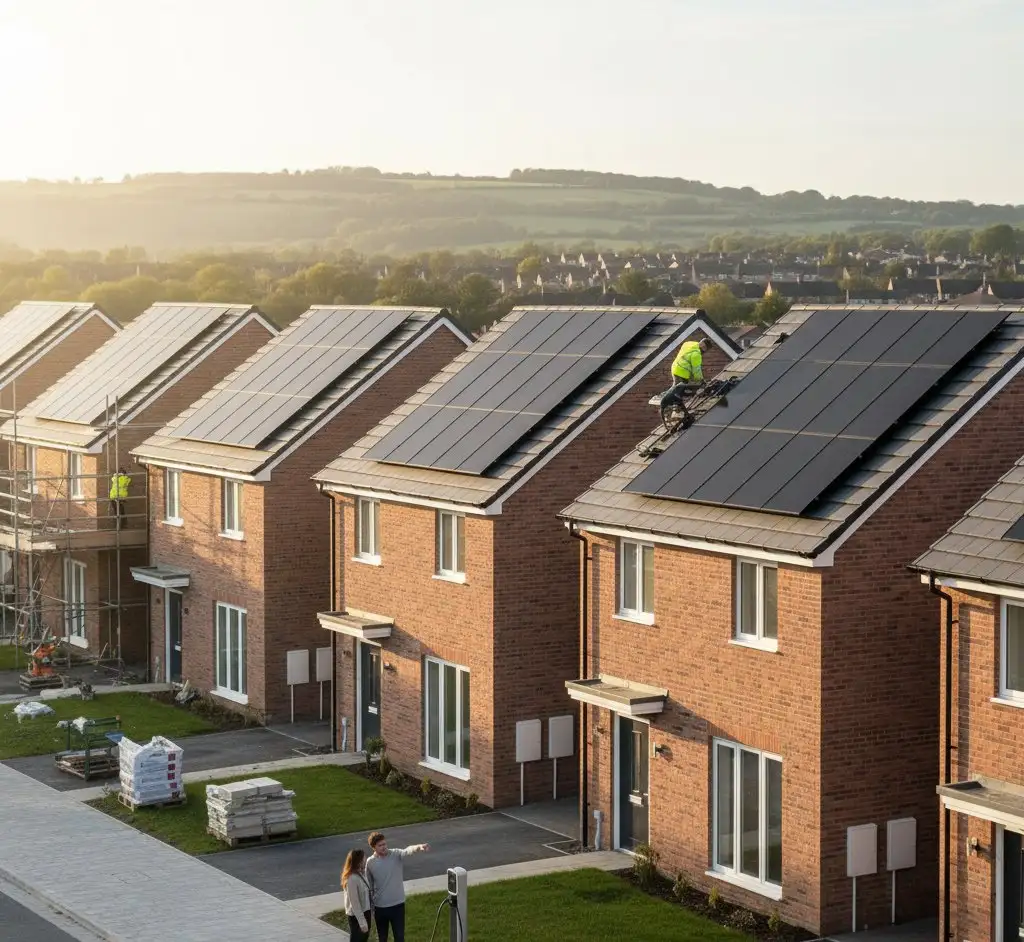
Solar Panels on New Build Homes: What Buyers Need to Know
Solar on new build homes in the UK — Part L building regulations, developer-installed systems, upgrading after moving in, and what to check before you buy.
Permitted Development: The 9m² Rule for Solar
Permitted development rights for solar panels in the UK — the 9m² limit for ground-mounted systems and what you can install without planning permission.
How Much Do Solar Panels Cost in the UK in 2026?
UK solar panel costs 2026: realistic prices by system size, what is included, and what to push back on in your quote.


Switch to Octopus Energy
Get 50 credit when you switch. We get 50 too — win-win.
What does this mean for YOUR home?
Design your perfect solar setup in under 3 minutes. Free, no sign-up required.
Build Your Solar System