This page contains affiliate links. If you purchase through them we may earn a small commission at no extra cost to you. Learn more
Solar Panel Maintenance Costs UK: What a Year of Upkeep Actually Costs
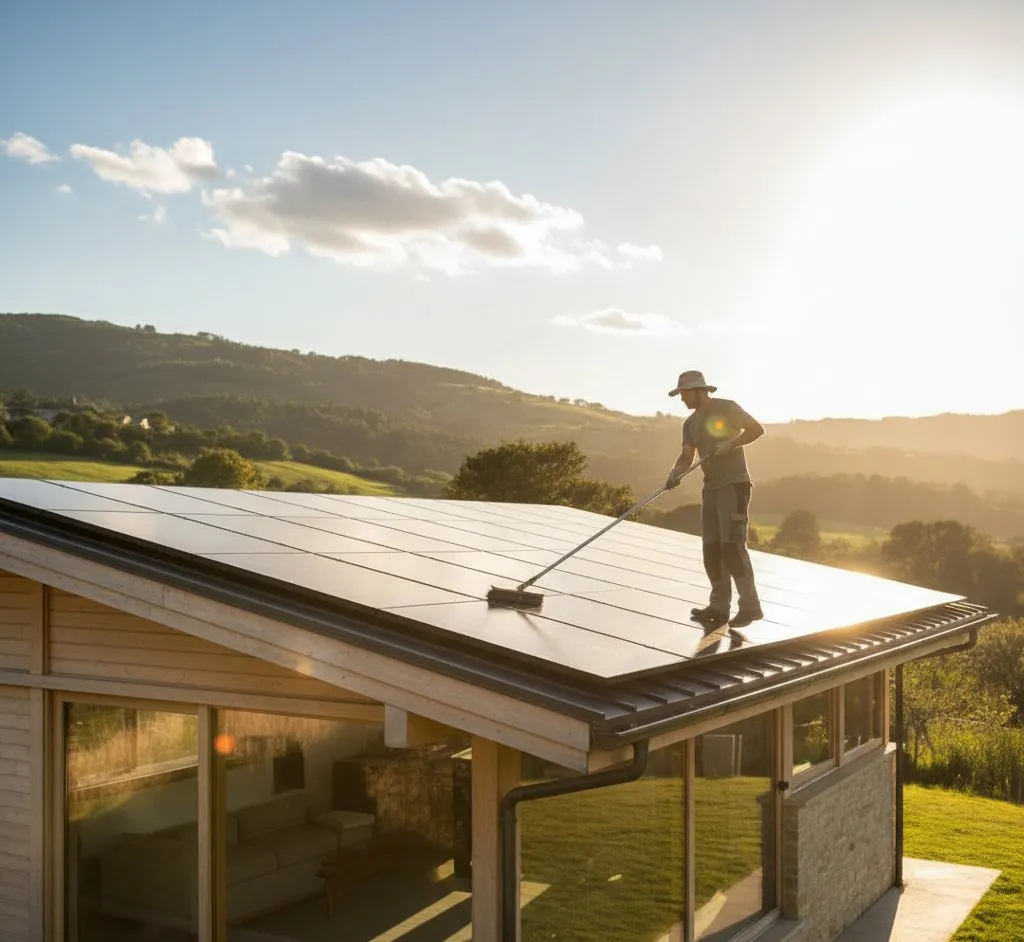
The honest answer: solar is cheap to maintain
If you are weighing up whether solar panels are worth the investment, maintenance costs are not a serious barrier. Over a typical 25-year system life, the realistic annual running cost — including everything averaged out — sits at around £100–250 per year.
To put that in context: at the current standard electricity rate of around 24p/kWh, a well-sized 4kW system on a south-facing UK roof typically saves £800–£1,200 per year in avoided grid electricity. Maintenance costs represent roughly 10–20% of those savings at most.
The low maintenance burden comes from the technology itself. Solar panels have no moving parts, no combustion, no fluids, and no filters. Unlike a boiler or an air conditioning unit, there is nothing to service annually by design. The main costs that do arise are predictable, widely spaced, and manageable.
This article gives you a complete cost picture so you can plan accurately and avoid unexpected bills.
Annual maintenance cost breakdown
The table below covers every realistic maintenance expense for a typical 4–6 panel residential solar system in the UK, including how often each cost arises and what it works out to per year when amortised over 25 years.
Total: approximately £100–250 per year averaged over 25 years, excluding scaffolding which is only needed in specific circumstances (see below).
The annual inspection is listed as optional because most homeowners in the UK carry out informal checks themselves. If you are confident reading your inverter data and doing a ground-level visual check, a paid annual inspection is not compulsory — it is a question of how much peace of mind you want.
Do solar panels need cleaning?
The UK climate does a reasonable amount of cleaning work for you. Rainfall is frequent, and modern panels have a hydrophilic coating that encourages water to sheet off the surface, carrying loose particles with it. General dust, pollen, and light soiling are usually cleared within a few wet days.
Professional cleaning makes sense in these situations:
- Bird droppings are present — these are the significant exception. Droppings do not wash off cleanly in rain, and a concentrated patch on even one cell can reduce that panel's output by 20–40% until it is removed
- You have flat-roof panels — lower tilt angles (under 15°) do not shed water as effectively, so debris accumulates faster
- Panels are near trees — leaf debris, pine needles, and sap from overhanging branches call for a more regular clean
- You are in a coastal location — salt residue from sea spray is not fully removed by fresh rainwater
For a typical pitched-roof installation without these risk factors, professional cleaning once every one to two years is sufficient. Some UK homeowners clean less frequently than that without measurable impact on output.
What professional cleaning adds: Studies on UK installations suggest a thorough professional clean on moderately soiled panels improves output by 3–5%. On a system generating 3,400 kWh/year, that is approximately 100–170 kWh recovered — worth around £24–£41 at 24p/kWh. That does not fully justify a £100–150 cleaning bill on its own, which is why clean-on-need (guided by your monitoring data) is more cost-effective than a rigid annual schedule.
Never attempt rooftop cleaning without proper safety measures
Never walk on solar panels or attempt to clean them from the roof without proper equipment. Falls from height are the leading cause of DIY solar maintenance injuries. Use a telescopic cleaning pole from ground level, or hire a professional with appropriate working-at-height insurance.
When do inverters need replacing?
The inverter is the only component in a solar system that routinely needs replacing during the system's lifetime. Panels can last 30 years or more with minimal degradation. The inverter — the box on the wall that converts DC electricity from the panels into AC for your home — is electronic equipment with a typical lifespan of 10–15 years.
Signs your inverter is approaching failure:
- Persistent error codes appearing in the app or on the display, particularly overtemperature or isolation fault warnings
- A gradual unexplained drop in generation (15–20% below previous years, with panels clean and no new shading)
- Intermittent shutdown during the day — the system stops mid-afternoon and restarts the following morning
- Unusual sounds: a soft hum is normal; buzzing, clicking, or grinding is not
Replacement cost by inverter type:
All prices include 0% VAT as inverter replacement qualifies as an energy-saving materials installation on a residential property.
Replacement is also an opportunity to upgrade. A standard string inverter replaced with a hybrid inverter — one that can connect to a battery — costs £200–400 more than a like-for-like swap, but puts you in a much stronger position to add battery storage in future without a second installation cost.
If your system is within the inverter's warranty period (commonly 5–12 years depending on the manufacturer), contact the manufacturer or your installer before paying for a replacement. Many faults within warranty are covered at no parts cost, though you may still pay installation labour.
Extended inverter warranties are usually worth the money
At the point of buying a new system, inverter manufacturers often offer 10-year extended warranties for £100–300. Given that replacement otherwise costs £700–1,200, this is generally worth considering — particularly for systems where the inverter will be in a hot or damp location.
What does an annual inspection cover?
A paid annual inspection from a solar maintenance company or MCS-accredited installer typically covers:
- Visual inspection of all panels — checking for cracking, delamination, discolouration, and micro-hotspots (usually spotted via thermal camera on premium checks)
- Frame and mounting hardware check — confirming that fixings are secure and there is no movement or corrosion
- Roof penetration check — verifying the areas around roof anchors are watertight
- Inverter check — reviewing error logs, ensuring ventilation is clear, checking all DC and AC connections are tight
- Generation performance review — comparing output against expected figures for the system size and location
- Battery health report (if applicable) — state of health, cycle count, and any error codes
A basic inspection costs £100–200. More thorough checks including thermal imaging to identify panel hotspots or failing cells cost £200–350 but give you a much clearer picture of system health.
For systems within the first five years of installation, a formal paid inspection is often unnecessary — the system is under warranty, monitoring platforms flag most issues automatically, and an informal DIY check covers the key bases. For older systems, particularly those approaching inverter replacement age, a professional inspection every two to three years is worth considering.
DIY vs professional maintenance
A significant portion of maintenance is straightforward enough to do yourself, which keeps costs down considerably.
What you can do yourself:
- Ground-level visual inspection — walking around the building and looking at panels for obvious damage, discolouration, or debris. Takes 10 minutes and costs nothing
- Inverter log review — checking your monitoring app for error codes and comparing this year's generation figures to last year's. Most platforms (GivEnergy, SolarEdge, Fronius Solar.web, Solis Cloud) are free to use and retain years of generation history
- Consumer unit check — confirming the solar generation breaker has not tripped
- Cleaning from ground level — if your panels are reachable with an extendable pole (3–5m), soft-bristle cleaning using plain water is safe and effective
What is better left to a professional:
- Any inspection that requires going onto the roof — this needs appropriate working-at-height equipment and training
- Inverter electrical work — AC and DC connections should only be handled by a qualified electrician or solar installer
- Fault diagnosis for unexplained output drops — a trained engineer with IV tracing equipment or a thermal camera can identify failed cells, wiring faults, or shading issues that are not visible from the ground
- Warranty claims that require professional sign-off
The practical split for most homeowners: DIY monitoring and ground-level checks throughout the year, with a professional called in only when something flags in the data or when inverter work is needed.
Hidden costs to budget for
A few costs that are easy to overlook when planning:
Scaffolding: If your roof requires scaffolding for safe access — most standard two-storey houses do — expect to add £200–400 per visit for erection and dismantling. This applies whether you are having panels cleaned, an inverter replaced, or bird proofing installed. Where possible, it is worth combining multiple tasks into a single scaffolding visit to avoid paying this charge multiple times. Some solar maintenance companies include scaffold costs in their quotes; confirm before booking.
Bird proofing (pigeon mesh): If birds are roosting or nesting under your panels, the mesh skirt that prevents access costs £300–600 depending on array size. This is a one-off cost, but it needs to be done before a colony establishes — once birds are nesting, you cannot legally remove an active nest during breeding season, and the clean-up afterwards adds significantly to the cost. If you live in an area with visible pigeon activity, include bird proofing in your budget from day one.
Tree management: Branches that grow to shade panels reduce generation and may require trimming every few years. This is not a solar-specific cost, but it is one that solar ownership draws your attention to. A tree surgeon visit to trim overhanging branches typically costs £150–400 depending on access and scale.
Insurance uplift: Most home insurers will cover your solar installation under buildings and contents policies, but you should notify them — failure to do so can invalidate claims. Many insurers add solar cover for £20–50/year extra. This is not a maintenance cost in the traditional sense, but it is an ongoing running cost worth including in your planning.
Maintenance contracts: are they worth it?
Some solar installers and specialist maintenance companies offer annual service contracts covering regular inspections, monitoring, and priority callout for faults. Typical pricing:
- Basic contract (annual inspection + monitoring review): £100–180/year
- Comprehensive contract (inspection, cleaning, priority fault callout): £200–350/year
- Full cover contract (includes parts and labour for inverter replacement): £300–500/year
Whether a contract offers value depends on your circumstances. For a newer system still under the manufacturer's inverter warranty, a contract is rarely necessary — the manufacturer covers parts, and the system needs little attention. For an older system approaching or beyond the inverter warranty, a contract that includes parts and labour cover for inverter replacement could be worthwhile if the premium is lower than the expected replacement cost amortised over the remaining life.
The simplest test: compare the annual contract cost against what you would pay for the same services on a pay-as-you-go basis. If you would expect to pay for one professional clean (£100–150) and one inspection (£100–200) per year anyway, a comprehensive contract at £200–350 may not represent a significant saving — particularly if it does not cover inverter parts.
Pay-as-you-go suits most homeowners. A contract is worth considering if you want predictable costs, live in a high-soiling area, or have an older system where unplanned bills concern you.
How maintenance affects payback
The payback period on a solar installation is typically calculated from the ratio of upfront cost to annual savings. Maintenance costs extend this period modestly, but not dramatically.
Working through a realistic example:
- 4kW system installed cost: £6,000
- Annual electricity savings: £900 (at 24p/kWh, typical consumption and self-use)
- Basic payback without maintenance: 6.7 years
Now factor in maintenance over 25 years:
- Professional cleaning (every 2 years at £120): £1,500 over 25 years — £60/year
- One inverter replacement at year 13 (£1,000): amortised = £40/year
- Bird proofing (one-off £400): amortised = £16/year
- Total maintenance: approximately £116/year
Net annual saving after maintenance: approximately £784/year. Revised payback: around 7.6 years. The difference is less than a year on a 25-year system.
Looked at another way: a system that would otherwise save £22,500 over 25 years (£900/year x 25) might save £19,600 after realistic lifetime maintenance costs. That is still a substantial return on a £6,000 investment — and it does not include SEG export income, which adds further over time.
Maintenance costs are real and worth planning for. But in the context of what a well-installed solar system saves over its lifetime, they are a minor line item — not a reason for hesitation.
Share this article

Order your Energy Performance Certificate online — see how solar improves your home's energy rating. Required before selling or renting. All assessors are fully accredited.
Affiliate link — we may earn a small commission at no extra cost to you
Stay informed
Get free solar updates direct to your inbox
Related reading
Annual Solar Panel Maintenance Checklist
A simple annual maintenance checklist for UK solar panel owners. What to check, when to check it, and when to call a professional.
Should You Clean Your Solar Panels? The UK Reality
Solar panel cleaning in the UK — whether it's worth it, how much professional cleaning costs, the DIY approach, and when dirt actually makes a difference.
Cleaning Solar Panels: Is It Worth It?
Do solar panels need cleaning in the UK? When it's worth it, when it's not, DIY vs professional cleaning, and what to never use on your panels.


Switch to Octopus Energy
Get 50 credit when you switch. We get 50 too — win-win.
What does this mean for YOUR home?
Design your perfect solar setup in under 3 minutes. Free, no sign-up required.
Build Your Solar System