This page contains affiliate links. If you purchase through them we may earn a small commission at no extra cost to you. Learn more
Solar Panels in Scotland: Do They Work and Are They Worth It?

"Solar doesn't work in Scotland" is one of the most persistent myths in UK renewable energy. It is also wrong.
Scotland receives less solar irradiance than southern England — that part is true. But the jump from that fact to "solar is not worth it" ignores longer summer days, cooler operating temperatures, a generous loan scheme, and planning rules that are now the most permissive in the UK.
This article sets out what Scottish homeowners actually need to know.
The myth, and the reality
The claim: Scotland does not get enough sun for solar to be worthwhile.
The accurate picture:
- Scottish solar yield: 750–850 kWh per kWp per year (Inverness reaches approximately 837 kWh/kWp/yr)
- South England solar yield: 950–1,050 kWh per kWp per year (Brighton: approximately 1,132 kWh/kWp/yr)
A Scottish system produces around 80–90% of the output of an equivalent system in the south. On a typical 4kWp installation, that is 3,000–3,400 kWh per year — still enough to cover 80–100% of a typical Scottish household's annual electricity consumption.
80–100%
of typical household electricity use — A 4kWp system in Scotland generates 3,000–3,400 kWh/year — less than the south, but still more than
Learn moreWhy Scotland performs better than raw irradiance suggests
The irradiance gap is real, but three factors narrow it in practice.
1. Longer summer days
In June, Scotland sees 16 or more hours of daylight — comparable to or exceeding southern England. The sun rises early and sets late. Even at lower intensity, those additional hours of generation accumulate into meaningful kWh.
2. Cooler temperatures make panels more efficient
Solar panels lose approximately 0.35% of their output for every degree Celsius above 25°C. On a hot southern English day — 30, 35, even 38°C — panels operate noticeably below their rated power. Scottish summer temperatures are consistently cooler. On the hottest UK days, a Scottish system may actually come close to matching a southern system's output per kWp, because the panels run closer to their rated efficiency.
3. Diffuse light still generates
Solar panels generate from daylight, not direct sunshine. Overcast conditions reduce output to 10–25% of peak, but Scotland's cloudy days are not generation-free days. The same physics that makes solar work in Germany — a country with weather very similar to the UK — applies equally in Scotland.
Grants and loans: what is available in April 2026
Solar grants from Home Energy Scotland stopped in June 2024
Many older guides and articles still reference the Home Energy Scotland solar grant. That grant scheme closed in June 2024. Do not apply for a grant — it no longer exists. What does still exist is an interest-free loan.
| Scheme | Status | Value | Notes |
|---|---|---|---|
| Home Energy Scotland solar grant | Stopped June 2024 | — | No longer available |
| Home Energy Scotland interest-free loan | Active | Up to £6,000 | Check hes.scot for current limit before applying |
| Warmer Homes Scotland | Active | Up to £10,000 | Low-income / fuel poverty households; solar not guaranteed — heating and insulation take priority |
| 0% VAT on solar | Active UK-wide | 0% until March 2027 | Not a Scottish grant; applies across the whole of the UK |
The interest-free loan from Home Energy Scotland is a genuine benefit. If you are borrowing to fund solar anyway, an interest-free loan is meaningfully better than a commercial loan or credit card. Always check the current loan ceiling at hes.scot before publishing or quoting a figure — the maximum has changed before and may change again.
For the Home Energy Scotland helpline: 0808 808 2282.
Planning permission in Scotland
Scotland has become the most permissive UK nation for solar planning. The key rules as of April 2026:
| Rule | Scotland | England (for comparison) |
|---|---|---|
| Roof projection limit | 1 metre above roof plane | 200mm above roof plane |
| 50 kW capacity cap | Removed May 2024 | No equivalent cap in GPDO 2015 |
| Flatted buildings | Permitted development rights apply (Class 4A) | Flats generally excluded |
| Conservation areas | Only primary elevation and road-facing elevation restricted | Entirely excluded from Class A |
| Listed buildings | Full planning required | Full listed consent required |
The removal of the 50 kW capacity cap under Planning Circular 2/2024 in May 2024 was significant. It opened the door to larger rooftop systems — on commercial and community buildings as well as homes — without requiring full planning permission. This is ahead of equivalent reform in England.
The Class 4A permitted development right for flatted buildings is unique to Scotland. In England, flats are generally excluded from Class A domestic solar permitted development, meaning flat-dwellers usually need a full planning application. Scottish flat-dwellers have more flexibility.
Check with your local planning authority for conservation areas and listed buildings
Even within Scotland's more permissive framework, listed buildings require listed building consent and conservation area restrictions still apply to certain elevations. If your home is listed or in a conservation area, contact your local planning authority before installation.
Building regulations: Part P does not apply in Scotland
England and Wales use Part P of the Building Regulations to govern electrical work. Part P does not apply in Scotland.
Scotland uses the Building (Scotland) Act 2003 and its associated Building Standards Technical Handbooks. The relevant standards for solar electrical work are:
- Standard 4.5 — electrical safety
- Standard 4.6 — electrical fixtures
The relevant certification body is SELECT (the Scottish Electrical Contractors Association). Local Authority Building Standards Scotland (LABSS) approved certifiers can also verify compliance.
This does not mean electrical rules are looser in Scotland — it means the legal framework is different, and the competent persons and approval routes are different too. If you are getting quotes from installers, confirm they are familiar with the Scottish building standards rather than assuming English and Scottish rules are identical.
Distribution network operators in Scotland
When your installer notifies the grid for a G98 or G99 connection, they will contact one of Scotland's two distribution network operators (DNOs):
- SP Energy Networks (SPEN) — central belt and south Scotland (spenergynetworks.co.uk)
- SSEN (Scottish and Southern Electricity Networks) — north Scotland and the islands (ssen.co.uk)
If you are on the islands — Orkney, Shetland, the Hebrides — you are served by SSEN. Island properties have historically faced grid constraint challenges for solar and storage. It is worth checking with your installer whether any grid upgrade or export limitation applies before committing to a large system.
Costs in Scotland
Scottish installations are, on average, the most expensive in the UK. DESNZ regional cost data for April 2026 puts the average installed cost at approximately £1,734 per kWp in Scotland, compared with approximately £1,591 per kWp for England as a whole.
For a 4kWp system, that is a difference of roughly £500–600. Remote and island properties carry higher costs still due to logistics and scaffolding.
This cost premium partially offsets the lower yield when calculating payback periods. Using UK-average cost figures for a Scottish installation will produce an overly optimistic result.
Is solar worth it in Scotland?
For most Scottish homeowners with a suitable roof, yes — but with realistic expectations.
The payback period will typically be longer than for a comparable system in southern England, because:
- Lower yield means fewer kWh generated per year
- Higher average installation cost per kWp
A reasonable estimate for a 4kWp system in central Scotland is a payback period of 9–13 years, depending on how much electricity you use during the day, whether you add a battery, and what electricity tariff you are on.
The panels then continue generating for 25 years or more.
The interest-free loan from Home Energy Scotland helps significantly if you are borrowing to fund the installation. At 0% interest, the loan cost does not extend your payback period in the way a commercial loan would.
Get multiple quotes from SELECT-registered installers
SELECT registration is the Scottish equivalent of NICEIC or NAPIT in England. When comparing quotes, confirm all installers are MCS-certified (required for SEG eligibility) and that the electrician for the grid-connection work holds relevant Scottish electrical certification.
Share this article
Energy-saving LED lighting — make the most of your solar electricity with efficient bulbs and fixtures
Affiliate link — we may earn a small commission at no extra cost to you
Stay informed
Get free solar updates direct to your inbox
Related reading
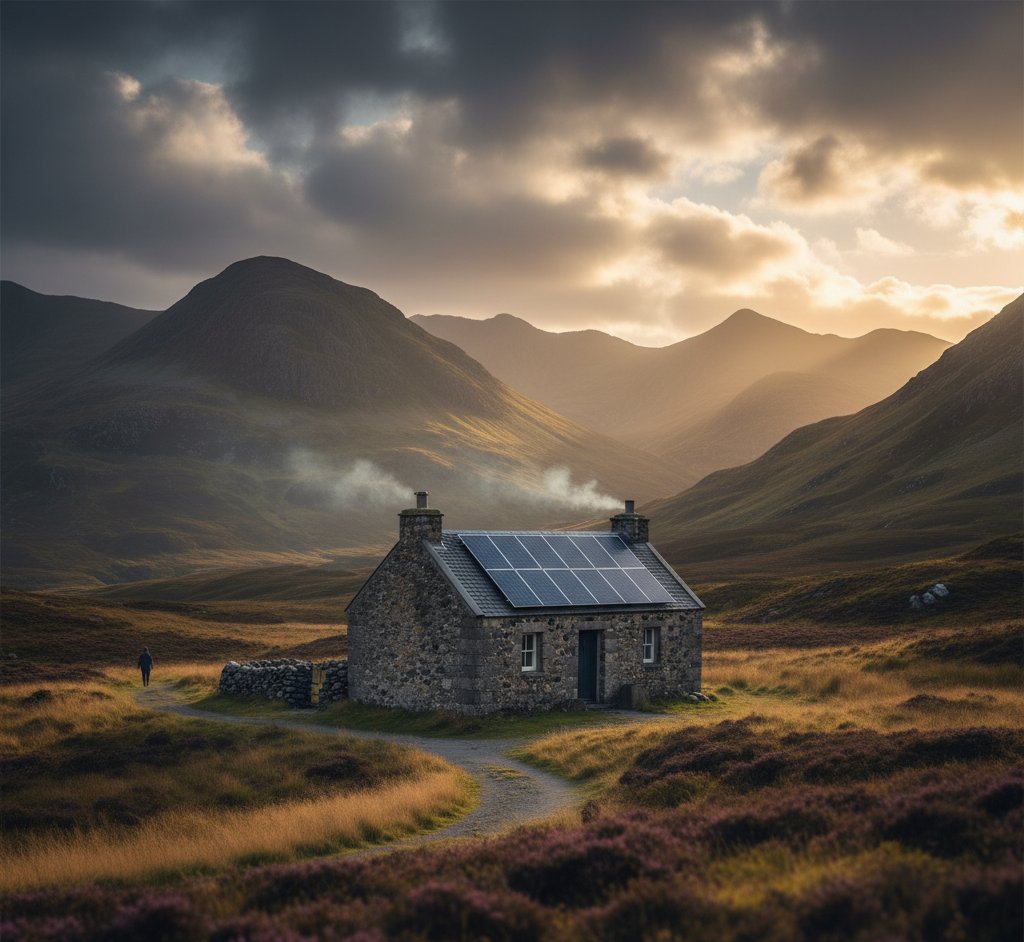
Scotland Warmer Homes: Free Solar for Scottish Homeowners
Warmer Homes Scotland and Home Energy Scotland can fund free solar panels for qualifying Scottish households. Full eligibility guide and how to apply.

Do Solar Panels Work in Winter and on Cloudy Days?
Yes, solar panels work in winter and on cloudy days in the UK. Here is how much they actually generate month by month.

Are Solar Panels Worth It in the UK? The Honest Answer
Are solar panels worth it in the UK in 2026? Honest assessment of costs, savings, payback, and who benefits most.


Switch to Octopus Energy
Get 50 credit when you switch. We get 50 too — win-win.
What does this mean for YOUR home?
Design your perfect solar setup in under 3 minutes. Free, no sign-up required.
Build Your Solar System