This page contains affiliate links. If you purchase through them we may earn a small commission at no extra cost to you. Learn more
Solar Subscriptions and Leasing: Are They Worth It in 2026?

Solar subscriptions are growing in the UK. They appeal to homeowners who want lower electricity bills without a large upfront payment. But almost every objective comparison of subscriptions vs buying is written by someone who wants to sell you a subscription. This guide is not.
Here is what the model actually involves, what it costs you over time, and how to decide whether it makes sense for your situation.
What is a solar subscription?
A solar subscription (sometimes called a solar lease or solar service agreement) works like this:
- A company assesses your property and installs solar panels on your roof
- You pay nothing upfront
- You pay the company a fixed monthly fee — typically for 10 to 25 years
- The company owns the panels throughout the contract
- You use the electricity the panels generate, reducing your grid electricity bill
- At the end of the contract, you either buy the panels, let the company remove them, or (in some agreements) they transfer to you
The key distinction: the panels are on your roof, but they are not your asset. This has financial and practical implications that run through every aspect of the model.
This is also different from the old "rent-a-roof" schemes that ran in the UK from roughly 2009 to 2019. Those schemes were free — the company kept the Feed-in Tariff (FiT) payments in exchange for installation. The FiT closed to new applicants in 2019 and those legacy schemes are no longer available. Modern subscriptions are a monthly payment model, not a free scheme.
Types of no-upfront-cost solar
There are several ways to get solar without a large initial payment. They are not the same thing.
| Model | Who owns the panels | Monthly cost | Contract length | At end of contract | Example |
|---|---|---|---|---|---|
| Subscription | Company | Fixed monthly fee | 10–25 years | Company removes, or you buy, or they transfer | Sunsave Plus |
| Lease / PPA | Company | Variable (based on generation or fixed) | 20–25 years | Transfer or buyout option | Various providers |
| Rent-a-roof (legacy) | Company | Free — they kept FiT payments | 25 years | Panels may stay or be removed | Defunct — no longer available |
| 0% loan | You (from day 1) | Fixed repayment | 5–10 years | You own outright at end | Green mortgage, Warm Homes Plan loan |
| Buy outright | You | None after purchase | N/A | You own from day 1 | Standard installation |
A power purchase agreement (PPA) is a variation where instead of a fixed monthly fee you pay a per-unit rate for the electricity the panels generate. Your bill varies with generation, similar to paying a grid tariff but at a contracted rate — often discounted relative to the grid rate. PPAs are more common in commercial solar; they are less common in UK residential but do exist.
The case for subscriptions
Subscriptions solve a real problem: access. A typical 4 kWp solar installation costs £6,000–8,000. That is a significant sum. For homeowners who cannot or do not want to commit that capital — or who cannot access finance — a subscription offers a route to lower electricity bills that would otherwise be unavailable.
The case for subscriptions, at its strongest:
- Zero upfront cost. No savings needed, no finance application
- No maintenance responsibility. The company owns the panels and is typically responsible for performance, repairs, and monitoring
- Performance guarantees. Some subscription agreements include minimum generation guarantees — if the system underperforms, the company bears the shortfall
- Accessible for those who cannot get finance. If green mortgages or personal loans are unavailable to you, a subscription may be the only realistic no-upfront route
- Removes technical risk. You do not need to manage an asset, worry about inverter failures, or understand the MCS certification process
If the alternative is doing nothing and continuing to pay full grid rates, a subscription that meaningfully reduces your electricity bill may well be worth it.
The case against subscriptions
The case against is also real, and subscription providers are not always upfront about it.
You do not own the panels. The panels are installed on your roof and anchored to your home, but they are legally the company's property. This has implications:
- House sale complications. If you sell your home, the buyer must either take on the subscription contract or you must pay an early exit fee. Some buyers and their mortgage lenders object to a long-term liability attached to a property. This can delay or complicate a sale.
- Mortgage implications. Some lenders are cautious about properties with solar subscriptions attached. This is worth raising with your mortgage adviser before signing.
- Early exit fees. If you want to end the contract — because you are moving, your circumstances change, or you want to buy the panels — exit fees can be substantial, particularly in the early years of a long contract.
You do not get the SEG export income. The Smart Export Guarantee pays for solar electricity you do not use and export to the grid. Under most subscription agreements, the company claims the SEG payments, not you. You get the benefit of the electricity you use; the export income goes elsewhere.
Total cost over time is higher than buying. This is the most important point, and we will cover it in detail below.
Buying versus subscription: the maths
Comparing a subscription to buying outright requires looking at the full picture over 20–25 years, not just the upfront figure.
Consider a 4 kWp system:
Buying outright:
- Upfront cost: approximately £6,000–8,000
- You own the system immediately
- You keep all electricity savings — worth roughly £600–900 per year at current rates, depending on your usage pattern
- You keep the SEG export payments — typically £100–300 per year
- The system continues generating for 25 years or more
- Total value generated over 25 years: considerably more than the purchase cost
Subscription:
- Upfront cost: £0
- Monthly fee: varies by provider and system size — typically £50–100/month at time of writing, but check current offers
- Over a 20-year contract, total payments could exceed £12,000–24,000
- The company keeps the SEG export payments throughout
- At the end of the contract, you may or may not own the panels
The comparison is not "£7,000 vs £0." It is "£7,000 now vs £15,000+ over 20 years, plus you give up export income." Over a long enough horizon, buying almost always comes out ahead — sometimes significantly.
The subscription makes the numbers work by converting a large one-off cost into a stream of payments. This is valuable if you genuinely cannot access the upfront capital. It is considerably less valuable if you could buy outright or use 0% finance.
Read the full contract before signing
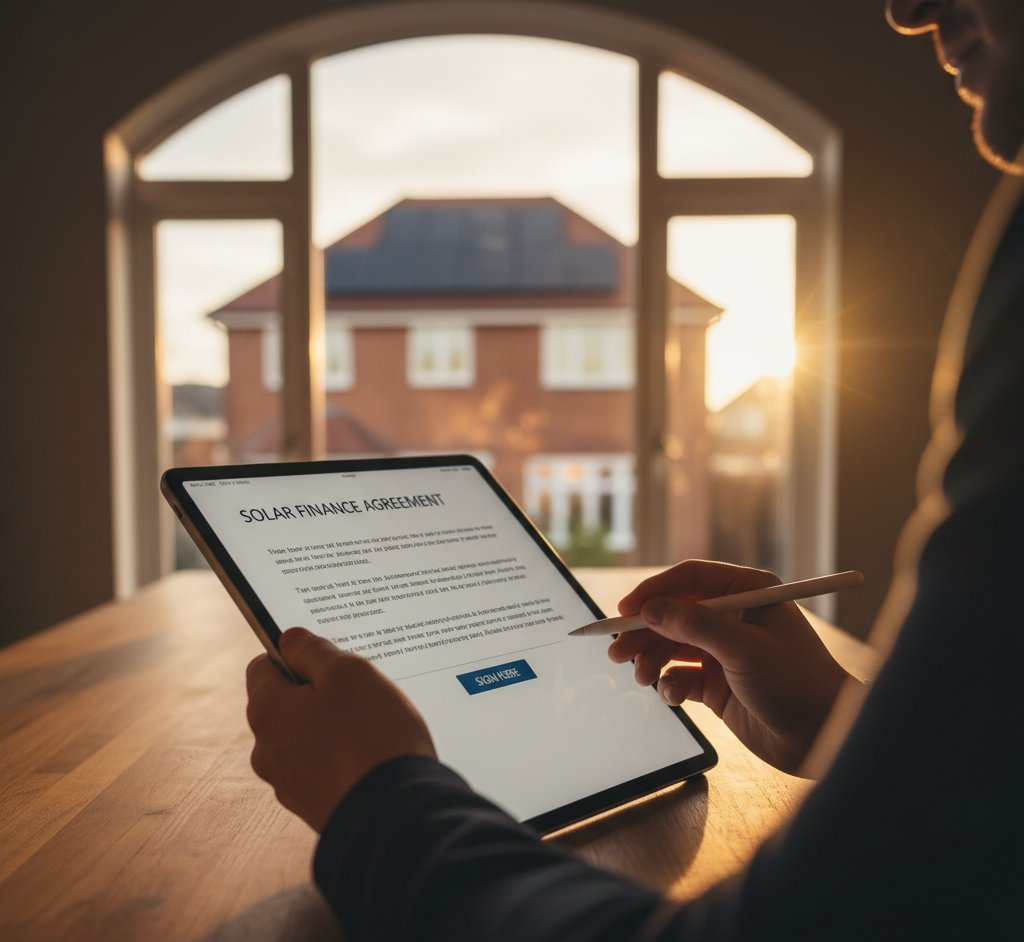
Key questions to answer before signing any subscription agreement: Can you exit early, and what does it cost? What happens when you sell your home? Who claims the SEG export payments? What maintenance and performance guarantees apply? What condition must your roof be in when the contract ends? What happens at the end of the contract — removal, buyout, or transfer? These are not peripheral details; they are the substance of what you are agreeing to.
What to check before signing
If you are seriously considering a subscription, go through this list before committing.
Contract length and exit terms
- How long is the contract? 10, 15, 20, or 25 years?
- What are the exit fees in year 1, year 5, year 10?
- Is there a buyout option, and at what price?
House sale
- Can the contract be transferred to a buyer?
- Does it require buyer consent, and can a buyer refuse?
- Is there a break clause if you sell within a certain period?
SEG export payments
- Who claims the SEG payments — you or the company?
- If the company claims them, is any share passed back to you?
Maintenance and performance
- Who is responsible for inverter replacement, panel cleaning, and monitoring?
- Is there a minimum generation guarantee, and what happens if it is not met?
- Does the company's insurance cover accidental damage during installation and maintenance?
End of contract
- What happens at the end — removal, automatic transfer to you, or a buyout at a specified price?
- If the panels are removed, who pays for roof reinstatement?
Mortgage and property
- Have you checked with your mortgage lender that a subscription agreement on the property is acceptable?
- Is the agreement registered as a charge or covenant on the title?
Alternatives worth exploring first
Before signing a subscription agreement, it is worth considering whether other routes might give you solar ownership without the long-term commitment.
- 0% green finance. Some energy suppliers and specialist lenders offer 0% or low-interest loans specifically for solar and heat pumps. If you can access this, you own the panels from day one and keep all savings and SEG income.
- Warm Homes Plan loans. The Warm Homes Plan includes government-backed loans for home energy improvements. Eligibility varies; check gov.uk for current criteria.
- Green mortgage additional borrowing. If you are remortgaging or buying, some lenders offer additional borrowing at preferential rates for energy efficiency improvements.
- Spreading the cost through a personal loan. A standard personal loan at, say, 7–9% is worth comparing against a subscription total cost. Over 20 years, the subscription may still cost more in total, even accounting for loan interest.
If you can access 0% finance, buying is almost always better
An interest-free loan via a green mortgage or Warm Homes Plan route means you own the system, keep all savings, keep all SEG export payments, and face no exit fees if you sell. If this route is available to you, it is worth exploring carefully before committing to a subscription.
Who subscriptions might genuinely suit
Subscriptions are not universally bad. There are situations where they make genuine sense:
- You have no savings and cannot access any form of finance, but you have a suitable roof and high electricity bills
- You are unwilling to take on any asset risk or maintenance responsibility
- You are in a property you expect to stay in for the full contract term
- You have checked with your mortgage lender and the subscription does not affect your mortgage
- You have read the full contract, understand the exit terms, and the monthly cost is clearly less than your current grid electricity spend
The decision depends heavily on your individual circumstances, the specific terms offered, and what alternatives are available to you.
What it should not depend on is a comparison that ignores the total cost over time, or a sales conversation that leads with "no upfront cost" without explaining what you are actually committing to.
Share this article
Order your Energy Performance Certificate online — see how solar improves your home's energy rating. Required before selling or renting. All assessors are fully accredited.
Affiliate link — we may earn a small commission at no extra cost to you
Stay informed
Get free solar updates direct to your inbox
Related reading

How Much Do Solar Panels Cost in the UK in 2026?
UK solar panel costs 2026: realistic prices by system size, what is included, and what to push back on in your quote.
How to Pay for Solar in the UK: Finance Options Compared
A honest comparison of every way to finance solar panels in the UK — cash, loans, green finance, 0% installer finance, solar PPA, and what to avoid.

Free Solar Panels UK: What's the Actual Catch?
Free solar panels in the UK explained — rent-a-roof schemes, solar PPAs, ECO4/Warm Homes grants, and what 'free' actually means for each option.


Switch to Octopus Energy
Get 50 credit when you switch. We get 50 too — win-win.
What does this mean for YOUR home?
Design your perfect solar setup in under 3 minutes. Free, no sign-up required.
Build Your Solar System