This page contains affiliate links. If you purchase through them we may earn a small commission at no extra cost to you. Learn more
Solar Installers in the UK: A Directory

Finding a solar installer is one of the most consequential steps in going solar. The quality of the installation affects your system's output, your warranty protection, and your ability to claim SEG export payments for the next 25 years. This directory covers what to look for, who operates across the UK, and how to check a company before you sign anything.
What to look for in a solar installer
Before looking at specific companies, it helps to know the baseline requirements that any reputable solar installer should meet.
MCS certification
MCS (Microgeneration Certification Scheme) certification is the key accreditation for domestic solar installers in the UK. It is not optional if you want:
- To register for Smart Export Guarantee (SEG) payments — your energy supplier will require MCS documentation
- To access certain government grants and schemes
- The legal consumer protections that come with MCS-certified work
Every MCS-certified company has a registration number, searchable at mcscertified.com. If an installer cannot provide this number, or says they use an "equivalent" scheme, do not proceed.
Public liability insurance
Any installer working on your property should carry public liability insurance of at least £2 million. This covers damage to your home or contents during the installation. Ask to see the certificate — a reputable installer will provide it without hesitation.
Workmanship warranty
MCS requires a minimum 2-year workmanship warranty, but the better installers offer 5–10 years. Crucially, the warranty should be backed by an Insurance-Backed Guarantee (IBG). An IBG means that if the installation company ceases trading during the warranty period, the remaining term transfers to the IBG insurer — so you are not left with a void warranty and no one to call.
Ask which IBG provider they use and request the name in writing.
Site survey
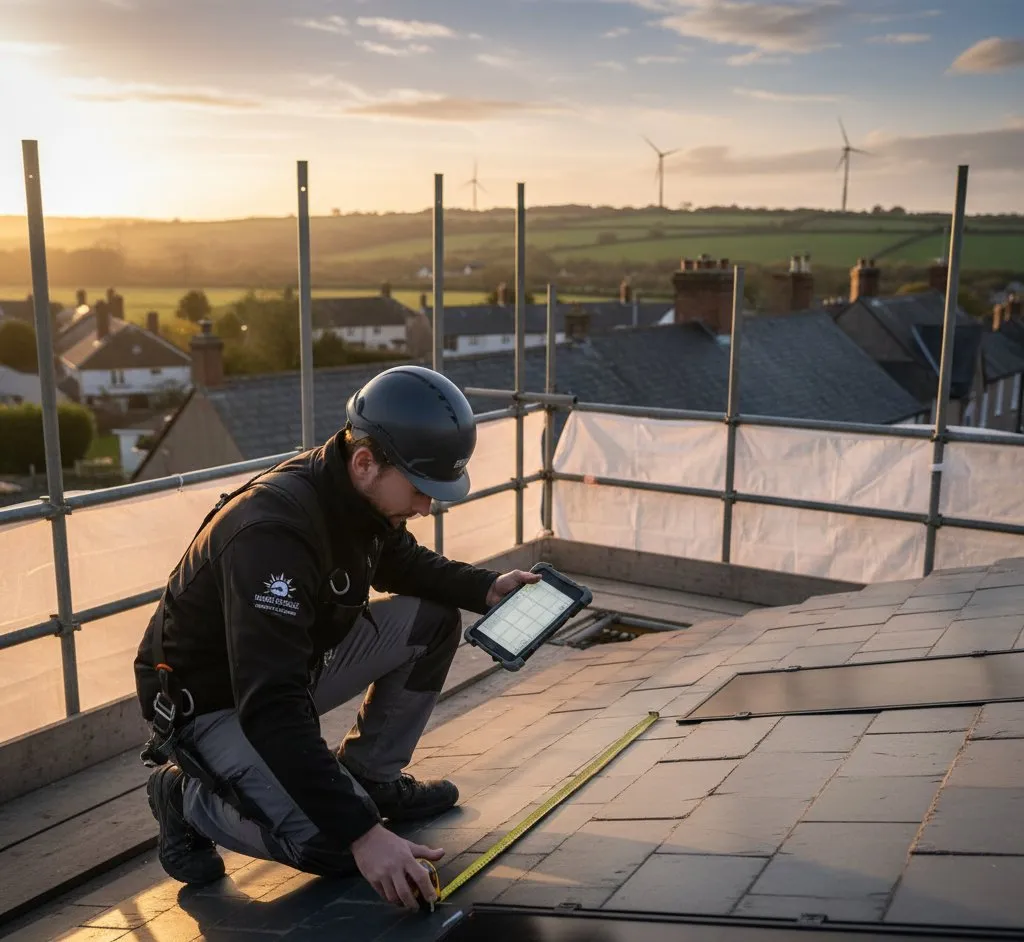
Any installer quoting purely from Google Maps or satellite imagery without visiting your property is cutting corners. A proper site survey involves a visit to assess:
- Roof condition, pitch, and orientation
- Shading from trees, chimneys, and neighbouring buildings
- Consumer unit condition and available space
- Roof access requirements for scaffolding
Quotes produced without a site survey are estimates at best, and the final price may shift once someone actually visits.
Aftercare and monitoring support
Solar systems generate data through an inverter monitoring app. A good installer will set this up as part of the handover and be available to help if the readings look unusual. Ask how they handle warranty call-outs and what their response time is.
Red flags to watch for
The following should prompt you to get a second opinion or walk away:
Pressure to sign on the day. "This price expires tonight" and "we only have two slots left" are sales tactics, not genuine offers. Reputable installers give you time to compare.
No physical site survey. Quoting solely from Google Earth is not sufficient. A price given without seeing the roof, the consumer unit, and the access requirements is not a reliable quote.
Full payment upfront. A reasonable deposit (typically 10–25%) is standard. Demanding full payment before any work begins is unusual and exposes you to significant financial risk if problems arise.
No MCS certification, or claims of an "equivalent". There is no recognised equivalent for domestic solar in the UK. MCS is the scheme. If an installer cannot produce an MCS number, they cannot provide you with a valid MCS certificate after installation — which means no SEG, and reduced consumer protection.
Unusually low price without explanation. A quote substantially below the market rate for your system size may indicate cheaper panels, an unqualified subcontractor, or corners being cut on electrical work. Ask what the lower price reflects.
VAT at 20% Is a Red Flag
Residential solar installations have been zero-rated for VAT since April 2022. If your quote includes 20% VAT on a home installation, the installer either does not understand the rules or is overcharging. This is one of the simplest checks you can make.
National installers operating across the UK
The following companies operate at national or near-national scale. These are factual descriptions of their coverage and business structure — this is not a ranking, and no endorsement is implied. Always obtain multiple quotes and verify MCS certification regardless of company size.
Octopus Energy Solar
Octopus Energy Solar operates across England and Wales. It is part of the Octopus Energy Group, which also runs electricity tariffs including Octopus Go and Intelligent Octopus Go. The integration between Octopus's energy tariffs and its solar offering may be of interest if you are already an Octopus Energy customer or are considering a time-of-use tariff alongside your solar installation.
British Gas Solar
British Gas Solar operates UK-wide under the Centrica group. British Gas has an existing customer base across the country and often bundles solar with boiler servicing contracts or its HomeCare product. It may be worth obtaining a quote from them if you are already a British Gas customer, alongside quotes from independent installers.
EDF Solar
EDF Solar operates in England and is backed by EDF Energy. It offers both outright purchase and lease arrangements for solar panels. As with any lease arrangement, check the full contract terms carefully — lease agreements typically mean the panels are not yours, which can complicate future property sales.
EON Next Solar
EON Next Solar operates in England as part of the EON energy group. Its solar offering integrates with EON Next energy tariffs. As with other large energy company solar arms, the key question is whether you are getting competitive pricing relative to independent installers.
Sunsave
Sunsave operates across England and Wales with an online-first model. Quotes are generated through an online process with a follow-up survey. It has positioned itself on competitive pricing for standard residential installations and uses an app-based approach to system design and aftercare.
Project Solar
Project Solar operates in England and offers both supply-and-install and supply-only services. The supply-only route may be of interest if you are working with your own electrician or are looking to source equipment separately from installation. Verify MCS arrangements carefully if pursuing supply-only, as the MCS certification responsibility sits with the installer, not the supplier.
Spirit Energy
Spirit Energy operates in England and Wales with a focus on residential solar installations. It offers solar-only and solar-plus-battery packages. As with any installer, request a full itemised quote before committing.
Green Building Renewables
Green Building Renewables operates in England through multiple regional branches. Its regional structure means you may find a local office covering your area, which can be an advantage for aftercare response times. The company covers both domestic and commercial installations.
Regional and independent MCS-certified installers
The UK has hundreds of smaller MCS-certified solar installers operating at regional or local level. These companies account for a significant share of residential installations and frequently offer competitive pricing. Smaller firms often have lower overhead costs and may be easier to reach for aftercare queries.
Examples of regional installers operating in specific areas (this is not an exhaustive list):
- SunGift Energy — South West England
- Joju Solar — South East England, London, and surrounding areas
- Egg Solar — North of England
- Mypower — South West England
- Atlantic Renewables — Wales
Finding regional installers in your area is straightforward using the MCS installer search (see below), filtered to your postcode.
How to verify an installer
Before accepting a quote or signing a contract, use the following to check an installer's credentials:
MCS Certified Installer Search — mcscertified.com/find-an-installer. Search by company name or postcode to confirm MCS registration is current. MCS accreditation can lapse, so check the status — not just whether a number exists.
TrustMark — trustmark.org.uk. TrustMark is a government-endorsed quality scheme for tradespeople. Many MCS-certified solar installers are also TrustMark registered.
Which? Trusted Traders — trustedtraders.which.co.uk. An independently assessed trader scheme. Useful as a secondary check, though not specific to solar.
Companies House — find-and-update.company-information.service.gov.uk. Check that the company is actively registered, when it was incorporated, and whether any significant charges or insolvency proceedings are listed. A company incorporated two months ago with no trading history warrants more scrutiny than an established business.
Check Reviews Across Multiple Platforms
Look for reviews on Google, Trustpilot, and MCS's own platform. Pay attention to how the company responds to negative reviews — this tells you more about their aftercare culture than a collection of five-star ratings from satisfied customers.
Getting quotes
Obtaining at least three quotes gives you enough data to assess whether a price is in the right range and to compare what each installer is actually offering. A lower headline price may reflect cheaper components, a shorter warranty, or excluded costs that appear later.
Each quote should include:
- Panel brand, model, and wattage per panel
- Inverter brand, model, and type (string or hybrid)
- Mounting system and fixing type for your roof
- Total system size in kWp
- Estimated annual generation in kWh (based on your location and roof orientation)
- Scaffolding cost, stated separately
- DNO notification (G98 or G99) — confirm the installer handles this
- MCS certificate — confirm this is issued on completion
- Workmanship warranty length and IBG provider name
One useful metric for comparing quotes of different sizes is cost per watt (£/W). Divide the total installed cost by the system size in watts to get a comparable figure. A 4kWp (4,000W) system quoted at £8,000 comes to £2.00/W. A 4.5kWp system at £8,500 comes to £1.89/W — which may be the better value even though the total price is higher.
For a full line-by-line breakdown of what each part of a solar quote means, and how to compare quotes using a consistent framework, see the guide to reading a solar quote.
Do Not Pay in Full Before Installation
A deposit is reasonable and standard. Full payment before work begins is not. Structure any payment with a deposit on contract signing, a stage payment on installation day, and the balance only once the system is commissioned and you have received the MCS certificate.
Share this article

Energy-saving LED lighting — make the most of your solar electricity with efficient bulbs and fixtures
Affiliate link — we may earn a small commission at no extra cost to you
Stay informed
Get free solar updates direct to your inbox
Related reading
How to Read a Solar Panel Quote: A Line-by-Line Guide
What every line on a solar installer's quote means, what should be included, what's missing, and the red flags that suggest you should get another quote.
Solar Panels by Location: UK City, County, and Regional Guides
Find your local solar guide. City, county, and regional guides covering costs, installers, and irradiance across the UK.

How Much Do Solar Panels Cost in the UK in 2026?
UK solar panel costs 2026: realistic prices by system size, what is included, and what to push back on in your quote.


Switch to Octopus Energy
Get 50 credit when you switch. We get 50 too — win-win.
What does this mean for YOUR home?
Design your perfect solar setup in under 3 minutes. Free, no sign-up required.
Build Your Solar System