This page contains affiliate links. If you purchase through them we may earn a small commission at no extra cost to you. Learn more
Hybrid Inverter vs String Inverter: Which Do You Need?
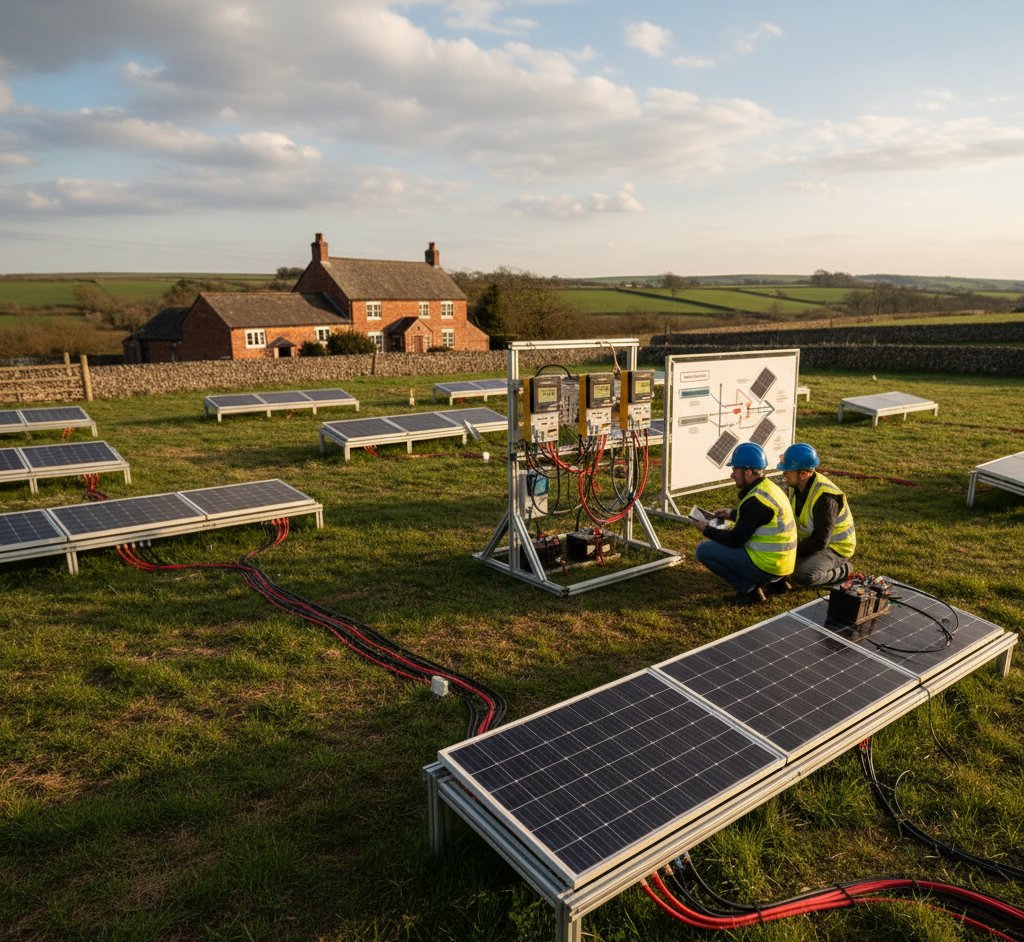
The inverter is the brain of your solar system. Choosing between a hybrid and a string inverter is one of the first decisions you'll make — and it has consequences for battery compatibility, future upgrades, and system cost. Here's a clear breakdown of the difference.
What Does an Inverter Actually Do?
Solar panels produce DC (direct current). Your home runs on AC (alternating current). An inverter converts the DC from your panels into AC that your home and the grid can use.
A string inverter handles this one job. It takes DC input from the panels (wired in one or more strings), converts to AC at grid frequency and voltage, and feeds it into your consumer unit.
That's it. A string inverter has no battery management capability.
What Makes a Hybrid Inverter Different?
A hybrid inverter does everything a string inverter does, plus it manages battery storage:
- Accepts DC from solar panels
- Charges a connected battery from solar (or from the grid at cheap-rate times)
- Discharges the battery to power your home
- Exports to the grid when both battery and home demand are satisfied
- Manages the priority order: solar → battery → home → grid
All of this happens in one box. There's no separate battery inverter or charge controller needed — the hybrid handles it.
Think of it as: string inverter = one-way street (solar to home). Hybrid inverter = junction box (solar, battery, home, grid all connected and managed).

Which Batteries Work With Which Inverters?
This is where it gets specific. Most hybrid inverters are designed to work with particular batteries — usually from the same manufacturer or a compatible range.
Common hybrid inverters and their battery partners:
| Hybrid Inverter | Compatible Battery | Approx Battery Cost (10 kWh) |
|---|---|---|
| GivEnergy 5kW | GivEnergy Giv-Bat | £3,500–4,500 |
| Solis RHI | Pylon / BYD / compatible | £2,500–4,000 |
| SunSynk 5kW | Any LV battery (low voltage) | £2,000–3,500 |
| Fox ESS H3 | Fox BMS-compatible | £2,500–4,000 |
| Sungrow SH5K | Sungrow SBR / LG | £3,000–4,500 |
| SolarEdge StorEdge | LG Chem RESU | £3,500–5,000 |
Some hybrid inverters (particularly SunSynk and certain Solis models) have broader battery compatibility — they use standard low-voltage protocols (CAN/RS485) that work with third-party batteries. Others are more proprietary.
If battery flexibility matters to you, check compatibility before buying the inverter.
String Inverter + Separate Battery Inverter (AC Coupling)
There's a third option: keep (or install) a standard string inverter for solar, and add a separate AC-coupled battery system later. This is how retrofitting works in most cases.
How it works:
- String inverter handles solar → AC conversion (as normal)
- A separate battery inverter (built into the battery unit) handles battery charging/discharging
- The two systems connect on the AC bus (your consumer unit)
This is called AC coupling. Common AC-coupled batteries include the Tesla Powerwall, GivEnergy AC unit, and Enphase IQ Battery.
When AC coupling with a string inverter makes sense:
- You already have a working string inverter — no need to replace it
- You want a specific battery product (e.g., Tesla Powerwall) that is AC-only
- You have a microinverter system — AC coupling is your only battery option
The trade-off: AC coupling involves an additional conversion step (DC → AC → DC → AC) which loses 3–5% more energy than a DC-coupled hybrid system. At current electricity prices this is roughly £10–20/year in extra losses — not huge, but real.
The Hybrid Now, Battery Later Strategy
Installing a hybrid inverter on a new solar system — even if you're not ready to buy a battery yet — keeps the DC-coupled option open. Most hybrid inverters operate fine without a battery connected. When you're ready to add storage, you simply connect a compatible battery: no rewiring, no replacing the inverter. The £500–1,000 premium for a hybrid now saves you the disruption and cost of inverter replacement later.
Cost Comparison
For a typical 4–6 kW residential system:
| Inverter Type | Typical Cost (Installed) | Notes |
|---|---|---|
| String inverter (e.g., Solis 5kW) | £700–1,100 | Solar only, no battery management |
| Hybrid inverter (e.g., GivEnergy 5kW) | £1,200–2,000 | Battery-ready, add storage later |
| String + AC-coupled battery | £700–1,100 (inverter) + battery cost | More equipment, AC coupling losses |
The hybrid premium is typically £500–1,000 compared to an equivalent string inverter. Across a 25-year system lifespan, this is modest — roughly £20–40/year extra spread over the system life.
If there's any chance you'll want a battery in the next 5–10 years (and for most people this is increasingly likely as battery prices fall), that £500–1,000 premium is worth it to avoid having to replace the inverter later.
When a String Inverter Is the Right Choice
Despite the arguments for hybrid inverters, a string inverter remains the right choice in certain situations:
1. You genuinely don't want a battery. If you have a very favourable SEG rate, export a large proportion of your generation, and don't see the case for storage — a string inverter does the job at lower cost.
2. You already have a working string inverter and want to add a battery. Replacing a functioning inverter for DC coupling makes little financial sense. AC couple a battery instead.
3. You're on a tight budget and the priority is getting solar installed now. The £500–1,000 saved on inverter cost could be put toward more panels or future battery savings.
4. Your system configuration is unusual. Some configurations (mixed orientations, complex shading, multiple roof planes) work better with string inverters plus optimisers than with a hybrid setup.
When a Hybrid Inverter Is the Right Choice
1. New install, battery in the plan. If you're installing solar and expecting to add a battery in the next 1–5 years, a hybrid inverter from day one is almost always the right call.
2. Installing solar and battery together. A hybrid inverter plus DC-coupled battery is the most efficient and simplest system architecture.
3. Three-phase property. Three-phase hybrid inverters (from Solis, Fox ESS, SunSynk) handle battery management across all three phases more elegantly than AC-coupled alternatives.
4. You want a clean, integrated system. One inverter managing everything is simpler than two separate systems — fewer failure points, unified monitoring.
Hybrid Inverter Brands: Do Your Research
The hybrid inverter market has expanded rapidly and quality varies significantly. Established brands with good UK service networks (GivEnergy, Solis, SunSynk, Fox ESS, Sungrow) are generally safer choices than low-price alternatives with no UK support. An inverter failure means no solar generation — and no battery. Choose a brand with at least a 5-year warranty and a UK distributor who can supply replacement parts.
Monitoring and Software
One underappreciated difference: hybrid inverters typically offer more sophisticated monitoring because they have more to track. You can see:
- Live solar generation
- Battery state of charge
- Grid import/export
- Home consumption in real time
- Historical data by hour/day/month
Apps like the GivEnergy portal, Fox ESS cloud, and SunSynk Connect are generally good and improving. Many hybrid inverters also integrate with home automation platforms (Home Assistant, Solarman, etc.) via local API or cloud connectors.
String inverters with monitoring apps (Solis Cloud, Solar.web for Fronius) are also good but show only the generation side — no battery or consumption data.
The Practical Summary
If you're getting solar for the first time and there's any possibility you'll want a battery in the next decade: get a hybrid inverter. The extra cost is modest and the optionality is valuable.
If you already have solar with a working string inverter: AC couple a battery when you're ready. Don't replace a working inverter just for DC coupling.
If you're on a tight budget and battery is off the table: a good string inverter is perfectly fine. Brands like Solis, Fronius, SolarEdge, and Growatt make excellent string inverters with long track records.
The choice isn't about which is "better" in the abstract — it's about which suits your situation, timeline, and plans for future upgrades.
Share this article

OVO has carefully selected trusted teams across the UK to install solar panels and heat pumps. Enjoy the personal touch of a local expert with the peace of mind of a household name.
Affiliate link — we may earn a small commission at no extra cost to you
Stay informed
Get free solar updates direct to your inbox
Related reading

AC-Coupled vs DC-Coupled Battery Systems: Which Is Right for You?
The difference between AC-coupled and DC-coupled battery systems, when each makes sense, efficiency trade-offs, and which inverters support which approach.
Adding a Battery to Existing Solar: What's Involved
How to add battery storage to an existing solar panel system. Compatibility, costs, installation options, and what to ask your installer before committing.
Solar Inverters Explained: Types, Sizing, and Real-World Limits
String, micro, and hybrid inverters explained clearly — plus the critical G98/G99 threshold at 3.68kW and what it means for what you can run simultaneously.


Switch to Octopus Energy
Get 50 credit when you switch. We get 50 too — win-win.
What does this mean for YOUR home?
Design your perfect solar setup in under 3 minutes. Free, no sign-up required.
Build Your Solar System