This page contains affiliate links. If you purchase through them we may earn a small commission at no extra cost to you. Learn more
Plug-In Solar Panels UK: Balcony Solar Rules, Costs, and What to Expect

Plug-in solar panels have been common in Germany for years. In the UK, they have been in a regulatory grey zone — technically purchasable, but without a clear legal framework covering installation and notification. That changed with a government announcement in March 2026 and a key update to UK wiring regulations. This guide explains where things stand now, what's still pending, and what you should realistically expect from a plug-in solar setup.
What is plug-in solar?
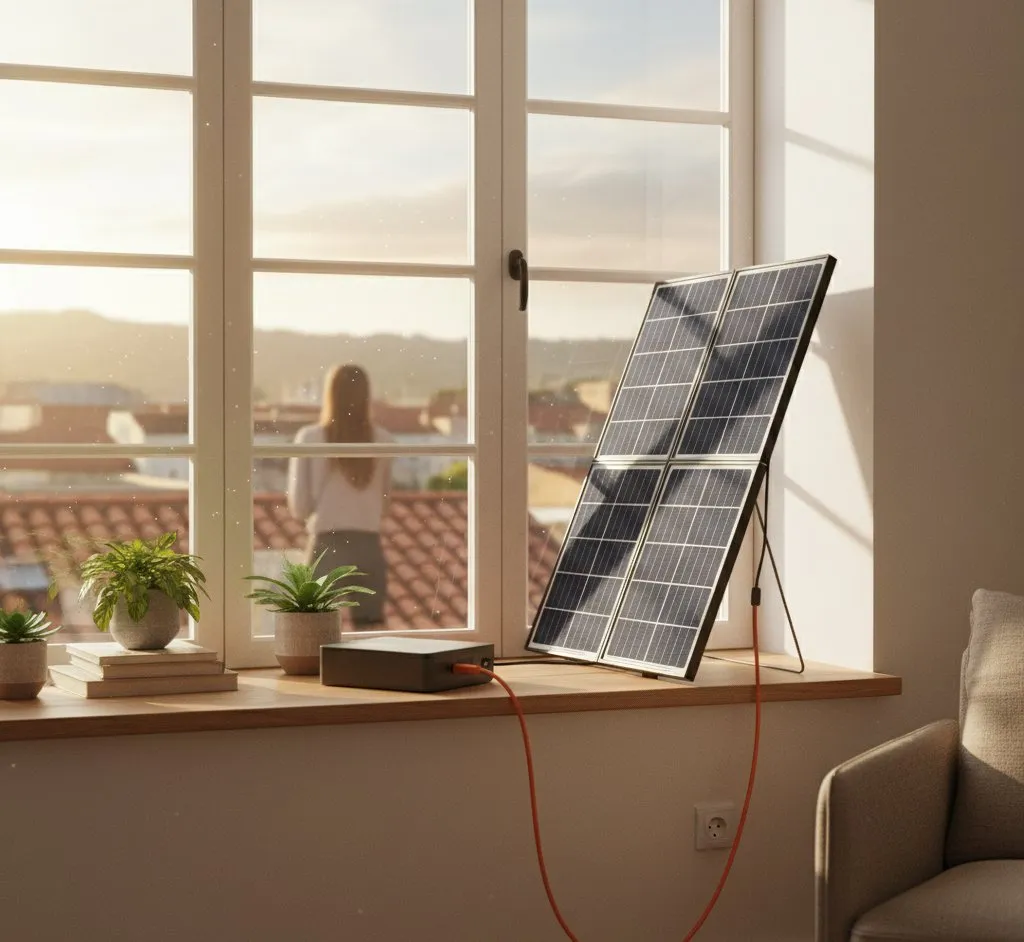
A plug-in solar system is exactly what it sounds like: one or two solar panels connected to a small micro-inverter that converts the DC output of the panel into AC power and feeds it into your home's wiring via a standard 13 A socket.
When the panel is generating power, the micro-inverter offsets whatever your home is consuming at that moment — your kettle, fridge, TV, and other appliances draw from the panel first, reducing how much you pull from the grid. You do not store the electricity; you use it as it is generated.
The terms "plug-in solar" and "balcony solar" refer to the same product class in the UK context. The name varies depending on where you mount the panels — on a balcony railing, a south-facing wall, a flat roof, or even a garden fence.

Current UK legal status
For most of 2025, the UK government's own guidance stated that plug-in solar was "currently unavailable" due to regulatory gaps. The UK was an outlier — Germany had over 426,000 registered plug-in solar installations by the end of 2025 after simplifying its rules in 2023.
The UK gaps centred on two areas:
Wiring rules: Standard UK domestic sockets sit on 32 A ring final circuits — different from the 16 A radial circuits common in continental Europe. Feeding power back through a 13 A plug on a ring circuit raises specific fault protection questions that needed to be addressed in UK wiring regulations before plug-in solar could be formally approved.
Product certification: EU product marks (CE, VDE) do not automatically satisfy UK Conformity Assessed (UKCA) requirements post-Brexit. A BSI standard covering the plugs and micro-inverters was needed before products could be formally approved for the UK market.
The legal status is transitional right now
As of April 2026, BS 7671 Amendment 4 is in force (effective 15 April 2026), providing the wiring rules for sub-800 W plug-in systems. However, the BSI product certification standard that defines what a "certified" plug-in solar unit looks like for the UK market is not expected until July 2026. Until that standard is published, the regulatory position remains transitional. Products sold via Amazon UK before April 2026 were purchased without a clear legal framework — some buyers accepted that uncertainty. If you are considering buying now, it is worth waiting until the product standard is finalised and compliant certified products become available through mainstream retailers.
What the March 2026 announcement committed to
On 24 March 2026, the UK government announced that plug-in solar would be made formally available "within months" by updating two regulatory instruments:
- G98 — the engineering recommendation governing small generator connections. The anticipated update will allow "fit and notify" registration for sub-800 W systems, meaning you install the unit and then submit a notification to your DNO within 28 days. No prior approval is required.
- BS 7671 — the wiring regulations standard. Amendment 4, published in January 2026 and in force from 15 April 2026, provides the technical wiring rules for socket-connected generation up to 800 W.
When both of these are fully in place alongside the product certification standard (expected July 2026), a homeowner will be able to buy a certified plug-in solar kit, install it themselves, and notify their DNO within 28 days — without needing an electrician.
What to expect from the regulatory timeline
The practical implication: the wiring rules exist now, but fully certified products for the UK market are still pending. Lidl and Iceland have both announced plans to stock units once formal clearance is in place.
How it works technically
Understanding a few technical basics helps set realistic expectations.
The 800 W limit: The framework covers systems up to 800 W AC output. This is a regulatory boundary, not a physical one — it is the threshold below which the simplified "fit and notify" process applies.
Micro-inverters and anti-islanding: The micro-inverter converts DC from the panel to AC and feeds it into your home circuit. A critical safety feature is anti-islanding protection — if the grid goes down, the inverter automatically shuts off within milliseconds. This prevents your system from back-feeding into a grid that engineers may be working on.
RCD compatibility: Your consumer unit's RCD (Residual Current Device) type matters. Standard Type AC RCDs, common in older UK consumer units, may not reliably detect DC fault currents that can arise from micro-inverters. Type A or Type F RCDs may be required. This is one of the technical issues that BS 7671 Amendment 4 addresses — checking your consumer unit before installation will be part of proper setup under the forthcoming guidance.
No storage without extra hardware: A basic plug-in solar system feeds power directly into your home circuit. The electricity is used as it is generated, or it flows back out to the grid (earning you nothing under standard tariffs, since the Smart Export Guarantee requires a smart meter and a separate SEG agreement). You cannot store it in a home battery unless you pair the system with dedicated hardware designed for that purpose.

Costs and realistic output
A typical one- or two-panel plug-in solar kit currently costs £200–600, depending on panel wattage, micro-inverter quality, and whether mounting hardware is included. Prices are likely to settle as mainstream retailers enter the market.
Realistic annual output:
A single 400 W panel facing south at a reasonable tilt in central England will generate approximately 300–400 kWh per year. A two-panel setup (800 W combined) could reach 500–700 kWh — but note that 800 W AC is the regulatory ceiling, and your panel peak DC output will be somewhat higher than 800 W to account for inverter efficiency.
What that's worth:
At the current standard flat tariff of around 24p per kWh, 400 kWh of self-consumed solar saves approximately £96 per year. 600 kWh saves around £144. These figures depend heavily on how much of the solar output you actually use — if nobody is home during the day, much of what the panels generate flows back to the grid unused and uncompensated under a standard tariff.
2–4 years
Typical payback for a plug-in solar kit, based on a £300–500 kit and £100–120/year in savings at 24p/kWh
See current UK electricity ratesThe German experience provides a useful benchmark. Savings there are typically quoted at the equivalent of £70–110 per year for a single panel. UK electricity prices in 2026 are broadly similar to Germany's, which means those figures translate reasonably well.
Who plug-in solar is suited for
Plug-in solar is not a substitute for a full roof installation — the output is too small for that. It is better understood as an entry point for people who cannot access roof solar at all.
Renters: If your landlord will not agree to a roof installation, a plug-in system that requires only landlord permission for external mounting (to comply with your tenancy agreement) is a practical alternative. You can take the system with you when you move.
Flat-dwellers and flats with balconies: People in flats rarely have roof access or control over the building fabric. A south- or southwest-facing balcony with a panel clamped to the railing is the most accessible solar option available.
People testing solar before committing: If you are uncertain whether solar is right for you, a £300–500 plug-in kit gives you real-world data on generation at your specific location and orientation before you consider a £6,000–9,000 full installation.
Households with limited suitable roof space: Some properties have small or heavily shaded roofs. A balcony or wall-mounted system may be the only viable option.

Limitations to be honest about
Plug-in solar is genuinely useful for a specific audience, but several limitations are worth understanding before you buy.
Modest savings: £70–120 per year is the realistic range for most setups. This is not insignificant, but it will not transform your energy bill. A full roof installation typically saves ten times more.
Self-consumption matters: The savings above assume you are using the electricity as it is generated. If you are out during the day and your panels are generating into an empty flat, you lose most of the benefit. Households where someone is home during daylight hours benefit most.
Landlord permission for external mounting: Plug-in solar does not require planning permission under permitted development, but if you are renting and want to mount a panel externally (on a balcony railing, wall bracket, or fence), you still need your landlord's permission. The panel itself is portable, but the mounting hardware creates an obligation to check your tenancy agreement. See solar panels for renters for more detail.
Battery pairing is not straightforward: Integrating a plug-in solar panel with a home battery requires compatible hardware. Products like the EcoFlow STREAM Ultra are designed specifically for this use case — they have built-in MPPT solar input alongside a plug-in AC interface. Standard plug-in solar kits (panel + micro-inverter into a socket) do not connect to a separate battery system without additional equipment.
G98 notification still required: Even under the simplified framework, you will need to notify your DNO within 28 days of installation. This is a straightforward online notification, not an approval process — but it is a legal requirement, not optional.
RCD type check: Before installing any plug-in solar system, you should check whether your consumer unit has a Type A or Type F RCD, or an older Type AC. Upgrading an RCD is an electrical task that may require a qualified electrician depending on what needs to change.
What to do now
The honest answer is that most people will be better served by waiting until July 2026, when the BSI product certification standard is expected, and compliant products begin appearing on shelves at mainstream retailers. That is when you will have the clearest picture of which products are formally certified for UK use and what the full notification process looks like.
If you are determined to act now:
- Products sold on Amazon UK before April 2026 exist in a transitional status. Some were sold without the regulatory framework being complete.
- Check that any unit you consider has anti-islanding protection compliant with UK standards (G98 compatible) and is rated for sub-800 W AC output.
- Verify your consumer unit's RCD type before connecting anything.
- Submit a G98 notification to your DNO once the system is connected — the process is online and free.
- If you are renting, get written permission from your landlord for any external mounting before you order mounting hardware.
For most people, this technology is worth keeping an eye on. The regulatory framework is finally coming into place, mainstream retailers are preparing to stock units, and the economics — particularly for renters and flat-dwellers with no other solar option — are genuinely attractive.
See also
- Can I install solar panels myself in the UK? — the broader DIY solar legal framework
- Solar planning permission — when you need it and when you don't
- Solar panels for renters — what the Renters' Rights Act means for solar access
- How much do solar panels cost? — full installation costs for comparison
Share this article

Energy-saving LED lighting — make the most of your solar electricity with efficient bulbs and fixtures
Affiliate link — we may earn a small commission at no extra cost to you
Stay informed
Get free solar updates direct to your inbox
Related reading

DIY Solar UK: The Complete Guide
Complete guide to DIY solar in the UK. What you can legally do yourself, costs, tools, and step-by-step resources.
Solar Panel Planning Permission UK: What You Need to Know
Do you need planning permission for solar panels in the UK? Permitted development rules, when you need to apply, and what happens in special areas.
Renters' Rights Act 2025: Can Tenants Now Get Solar Panels?
Renters' Rights Act 2025 and solar panels. Tenant rights to request energy improvements, landlord obligations, and practical options.


Switch to Octopus Energy
Get 50 credit when you switch. We get 50 too — win-win.
What does this mean for YOUR home?
Design your perfect solar setup in under 3 minutes. Free, no sign-up required.
Build Your Solar System