This page contains affiliate links. If you purchase through them we may earn a small commission at no extra cost to you. Learn more
How Close Can Solar Panels Go to the Roof Edge? UK Rules Explained

The 400mm rule — what MIS 3002 actually says
MIS 3002:2025 — the MCS installation standard for solar PV — requires that panels be positioned at least 400mm from any roof edge unless additional wind-uplift measures are in place. This is a design obligation, not a suggestion. Any installer holding MCS certification must comply.
The "roof edge" includes:
- The eaves (bottom edge)
- The verge (side edges)
- The ridge (top edge)
- Any internal valleys or hips
If panels are arranged in multiple rows, the 400mm clearance applies to the outer boundary of the entire array — not to each panel individually. So a single large array that covers most of a roof slope still needs its perimeter kept 400mm clear of every edge.
This rule exists for good physics-based reasons, which the next section explains.
Why 400mm? Wind pressure at roof edges
Wind loading on a roof is not uniform. BRE Digest 489 — the industry design guide for wind loads on roof-mounted PV and solar thermal — maps roofs into wind pressure zones:
| Zone | Location | Relative wind pressure |
|---|---|---|
| Zone 1 | Centre of the roof slope | Lowest — baseline load |
| Zone 2 | Edges (eaves, verge, ridge) | Higher — typically 1.5–2× Zone 1 |
| Zone 3 | Corners | Highest — often 2–3× Zone 1 |
The physics is the same principle that generates lift on an aircraft wing: wind accelerates as it flows around a protruding edge, creating a low-pressure zone that generates strong upward (or outward) suction. At roof corners, the effect compounds from two directions simultaneously.
A panel sitting at the roof edge experiences substantially higher uplift forces than one in the middle of the same array. The 400mm setback moves panels away from the worst of this pressure zone and into an area where standard mounting systems and fixings are rated to cope.
Wind damage almost always means edge panels first
When panels do detach in storms, the failure typically starts at the array edges — specifically at corners. This is not random: it directly maps to the BRE Digest 489 pressure zones. Proper edge clearance and correctly specified corner fixings are the primary defences against storm uplift.
Going closer than 400mm — what it takes
The 400mm rule can be reduced, but only through a documented engineering process. An installer wishing to place panels closer to the edge must:
- Commission a wind-uplift calculation to BRE Digest 489, accounting for the site's wind zone, roof height, terrain category, and the specific array layout.
- Specify enhanced fixings — higher-rated roof hooks, closer fixing intervals, or additional cross-bracing — capable of resisting the calculated uplift forces at the reduced setback.
- Document the additional measures in the system design record, as required by MIS 3002.
- For anything beyond a minor reduction, a structural engineer's sign-off is likely required.
In practice, most installers stay at or beyond 400mm. The engineering overhead of reducing the setback is rarely worthwhile for domestic installations — and some roof structures simply cannot take the additional fixing loads that enhanced edge-zone mounting demands.
Fire brigade access — NFCC clearance requirements
There is a second, independent reason to keep panels away from roof edges: fire brigade access.
The National Fire Chiefs Council (NFCC) has published best practice guidance specifying clear zones around solar arrays so that firefighters can work safely on roofs:
| Roof type | Required clear access zone |
|---|---|
| Pitched roof | 1 metre around the array perimeter |
| Flat roof | 1.5 metres around the array perimeter |
These zones allow firefighters to:
- Create ventilation openings without cutting into the array
- Move horizontally across the roof in a safe corridor
- Place ladders against the roof edge without the array blocking working space
Panels produce live DC voltage even when the AC supply is switched off
Solar panels continue generating DC voltage whenever light falls on them — including during a house fire attended in daylight. Switching off the AC isolator does not de-energise the DC cabling between the panels and the inverter. A typical domestic 4 kWp system may present 300–600 V DC on that cable run in daylight. This is one reason firefighters need unobstructed access to the DC isolation switch, and why array layout matters for building safety — not just energy yield.
The NFCC guidance is not a statutory requirement under the General Permitted Development Order (GPDO), but fire authorities increasingly reference it in Building Regulations discussions. For larger commercial systems, some local planning authorities treat it as a material design consideration.
Practical implication: on a standard pitched roof, the NFCC 1m clearance and the MIS 3002 400mm rule generally stack in the same direction. Complying with MIS 3002 gets panels 400mm from the edge; adding NFCC guidance pushes the practical working minimum closer to 1m for the long sides of the array. Installers must satisfy both.
Ridge tiles adjacent to panels
MIS 3002 includes a specific requirement about ridge tiles near solar arrays: ridge tiles adjacent to panels must be secured. This is often done with mortar or mechanical fixings before panel installation begins.
The reason is straightforward: wind acting on the panels creates vibration that transmits into the roof structure. Over time, this repeated low-amplitude movement can loosen ridge tiles that were previously sitting comfortably on a dry-mortar bed. A loose ridge tile presents a falling hazard — and the risk is greater next to an array where the vibration source is constant.
Any installer following MIS 3002 correctly should check and secure ridge tiles as part of the pre-installation roof survey. If you are buying a home that already has solar, it is worth confirming this was done.
Rainwater and snow redirected by panels
Panels near the eaves also change how water and snow move off the roof — and this can cause problems that have nothing to do with structural loading.
Rainwater
Panels act as a collector. Rainfall hitting the array runs off the lower edge of the panels rather than dispersing naturally across the tiles and into the guttering. If the panel edge sits close to or over the gutter, a concentrated stream of water can:
- Overshoot the gutter during heavy rain
- Erode the ground or path directly below
- Cause damp at the fascia board where the gutter meets the roof
A good installer will assess gutter capacity and, where necessary, fit drip strips or gutter extensions to manage the redirected flow.
Snow
Snow that accumulates on panels slides off in a single sheet rather than drifting down gradually as it would from tiles. A large array at low pitch can release a significant mass of snow in one event. If the eaves overhang a path, entrance, or conservatory roof, this is a genuine hazard — particularly where children or elderly people regularly pass below.
Where there is a risk to pedestrians, installers sometimes fit anti-snow guards at the lower panel edge to break the slide and prevent a single large release. Worth raising with your installer if your layout has panels above a frequently used path.
Flat roof rules — a different set of standards
Flat roofs follow the same BRE Digest 489 wind zone principles, but the geometry is different and the rules diverge from pitched roof practice in important ways.
Wind pressure on flat roofs is particularly high at edges and corners because there is no slope to guide airflow. The wind coefficients in BRE Digest 489 for flat roofs reflect this — corner zones are especially demanding.
Ballasted systems (where mounting frames are held down by concrete blocks rather than roof penetrations) use a default friction coefficient of 0.3 in BRE Digest 489 calculations. This means the ballast must weigh enough that even at the friction limit, the frame does not slide. The calculation is site-specific: wind zone, roof height, array size, and frame geometry all feed into the required ballast mass.
Structural engineer required: A structural engineer must confirm the flat roof can carry the combined weight of the mounting frames, panels, and all the ballast. Flat roofs — especially those on 1970s–1990s commercial or residential buildings — often have lower structural capacity than they appear. This is not optional: MIS 3002 makes it a design requirement for flat roof installations.
Minimum 1m clearance from flat roof edge is the typical working minimum, reflecting both the severe edge wind zone and the NFCC 1.5m access requirement. In practice, the NFCC guidance is the binding constraint on flat roofs.
Ask your installer for the wind calculation
MCS-certified installers are required to produce a wind-uplift calculation for the specific site. You are entitled to ask for this document as part of your installation paperwork. It will show your site's wind zone, the design pressure used, and the fixing specification — confirming your system was engineered for your roof, not just fitted to a generic template.
What this means if you are doing a DIY installation
The 400mm rule and NFCC access guidance are MCS installer obligations. If you are installing panels outside the MCS framework — as a DIY project not covered by a certified installer — you are not legally bound by MIS 3002.
However, the rules exist because the physics is real. Panels really do experience dramatically higher uplift at roof edges and corners. Systems really have blown off roofs in UK storms when edge clearance and corner fixings were inadequate.
If you are doing a DIY installation, following MIS 3002 design principles — including the 400mm edge clearance, ridge tile securing, and BRE Digest 489 wind zone calculations — is strongly worth considering. The cost of a blown-off panel and damaged roof is considerably higher than the time spent getting the mounting right.
For more on how wind and snow loads affect solar panel systems, see Snow and wind loading on solar panels.
Share this article

Order your Energy Performance Certificate online — see how solar improves your home's energy rating. Required before selling or renting. All assessors are fully accredited.
Affiliate link — we may earn a small commission at no extra cost to you
Stay informed
Get free solar updates direct to your inbox
Related reading
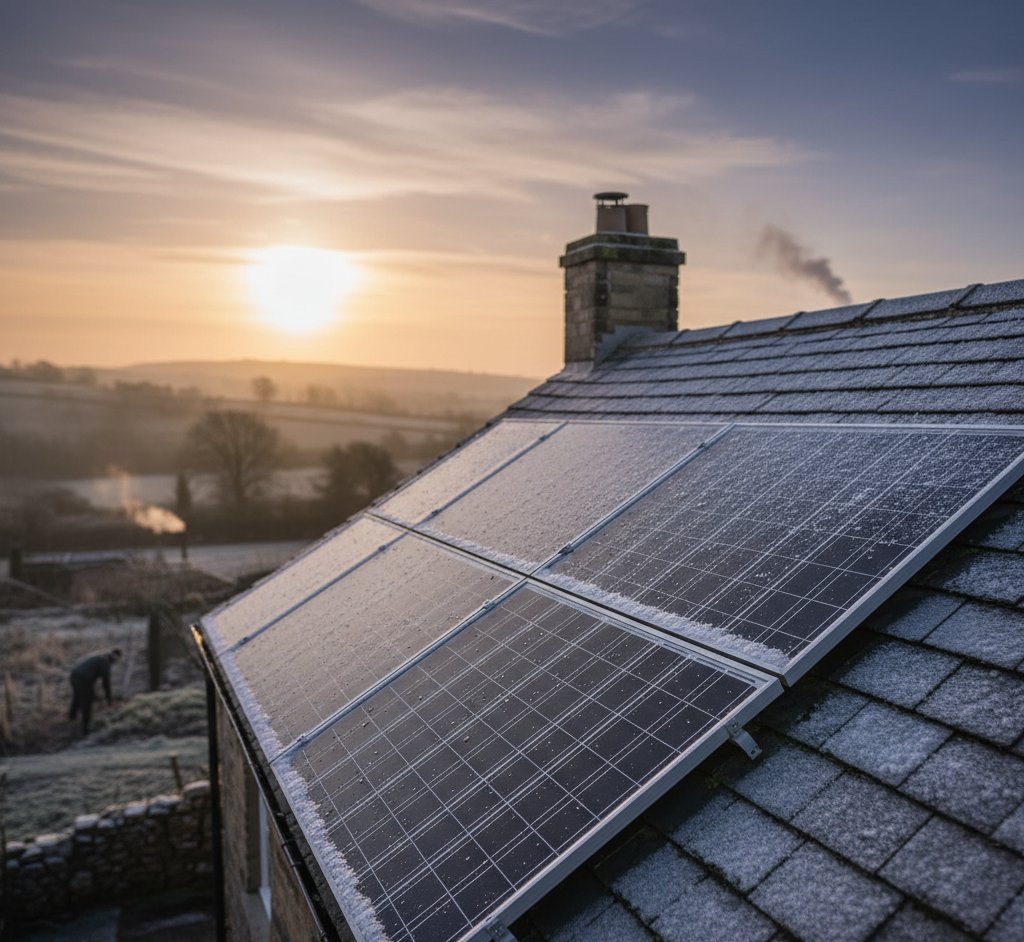
Snow and Wind Loading on Solar Panels
How UK solar panels handle snow and wind. Loading calculations, mounting requirements, panel survival in storms, and whether to clear snow off panels.
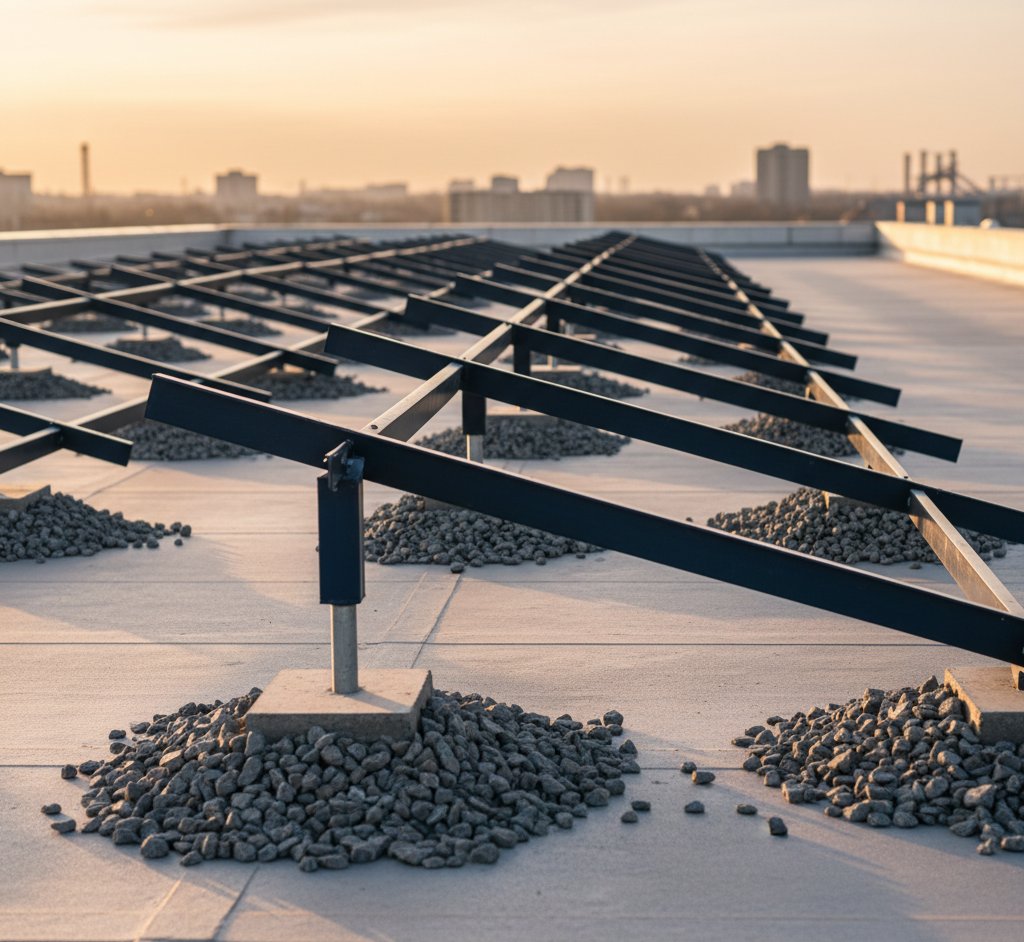
Solar Panels on a Flat Roof: Mounting, Costs and Planning
Flat roof solar in the UK — ballasted vs frame-mounted systems, optimal tilt angle, planning permission, costs vs pitched roof, and pros and cons.

Is My Roof Suitable for Solar Panels?
Find out if your roof can take solar panels — covering direction, angle, shading, structural condition, and options for tricky roofs.


Switch to Octopus Energy
Get 50 credit when you switch. We get 50 too — win-win.
What does this mean for YOUR home?
Design your perfect solar setup in under 3 minutes. Free, no sign-up required.
Build Your Solar System