This page contains affiliate links. If you purchase through them we may earn a small commission at no extra cost to you. Learn more
How Quickly Are Solar Panels Improving? The Efficiency Trajectory

Solar panels have improved dramatically over the past fifteen years — in both efficiency and cost. But the pace of improvement is often misunderstood. Panels are not doubling in efficiency every few years. They're improving steadily, in incremental steps, generation by generation.
Understanding this trajectory helps answer the question that almost every prospective buyer asks: should I wait for better technology?
The efficiency timeline
Efficiency in solar panels is the percentage of sunlight hitting the cell that is converted into electricity. A panel rated at 22% converts 22% of the light energy landing on it into electrical power.
Here is how mass-production residential panel efficiency has evolved:
| Year | Dominant technology | Typical mass-production efficiency |
|---|---|---|
| 2010 | Mono crystalline | ~15% |
| 2015 | Mono (improved) | ~17–18% |
| 2018 | PERC | ~19–20% |
| 2022 | PERC (mature) | ~21–22% |
| 2024 | TOPCon | ~22.5–23% |
| 2026 | TOPCon / HJT | ~22.5–25% |
These are mass-production figures — what you can actually buy for a residential installation. Laboratory record cells now exceed 26%, but those results don't translate directly into what ships on a pallet to your installer.
The three technologies on the market today
PERC — the outgoing mainstream
Passivated Emitter and Rear Cell (PERC) technology uses p-type silicon with a passivation layer on the rear surface to reduce electron recombination. It dominated the residential market from roughly 2018 to 2023, and many PERC panels are still being installed today.
At 21–22% efficiency, PERC panels remain perfectly good performers. Their limitation is a slightly higher annual degradation rate (~0.50% per year) and a tendency toward light-induced degradation (LID) in the first year of operation.
TOPCon — today's mainstream
Tunnel Oxide Passivated Contact (TOPCon) panels use n-type silicon, which avoids the boron-oxygen recombination issue that causes LID in PERC. They degrade more slowly (~0.40% per year), perform better in warm conditions, and have pushed mass-production efficiency to 22.5–24%.
TOPCon now accounts for an estimated 75% of Chinese manufacturing output as of 2026, and is the default technology in most new UK residential installations. Prices have converged with PERC, making PERC increasingly hard to justify.
HJT — the premium option
Heterojunction Technology (HJT) sandwiches n-type crystalline silicon between layers of amorphous silicon. The result is the best temperature performance of any mass-market cell (-0.24 to -0.26%/°C) and the lowest degradation rate (~0.30% per year).
HJT panels reach 23–25% efficiency in mass production. The catch is cost — manufacturing HJT cells requires more complex deposition processes, keeping prices above TOPCon. In UK conditions, where cell temperatures rarely exceed 35°C, much of HJT's temperature coefficient advantage is less relevant than in hotter climates. The low degradation rate remains valuable over a 25-year system life.
The practical difference between technologies
Over a 25-year system lifetime, the difference in annual output between a PERC and a TOPCon panel at the same rated wattage is small in any given year — but the degradation gap compounds. A TOPCon panel degrading at 0.40%/yr retains about 90% of its original output after 25 years. A PERC at 0.50%/yr retains around 88%. For a 6 kWp system, that's roughly 150–200 kWh of additional generation per year by year 25. Worth having, but not the primary reason most people choose one technology over another.
What's coming next: perovskite tandems
The technology generating the most excitement in solar research is perovskite tandem cells — a structure that stacks a perovskite cell layer on top of a conventional silicon cell, capturing different parts of the solar spectrum in each layer.
Lab perovskite tandem cells have demonstrated efficiencies exceeding 30%. The challenge is durability: perovskite materials degrade faster than silicon under real-world conditions, and scaling production without losing the efficiency gains has proven difficult.
Commercial perovskite tandem panels are expected to begin reaching the market between 2027 and 2030. Several manufacturers are working toward commercial products. When they arrive, they could shift mass-production efficiency beyond 26–28%.
Bifacial panels — which capture light on both front and rear surfaces — are also becoming more common. For UK domestic rooftop installations they offer little benefit (the rear face is against the roof), but for ground-mount commercial arrays with a light-coloured or reflective surface beneath, rear-face yield gains of 5–30% are achievable.
Should you wait for better technology?
This is the question the efficiency trajectory always raises. The answer is consistently no, and the maths explains why.
Each generation of panels improves efficiency by roughly 1–2% per year across mass production. In practice, that means the panels available in twelve months will be incrementally better — but not transformatively so.
Meanwhile, every year you delay means a year of paying full grid electricity prices for every kWh you use. At current rates, a typical household with solar saves roughly £400–£700 per year on electricity bills. A one-year delay costs you at least one year of those savings.
The efficiency gain you'd get by waiting: perhaps 1% more output from a system of the same physical size. On a 6 kWp system that generates around 5,400 kWh per year, 1% is 54 kWh — worth roughly £13 at current unit rates.
You'd wait twelve months and sacrifice £400–£700 in savings to gain £13 in annual generation improvement. The maths does not favour waiting.
Panel efficiency and system output are not the same thing
Higher efficiency panels convert more sunlight per square metre — they don't necessarily produce more total electricity if you're fitting the same number of panels on the same roof. Where efficiency matters most is when you have limited roof space and need to maximise output from the area available. If you have plenty of roof space, adding one more standard panel often beats paying a premium for higher-efficiency panels.
Cost: the real story
Panel efficiency often gets all the attention, but cost reduction is where solar's transformation has been most dramatic.
The cost per watt of solar panels has fallen by approximately:
- 99% since 1976 (from ~$76/W to under $0.20/W at wholesale)
- ~90% since 2010 in the UK
What you pay today for a fully installed solar system would have bought only the panels fifteen years ago — and those panels were half as efficient.
The best time to install solar was ten years ago. The second best time is today — and today's panels are substantially better than those installed a decade back, at a fraction of the cost.
For a comparison of the specific panel models available in the UK right now and how TOPCon and HJT options stack up, the panel technology comparison guide covers the current market in detail.
Share this article

OVO has carefully selected trusted teams across the UK to install solar panels and heat pumps. Enjoy the personal touch of a local expert with the peace of mind of a household name.
Affiliate link — we may earn a small commission at no extra cost to you
Stay informed
Get free solar updates direct to your inbox
Related reading

How Do Solar Panels Work? A Simple Explanation
Plain-English explanation of the photovoltaic effect, how solar electricity gets from roof to home, and what happens at night or on cloudy days.
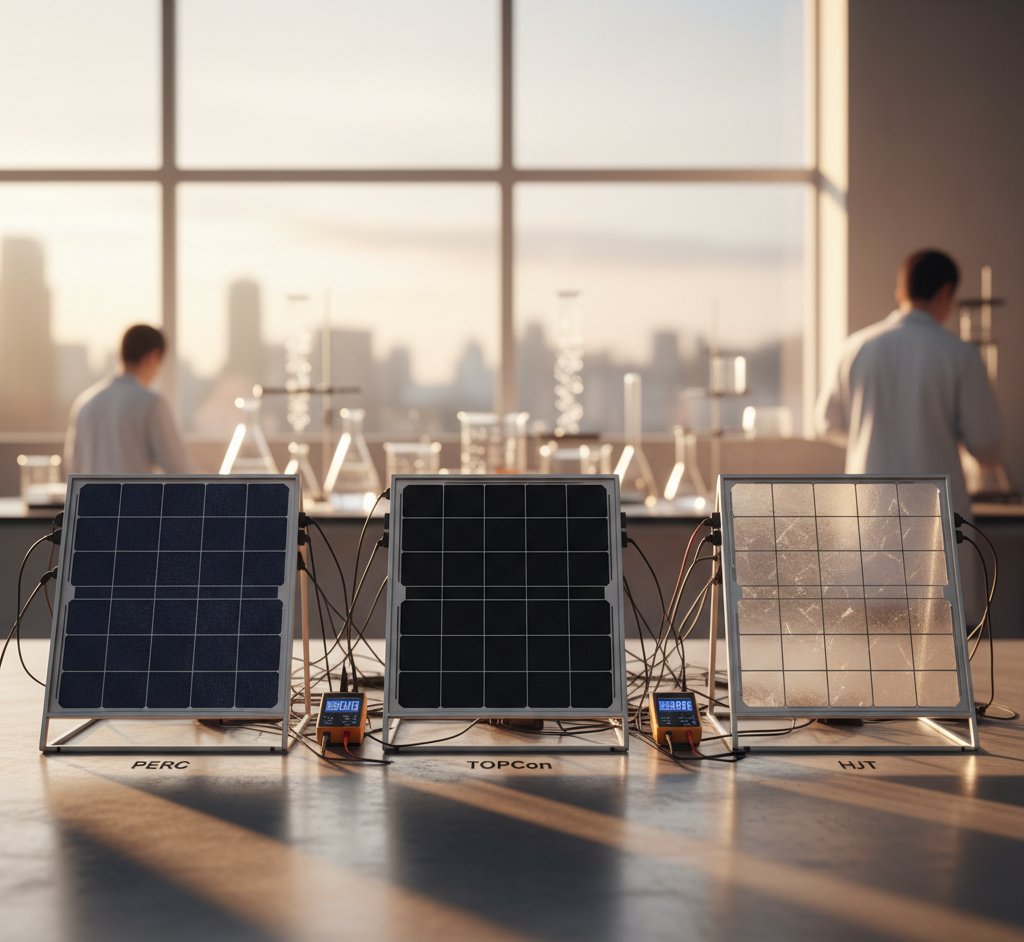
PERC vs N-type TOPCon vs HJT: Solar Panel Technology Compared for 2026
Three solar cell technologies in the UK: mono PERC, N-type TOPCon, and HJT. How they differ in efficiency, degradation, and value — with real prices.

Best Solar Panels for UK Homes 2026
The best solar panels for UK homes in 2026 — JA Solar, Trina, Canadian Solar, and LONGi, with real specs and what to look for when comparing quotes.


Switch to Octopus Energy
Get 50 credit when you switch. We get 50 too — win-win.
What does this mean for YOUR home?
Design your perfect solar setup in under 3 minutes. Free, no sign-up required.
Build Your Solar System