This page contains affiliate links. If you purchase through them we may earn a small commission at no extra cost to you. Learn more
Commercial Solar Panels UK: Costs, ROI, and What Businesses Need to Know
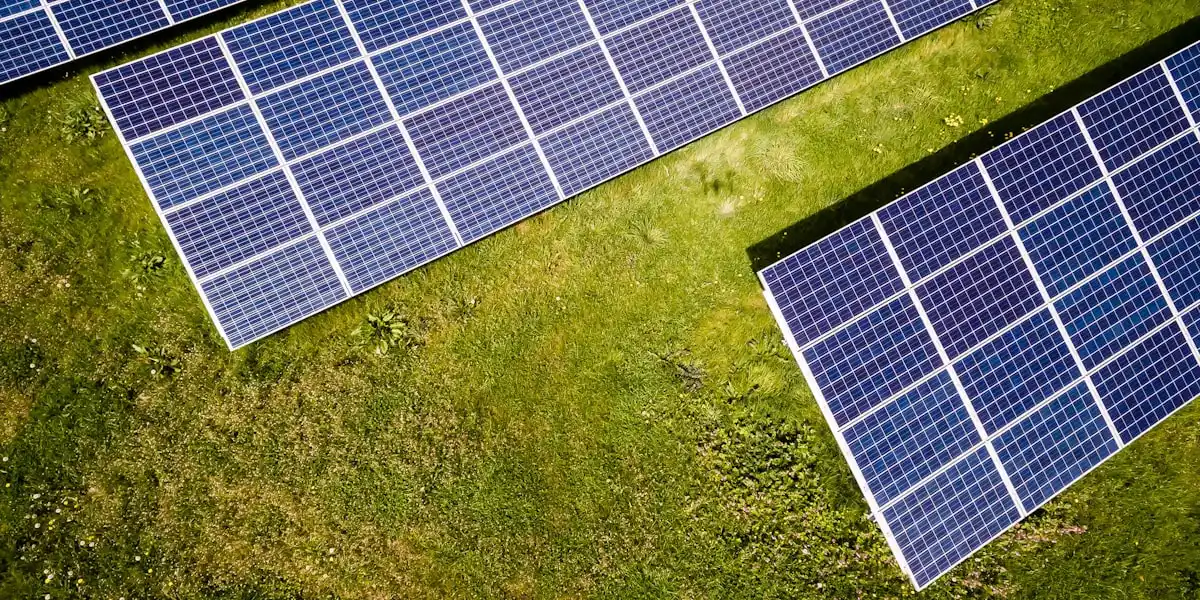
Business solar is a different animal from residential installations. The system sizes are larger, the grid connection process is more formal, the tax treatment is more favourable, and the economics often work out better — because businesses use electricity during the day, when panels are generating.
This guide covers what makes commercial solar distinct, what it costs, how the finances work out, and what to look for in a commercial installer.
How commercial solar differs from domestic
The headline difference is scale. A typical UK home might have a 3–6 kW system. Commercial installations start at around 10 kW for a small office or farm building and can run to 250 kW or more for a large warehouse or manufacturing facility.
That scale difference ripples through everything:
The VAT difference is worth pausing on. Commercial solar installations attract 20% VAT, whereas residential installations are currently zero-rated. However, most VAT-registered businesses can reclaim input VAT, so the net cost is similar to the quoted pre-VAT figure. Check with your accountant if your business is not VAT-registered.
Typical installation costs
Commercial solar benefits from economies of scale. The cost per watt installed falls as system size increases, partly because fixed costs (scaffolding, design, electrical works) are spread across more panels.
For comparison, domestic systems in 2026 typically run at £1.10–£1.50 per watt installed. The larger the commercial system, the better the cost-per-watt — which is why oversizing slightly often makes financial sense when the economics already stack up.
These figures assume standard rooftop installation on an industrial or commercial building. Ground-mounted systems, complex roofs, or significant DNO reinforcement requirements can increase costs.
Get a structural survey included in your quotes
Many commercial buildings — particularly older industrial units — have roofs that need a structural engineer's sign-off before panels are mounted. Ask every installer whether their quote includes a structural assessment, or whether this is billed separately. It typically costs £500–£1,500 but is a mandatory step.
ROI and payback period
The economics of commercial solar are often more compelling than domestic, for one key reason: businesses use electricity during the day.
A typical household is empty from 8am to 5pm on weekdays. Solar panels generate most of their output between 9am and 4pm. The result is that domestic households often self-consume only 20–40% of what their panels generate — the rest is exported at low SEG rates.
A business operating Monday to Friday, 9am to 5pm, can self-consume 60–80% of generation during those hours. At 24p/kWh (the April 2026 standard flat rate), every kilowatt-hour you consume directly from your panels rather than from the grid saves 24p. That self-consumption alignment dramatically improves the return.
Example: 50 kW warehouse, South of England
- Annual generation: approximately 46,000 kWh (50 kW × 920 kWh/kWp)
- Assumed self-consumption: 65% (30,000 kWh used on site)
- Exported: 16,000 kWh at SEG best fixed rate of 15p/kWh
- Annual electricity saving: 30,000 kWh × 24p = £7,200
- Annual export income: 16,000 kWh × 15p = £2,400
- Total annual benefit: approximately £9,600
- Installation cost (mid-range): £45,000
- Simple payback: approximately 4.7 years
After payback, that system generates free electricity for another 20+ years. Most commercial solar panels carry 25-year performance warranties.
Tax advantages: Annual Investment Allowance
This is where commercial solar has a significant financial advantage over domestic installations. As a business, you can deduct the cost of solar panels against your taxable profits using the Annual Investment Allowance (AIA).
The AIA allows you to write off the full purchase cost of qualifying plant and machinery in the year of purchase — up to a £1 million annual limit (as of 2026). Solar panels installed on a commercial building qualify.
What this means in practice:
A 50 kW system costing £45,000 (excl. VAT) can be deducted entirely against your corporation tax bill in year one. At the current corporation tax rate of 25% (for companies with profits over £250,000), that's £11,250 off your tax bill. Smaller companies paying 19% corporation tax save £8,550.
This effectively reduces the net cost of the system by 19–25% in year one, bringing that £45,000 system down to £33,750–£36,450 in real terms after tax relief.
Full expensing — the successor to the temporary Super Deduction — also allows limited companies to claim 100% first-year allowances on new plant and machinery. In most cases this achieves the same outcome as the AIA for commercial solar. Your accountant can advise on which route is most appropriate for your business's tax position.
Sole traders and partnerships also benefit
AIA is not limited to limited companies. Sole traders and partnerships can also claim AIA on solar panel installations, deducting costs against income tax. The relief rate depends on your income tax band.
G99 connection process
Any solar installation above 3.68 kW per phase (16A) must go through a formal G99 application to your Distribution Network Operator (DNO) before installation begins. For most commercial systems — which are almost invariably above this threshold — G99 is mandatory.
G99 is not a refusal mechanism. It is a pre-approval process that allows the DNO to check whether the local grid has capacity for the additional generation. The DNO may:
- Approve the application as submitted
- Approve with conditions (for example, requiring an export limiter)
- Request additional engineering studies
- Require grid reinforcement works (rare, but possible for very large systems or rural locations)
Typical timeline:
The G99 application is your installer's responsibility, but it is worth understanding the timeline when planning your project. Do not allow any work to start before G99 approval is received in writing.
Grid reinforcement costs can be significant
For large systems (100 kW+) in rural areas or on weaker grid connections, the DNO may require reinforcement works before your system can connect. These costs fall on you, the applicant — not the DNO. They can range from a few thousand pounds for minor works to tens of thousands for major cable upgrades. Ask your installer to flag this risk early by reviewing your local grid capacity before you commit.
Planning permission
Domestic solar in England often benefits from Permitted Development rights, meaning no planning application is needed. Commercial solar is treated differently.
For most commercial and industrial buildings, solar panels — whether on the roof or ground-mounted — require a full planning application. There are some exceptions (certain industrial and warehouse buildings have their own Permitted Development categories), but you should not assume PD applies to your site without checking with your local planning authority.
Additional restrictions apply to:
- Listed buildings — any external alteration including solar panels requires listed building consent
- Conservation areas — panels visible from the street may be refused or heavily conditioned
- Agricultural buildings — different PD thresholds apply; check with your planning authority
- Ground-mounted arrays — almost always require planning permission regardless of building type
Planning applications for commercial solar typically take 8–13 weeks to determine. Factor this into your project timeline alongside the G99 process.
Flat roofs
A high proportion of commercial and industrial buildings in the UK have flat roofs, which suit solar well — often better than a pitched residential roof.
Advantages of flat roofs:
- Optimal tilt angle — panels can be mounted at the ideal angle (typically 10–20° for UK latitudes) regardless of roof orientation
- No south-facing requirement — you can orient every panel to face south
- Easier access for maintenance
Key considerations:
- Ballasted mounting systems — most flat roof installations use weighted frames rather than penetrating the roof membrane. This avoids voiding the roof warranty and reduces leakage risk, but requires wind loading calculations to ensure the frames won't shift
- Roof condition assessment — flat roofs should be surveyed before installation. If the roof membrane is due for replacement within 5–10 years, it is worth doing this before panels go on (removing and refitting panels later adds cost)
- Structural loading — ballasted systems add 15–25 kg/m² of load to the roof structure, which must be verified by a structural engineer
Power Purchase Agreements (PPAs)
If capital investment is a barrier, a Power Purchase Agreement offers an alternative structure. Under a PPA, a third-party investor installs solar panels on your building at no upfront cost to you. In return, you agree to buy the electricity generated by those panels at a fixed price — typically 10–20% below the current grid rate — for a period of 10–25 years.
Who PPAs work well for:
- Businesses with strong credit ratings and long-term lease certainty
- Organisations that cannot or prefer not to deploy capital into solar
- Businesses that want to lock in energy costs without owning the asset
Potential downsides:
- You do not own the system, so you cannot claim AIA or other tax allowances
- The long contract term (often 15–25 years) can complicate property sales or lease renewals
- Exit clauses and buyout terms vary — read the contract carefully
- You do not benefit from the full value of SEG export payments (these go to the PPA provider)
For businesses that can invest capital, outright ownership typically delivers better long-term returns than a PPA. For those that cannot, a well-structured PPA is still worth exploring as an entry point into on-site generation.
Battery storage for businesses
Commercial battery storage serves somewhat different purposes from domestic use.
In residential settings, batteries primarily shift solar generation from daytime to evening. In commercial settings, the key applications are:
- Peak shaving — some larger commercial electricity contracts include "demand charges" based on peak consumption during a billing period. A battery can prevent short consumption spikes, reducing demand charges
- Time-of-use arbitrage — if your business is on a half-hourly metered tariff with varying rates, a battery can charge during cheap periods and discharge during expensive ones
- Backup power — for businesses where downtime is costly (data centres, cold storage, manufacturing), a battery provides resilience against grid outages
For smaller businesses on flat-rate electricity contracts (common for SMEs), battery economics are simpler: store surplus solar for use outside generating hours or on cloudy days.
Battery systems for commercial installations typically start at 10 kWh and can run to several hundred kWh. Costs broadly follow the same pattern as panels — better value per kWh at larger scale.
Which businesses benefit most
Solar economics depend heavily on how much electricity you use during daylight hours. These business types typically see the strongest returns:
Businesses that are closed during the day — nightclubs, late-night hospitality, overnight logistics — see weaker self-consumption and longer payback periods.
Maintenance
Commercial solar systems require regular maintenance to perform at specification over their full lifetime. Typical requirements:
- Annual inspection and electrical test — checking for faults, degraded connections, inverter performance logs
- Panel cleaning — flat roof installations in particular accumulate dirt and bird fouling; cleaning frequency depends on location and nearby pollution sources
- Inverter maintenance — commercial-grade inverters (SMA, Fronius, Sungrow, Huawei) are generally reliable but benefit from periodic checks of cooling fans and firmware
Typical maintenance costs:
Many commercial installers offer ongoing maintenance contracts. When comparing quotes, check whether a maintenance contract is included for the first year and what the ongoing cost will be.
What to look for in a commercial installer
Commercial solar requires a different skill set from domestic. When assessing installers, look for:
- MCS certification — required for SEG eligibility; also a minimum quality signal
- G99 experience — ask how many G99 applications they have submitted and completed in the last 12 months
- In-house structural engineer or established structural engineer partnership — essential for flat roof and large-scale installations
- Project management capability — commercial projects involve coordinating planning, DNO applications, structural surveys, scaffolding, and electrical sign-off. An experienced commercial installer handles this as a project rather than just a trade job
- References from similar projects — a 10 kW farm installation and a 200 kW warehouse installation involve quite different challenges; ask for relevant references
- Insurance cover — check that the installer carries adequate public liability and professional indemnity cover for the scale of your project
Ask about design software outputs
A professional commercial installer should be able to provide a shading analysis and energy yield simulation — typically produced using tools such as PVsyst or Helioscope. This gives you a realistic annual generation estimate for your specific roof, orientation, and shading conditions, not just a back-of-envelope figure.
Next steps
- Solar panel costs in the UK — full residential cost breakdown for comparison
- G98 and G99 connection explained — the grid connection process in detail
- Solar planning permission — when you need permission and how to apply
- VAT and zero-rating for solar — how VAT applies and what businesses can reclaim
- Smart Export Guarantee — earning money for electricity you export to the grid
Share this article

Energy-saving LED lighting — make the most of your solar electricity with efficient bulbs and fixtures
Affiliate link — we may earn a small commission at no extra cost to you
Stay informed
Get free solar updates direct to your inbox
Related reading
How Much Do Solar Panels Cost in the UK in 2026?
UK solar panel costs 2026: realistic prices by system size, what is included, and what to push back on in your quote.
Solar Panel Planning Permission UK: What You Need to Know
Do you need planning permission for solar panels in the UK? Permitted development rules, when you need to apply, and what happens in special areas.
0% VAT on Solar Panels: What Qualifies?
Zero-rate VAT on solar panels saves UK homeowners 20% on installation costs. What qualifies, what doesn't, and how to make sure your quote is correct.


Switch to Octopus Energy
Get 50 credit when you switch. We get 50 too — win-win.
What does this mean for YOUR home?
Design your perfect solar setup in under 3 minutes. Free, no sign-up required.
Build Your Solar System