This page contains affiliate links. If you purchase through them we may earn a small commission at no extra cost to you. Learn more
Why Your Inverter Limit Matters More Than Your Panel Capacity
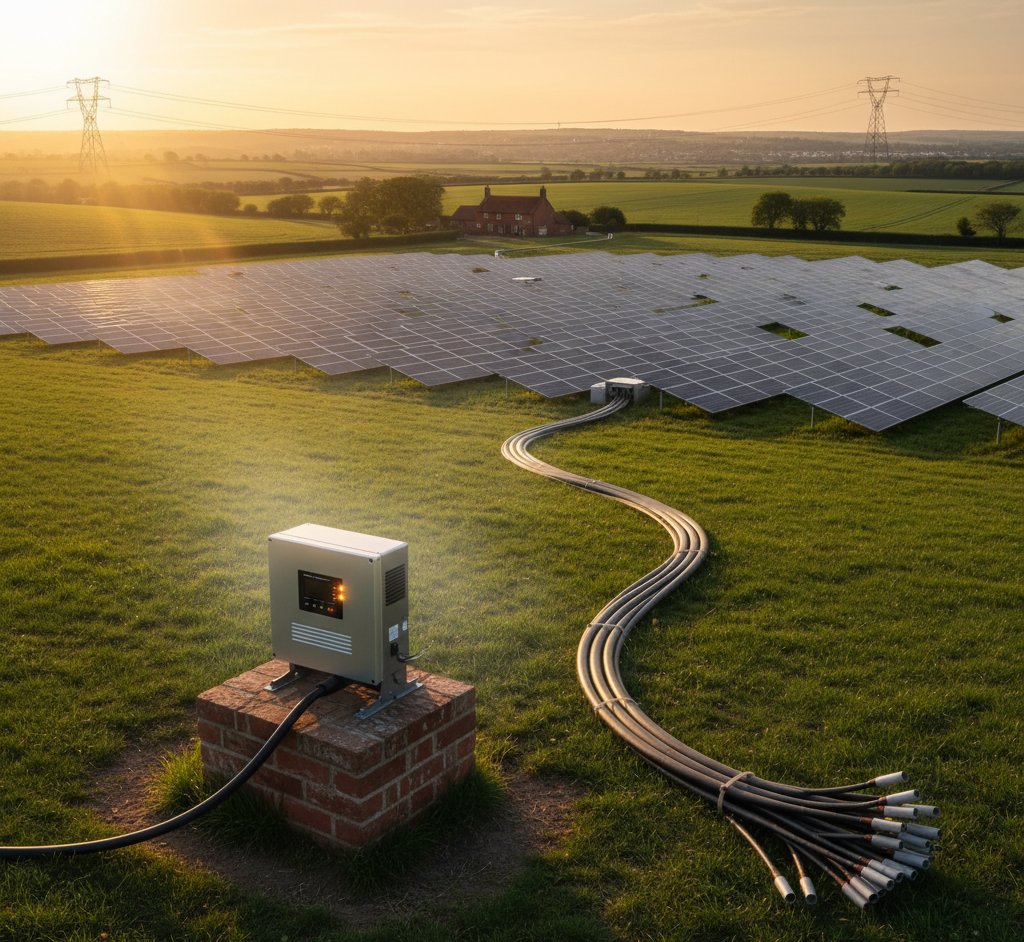
You've just had solar quotes through and something doesn't add up. The installer is proposing 12 panels at 450W each — that's 5.4kW of panels — but the inverter is only rated at 3.6kW. Are they trying to cut corners? Is half your expensive roof hardware going to waste?
No. This is completely intentional, it's industry standard practice, and understanding why is one of the most important things you can learn about solar system design.
The mismatch nobody explains
When you see a solar system spec sheet, you'll notice two different power ratings:
- Panel capacity (kWp): The combined peak output of all your panels under perfect laboratory conditions. 12 x 450W panels = 5.4kWp.
- Inverter output (kW): The maximum AC power the inverter can deliver to your home and the grid. A typical residential inverter might be rated at 3.6kW or 5kW.
When the panel capacity exceeds the inverter output, this is called oversizing or having a high DC:AC ratio. In our example above, 5.4kWp of panels with a 3.6kW inverter gives a DC:AC ratio of 1.5:1.
This isn't a mistake. It's a deliberate design choice that almost every solar installer in the UK makes, and for good reason.
Why oversizing works
The key insight is that your panels almost never produce their rated output. That headline "450W" figure comes from Standard Test Conditions (STC) — a laboratory setup with perfect irradiance of 1,000 W/m², a cell temperature of exactly 25 degrees C, and an air mass of 1.5. In other words, conditions that barely exist outside a testing lab.
Here's what actually happens in the UK:
On a good sunny day (clear skies, summer), your panels will typically produce 70-85% of their rated capacity. Our 5.4kWp array might peak at around 3.8-4.6kW. Even on the best days, cloud wisps, panel temperature (hot panels are less efficient), cable losses, and less-than-perfect sun angles all chip away at that theoretical maximum.
On an overcast day (which is most of the year, let's be honest), your panels will produce 20-50% of their rated capacity. That 5.4kWp array might be putting out 1.1-2.7kW — nowhere near the inverter's 3.6kW limit.
On a dull winter morning, you might see 5-15% output. Every watt counts, and having more panel area means you're capturing more of what little light is available.
This is exactly why oversizing makes sense. By installing more panels than the inverter can theoretically handle, you're generating significantly more electricity during all the hours when conditions aren't perfect — which in the UK is the vast majority of the time. The extra panels earn their keep on cloudy mornings, winter afternoons, and the long shoulder hours of autumn and spring.
Oversizing is about annual yield, not peak output
A system with 5.4kWp of panels and a 3.6kW inverter will generate more total kWh per year than a system with 3.6kWp of panels and a 3.6kW inverter. The extra panels boost output during the many hours when conditions are below peak, which more than compensates for the small amount of energy lost during the few hours when panels exceed inverter capacity.
When clipping happens
On the sunniest days of the year — think clear skies in late May or June, sun high in the sky, panels facing due south — your 5.4kWp of panels might briefly produce 4.5kW or more of DC power. But your 3.6kW inverter can only convert and output 3.6kW of AC power. So what happens to the rest?
The inverter simply caps its output at 3.6kW. It shifts the panels' operating point away from their maximum power point, effectively telling them to produce less. This is called clipping (sometimes called curtailment or power limiting). No energy is stored or wasted dramatically — the panels just produce less than they could for those few hours.
How much energy does clipping actually cost?
Less than you'd think:
- DC:AC ratio of 1.2:1 — Clipping loss is negligible, typically well under 1% of annual generation
- DC:AC ratio of 1.3:1 — Clipping loss is around 1-2% of annual generation
- DC:AC ratio of 1.5:1 — Clipping loss is around 3-5% of annual generation
These losses occur over perhaps 20-50 hours across the entire year. Meanwhile, the extra panels are boosting your generation for the other 4,300+ hours of daylight. The maths works out firmly in favour of oversizing.
The G98 strategy
This is where theory meets the practical reality of UK solar installations, and it's the single biggest reason you'll see the panel-inverter mismatch on quotes.
In the UK, solar systems are governed by two connection standards:
- G98: For systems with inverter output up to 3.68kW. This requires only a simple notification to your DNO — fill in a form, send it off, and you can proceed with installation.
- G99: For systems with inverter output above 3.68kW. This requires a formal application to the DNO, a technical assessment, and potentially a wait of 4-8 weeks (sometimes longer) before you get approval. In some areas, the DNO may impose export limitations or even refuse the connection.
The strategy is straightforward: install 4-5kWp of panels (or even more) but pair them with a 3.6kW inverter. You stay under the G98 threshold, avoid the G99 application process entirely, and still benefit from the extra panel capacity during the majority of daylight hours.
The 3-5% clipping loss is a trivial price to pay compared to weeks of delay, potential export restrictions, or the risk of refusal. This is the most common residential solar configuration in the UK for good reason.
The 3.68kW threshold is about inverter output, not panel capacity
The G98/G99 threshold applies to the inverter's rated AC output, not the panel array size. You can install as many panels as you like (within planning rules) as long as the inverter output stays at or below 3.68kW. This is why you'll commonly see 5kWp or even 6kWp of panels paired with a 3.6kW or 3.68kW inverter.
When oversizing IS a problem
While a DC:AC ratio of 1.2-1.5:1 is sensible and widely practised, there are situations where the mismatch can genuinely cost you:
The ratio is too aggressive
If your DC:AC ratio exceeds 2:1 — say 8kWp of panels on a 3.6kW inverter — you're leaving a significant amount of energy on the table. Clipping losses climb steeply beyond 1.5:1, and you'll be curtailing output for a large portion of sunny days, not just a handful of peak hours. Most inverter manufacturers recommend staying below 1.5:1, and some void warranties above certain ratios.
You're on a premium export tariff
If you're earning good money from exporting electricity — particularly on variable tariffs like Octopus Agile Outgoing where peak export rates can hit 25p/kWh or more — then every clipped kWh has a direct financial cost. In this scenario, you might be better off with a larger inverter and accepting the G99 process, because the extra export revenue could outweigh the clipping savings.
You plan to add a battery
This one catches people out. You might assume that a battery could absorb the energy the inverter is clipping. But most home battery systems — GivEnergy, Tesla Powerwall, Fox ESS — charge from the AC side, not the DC side. That means the battery can only charge with what the inverter outputs. If the inverter is clipping at 3.6kW and your home is using 1kW, the battery can charge at up to 2.6kW, but you're still limited by the inverter's AC output ceiling.
Some hybrid inverters with DC-coupled battery ports can charge batteries directly from the panels before AC conversion, potentially capturing some of the clipped energy. But this depends on the specific inverter model and its DC input limits. Don't assume your battery will solve a clipping problem without checking the technical details.
Check your inverter warranty terms
Some inverter manufacturers specify a maximum DC:AC ratio in their warranty terms. Exceeding it — typically above 1.5:1 — could void your warranty. Always check the datasheet and warranty documentation before finalising your system design. If your installer is proposing a high ratio, ask them to confirm the manufacturer's position in writing.
The real bottleneck: understanding both numbers
Think of it this way:
- Your inverter determines the maximum power your system can deliver at any single moment. It's the width of the pipe. A 3.6kW inverter means you can never use or export more than 3.6kW of solar power simultaneously, regardless of how many panels you have.
- Your panels determine how many total kilowatt-hours you generate over the course of a year. They're the total volume of water. More panels = more kWh annually, even if the instantaneous peak is capped by the inverter.
Both matter, but they matter for different reasons. If you're trying to cover a large instantaneous load — running an EV charger, immersion heater, and kitchen appliances simultaneously from solar — then inverter size is your constraint. If you're trying to maximise annual self-consumption or export income, panel capacity is what drives your numbers.
For most UK homeowners, the sweet spot is maximising panel capacity within the G98 inverter limit. You get the most annual generation with the least regulatory friction, and the clipping trade-off is minimal.
What to check on your quote
When you're reviewing a solar installation quote, look for these things:
-
The DC:AC ratio — Calculate it yourself (total panel Wp divided by inverter rated output). Anything from 1.1:1 to 1.5:1 is standard practice. Below 1:1 means you've arguably over-specified the inverter. Above 1.5:1, ask the installer to justify the choice.
-
The inverter's rated output — Is it at or below 3.68kW? If so, you're in G98 territory (simpler process). If above, make sure the installer is handling the G99 application and has factored in the timeline.
-
Clipping estimate — A good installer should be able to give you an estimated annual generation figure that accounts for clipping losses. If they're quoting the theoretical maximum from panels alone without accounting for the inverter limit, push back.
-
Warranty compatibility — Confirm the proposed DC:AC ratio is within the inverter manufacturer's warranty terms.
The mismatch between your panel capacity and your inverter output isn't a problem to solve — it's a design feature to understand. Once you understand it, you're in a much better position to evaluate quotes, ask informed questions, and make the right choices for your specific situation.
Share this article

OVO has carefully selected trusted teams across the UK to install solar panels and heat pumps. Enjoy the personal touch of a local expert with the peace of mind of a household name.
Affiliate link — we may earn a small commission at no extra cost to you
Stay informed
Get free solar updates direct to your inbox
Related reading
Solar Inverters Explained: Types, Sizing, and Real-World Limits
String, micro, and hybrid inverters explained clearly — plus the critical G98/G99 threshold at 3.68kW and what it means for what you can run simultaneously.
DNO Issues with Solar: G98, G99, and Export Limits
Understanding DNO requirements for solar panels in the UK. G98 notification, G99 applications, export limits, and what happens if the grid can't accept your power.
G100 Export Limitation: What It Is and How It Affects You
G100 export limitation caps how much solar electricity you can send to the grid. What it means, when it applies, and strategies to minimise the impact.


Switch to Octopus Energy
Get 50 credit when you switch. We get 50 too — win-win.
What does this mean for YOUR home?
Design your perfect solar setup in under 3 minutes. Free, no sign-up required.
Build Your Solar System