This page contains affiliate links. If you purchase through them we may earn a small commission at no extra cost to you. Learn more
Do You Need Panel Optimisers? A Practical Guide

What does a panel optimiser actually do?
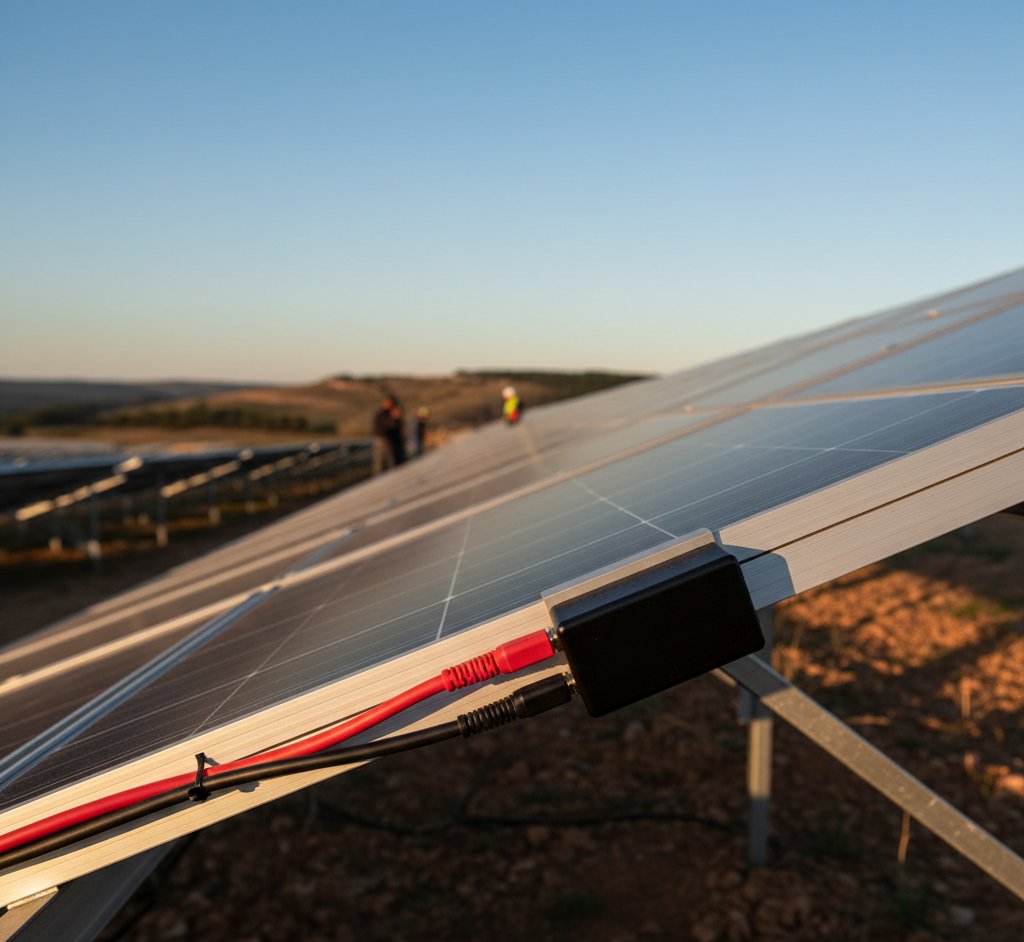
A panel optimiser is a small DC-DC converter that bolts to the back of each solar panel. Its job is Maximum Power Point Tracking — or MPPT — at the individual panel level.
Here's why that matters. In a standard string inverter setup, every panel in a string is wired in series, so the whole string shares one electrical circuit. The string's output is effectively set by the worst-performing panel. One shaded panel, one dirty panel, one panel angled slightly differently — and every panel in that string underperforms alongside it.
An optimiser breaks that constraint. It continuously adjusts each panel's voltage and current so that panel is always at its own best operating point, regardless of what its neighbours are doing. Think of it as each panel being in its own gear rather than the whole string being stuck in the same gear together.
The optimised DC output then feeds into a central string inverter, which converts it to AC for your home. The inverter itself stays the same — the optimisers work upstream of it.
When you genuinely need them
Optimisers earn their cost in specific situations. If any of the following apply to your roof, they're worth a serious look:
Partial shading from fixed objects. Trees, chimneys, dormer windows, satellite dishes, neighbouring buildings — anything that casts a shadow across part of your array at some point during the day. The key word is "part": if the shading hits some panels and not others at the same time, optimisers prevent the shaded panels from dragging down the unshaded ones.
Panels on multiple orientations. East and west faces on a hipped roof, or a system split across two different pitches, will have panels receiving different amounts of sun at any given moment. A hybrid inverter with two MPPT inputs handles this well for many split arrays — but if you're running a single string that mixes orientations, optimisers let each panel stay at its own peak.
Panel-level monitoring. Optimisers report each panel's output individually. If a panel develops a fault, degrades faster than its neighbours, or gets a pigeon dropping stuck on it for three weeks, you'll see it in the data rather than wondering why generation has dipped slightly. This diagnostic value is real, even if the yield benefit on an unshaded roof is marginal.
Long or uneven strings. Strings with many panels, or where some panels run hotter than others due to airflow differences, benefit from per-panel MPPT keeping everything matched.
When you probably don't need them
For the most common UK domestic scenario — a reasonably unshaded south-facing roof with all panels in similar conditions — the honest answer is that you likely won't see a meaningful return on the extra cost.
Unshaded south-facing roof. If your installer's shading simulation shows less than 5–8% shading loss, there's not much for optimisers to recover. The string inverter's MPPT is already working on a near-perfect array.
Small, uniform array. Four to six panels, all the same orientation, all getting the same light — a modern string inverter or hybrid inverter will extract the energy just fine.
Tight budget. This is probably the most important consideration. At ~£55 per panel, a 10-panel system adds roughly £550. That money has alternatives with far better returns — see the cost-benefit section below.
SolarEdge P801 vs Tigo TS4-A-O
The two products you'll encounter most from UK installers:
| SolarEdge P801 | Tigo TS4-A-O | |
|---|---|---|
| Typical cost | ~£54 per unit | ~£55 per unit |
| Ecosystem | Closed — must pair with a SolarEdge inverter | Open — works with any inverter brand |
| Monitoring | Full panel-level monitoring via SolarEdge portal | Panel-level monitoring via Tigo Cloud |
| Retrofit-friendly | No — requires SolarEdge inverter | Yes — can be added to an existing system |
| Industry use | Dominant in UK commercial installs | Strong in retrofit and independent installs |
| Rapid shutdown | Yes | Yes |
The practical implication: if you already have a GivEnergy, SunSynk, Solis, or Growatt hybrid inverter, SolarEdge is not an option — their optimisers only work with SolarEdge's own inverter. In that situation, Tigo is your realistic choice. If you're starting from scratch and are willing to commit to the SolarEdge ecosystem, either is viable — SolarEdge has a longer track record in commercial settings, while Tigo's open architecture offers more flexibility if you want to change inverter brands later.
1.2%
Extra yield from optimisers vs modern string inverters in moderate shading — PVSol simulation, 10 panels, London, chimney and tree shading
See shading analysisThe diminishing returns reality
This is where the marketing materials and the real-world data diverge.
PVSol simulation data for a 10-panel system (10 × 355 W, London, moderate chimney and tree shading):
| Configuration | Yield loss from shading |
|---|---|
| String inverter (Fronius) | 9.5% |
| Panel optimisers (SolarEdge) | 8.3% |
| Advantage from optimisers | ~1.2 percentage points |
That 1.2% is real. But it's far smaller than the figures you'll sometimes see in brochures — because those figures were often generated using older string inverter technology as the baseline.
Modern string inverters implement global maximum power point tracking that partially compensates for partial-string shading. Fronius Dynamic Peak Manager and SMA ShadeFix both scan the power curve to find the true global maximum rather than getting stuck at a local one. This wasn't true of string inverters a decade ago, and the gap has narrowed considerably.
The 1.2% advantage widens with more severe or complex shading — if a chimney casts a shadow that moves across different panels at different angles throughout the day, optimisers earn more. But for moderate, predictable shading from a fixed object, the simulation above is a reasonable guide.
The cost-benefit decision
Numbers for a typical 10-panel system:
- System size: 4.5 kWp
- Annual generation (London, south-facing, moderate shading): ~3,800 kWh
- Yield improvement from optimisers: ~1.2% = ~46 kWh/yr
- Value of that extra generation at current import rates: roughly £11/yr
- Cost of 10 optimisers at ~£55 each: £550
At £11/yr of extra value, the payback period on the optimiser investment alone is around 50 years — considerably longer than the system's expected lifespan.
For comparison: that same £550 spent on one additional panel (roughly 400 W) would generate around 340–380 kWh per year — almost 8–9 times the extra energy for the same money.
This does not mean optimisers are never worth it. It means the decision should be driven by your specific shading situation, not by the general marketing case. If your shading loss is 20%+ rather than ~9%, the numbers change significantly. Run the simulation first.
Ask for the shading simulation numbers
Before agreeing to optimisers, ask your installer to model the system with and without them in PVSol or a comparable tool. The software will show you the expected yield improvement in kilowatt-hours per year. Divide the optimiser cost by the value of that extra generation and you have your payback period. The numbers are rarely as dramatic as the brochure suggests — but sometimes they genuinely do stack up.
The decision in plain terms
- You have meaningful shading (a chimney that shades two or three panels for part of the day, a dormer window, a tree that will only grow): consider optimisers, and ask for a PVSol simulation to quantify the gain.
- You have panels on east and west faces and they'll share a string: consider optimisers, or explore whether a hybrid inverter's two MPPT inputs can handle the split instead.
- You want per-panel fault monitoring: optimisers deliver this cleanly. Weigh the monitoring value against the cost.
- Your roof is unshaded, south-facing, and all panels get similar conditions: the case for optimisers is very weak. Consider spending the money on an extra panel or towards battery storage instead.
For the full technical comparison of optimisers against microinverters — including the case for whole-panel independence rather than string-with-optimisers — see Optimisers vs Microinverters: Which Do You Need?.
Share this article

Smart home energy monitoring and automation — track your solar generation and control your home with Wi-Fi devices
Affiliate link — we may earn a small commission at no extra cost to you
Stay informed
Get free solar updates direct to your inbox
Related reading
Optimisers vs Microinverters: Which Do You Need?
Power optimisers vs microinverters for solar panels: how they work, when you need them, cost differences, and which is best for UK installations.
Solar Shading Analysis: How Much Does Shade Matter?
How shading affects solar panel output in the UK, tools for shading analysis, and solutions like optimisers and microinverters to reduce shade losses.
Hybrid Inverter vs String Inverter: Which Do You Need?
Hybrid vs string inverters: when you need a hybrid, cost differences, and when a string inverter plus separate battery inverter makes more sense.


Switch to Octopus Energy
Get 50 credit when you switch. We get 50 too — win-win.
What does this mean for YOUR home?
Design your perfect solar setup in under 3 minutes. Free, no sign-up required.
Build Your Solar System