This page contains affiliate links. If you purchase through them we may earn a small commission at no extra cost to you. Learn more
Solar Panels and Air Conditioning: A Perfect Match?

Most articles about solar focus on the winter problem: your panels generate least when you need heating most. The summer story is very different — and it is one of the most compelling cases for solar that rarely gets told.
Air conditioning and solar panels are a near-perfect pairing. Here is why.
Why the timing aligns
Solar panels generate most on hot, sunny days. Air conditioning demand peaks on hot, sunny days. The two loads are almost perfectly correlated.
This is the opposite of the solar-heating problem, where demand and supply are completely mismatched across seasons. With AC, the electricity you most want to run on solar is the electricity you are generating most of. On a 30°C July afternoon, your panels are at or near peak output — exactly when you want the house cooled.
A household that was exporting a large surplus of solar generation in summer may find that running an AC unit virtually eliminates that export — converting cheap exported electricity into useful cooling at the full import rate value.
50–60%
with AC running during solar peak — vs 25–35% without AC or a battery — solar and air conditioning align almost perfectly in timing
Learn moreMost domestic AC units are heat pumps
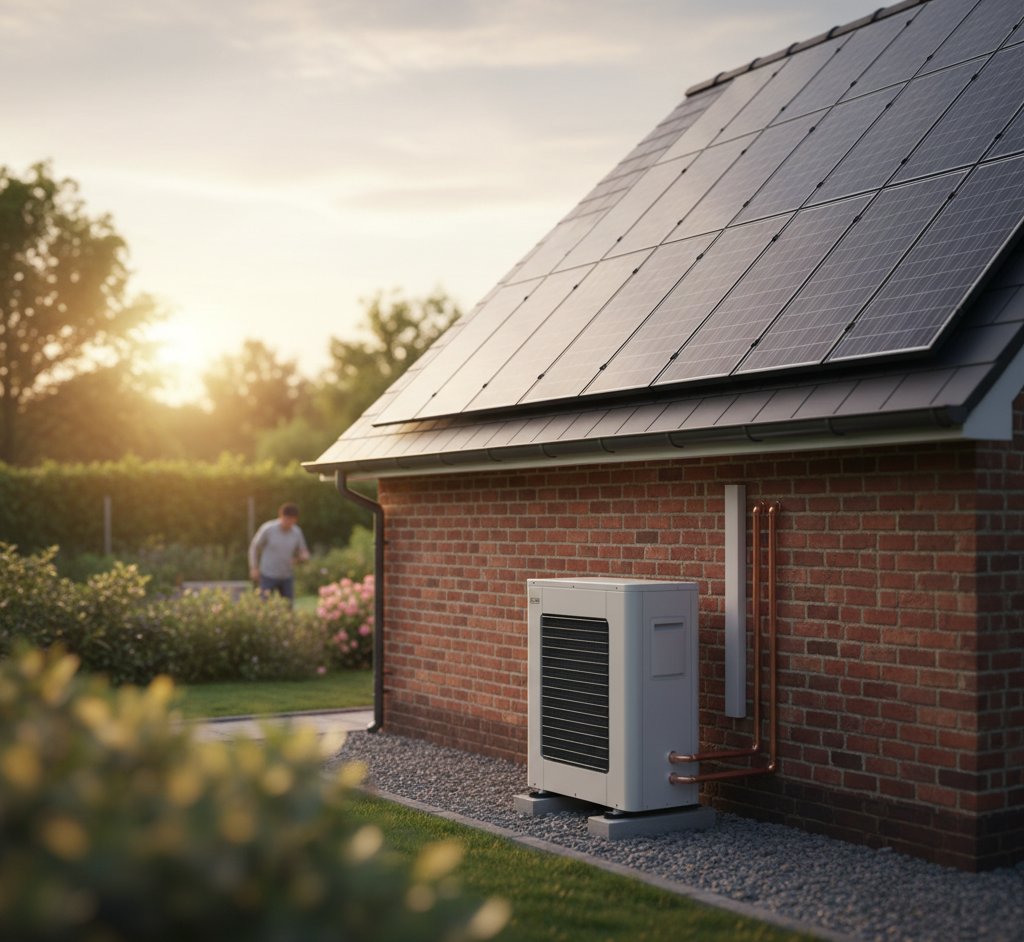
The majority of wall-mounted domestic split-system air conditioners are air-source heat pumps operating in reverse. The same refrigerant cycle that moves heat into a building in winter cooling mode moves heat out of the building in summer. The unit is reversible.
This has two important implications:
1. A reversible heat pump gives you year-round value from solar
In winter, the heat pump heats your home. Solar panels generate less in winter, but they still generate something, and the heat pump runs at high efficiency (COP of 3–4, meaning 3–4 units of heat for every unit of electricity). In summer, the same unit cools your home on solar power. The investment earns in every season.
2. The BUS grant may apply
Where a reversible AC unit is used primarily for heating (with cooling as a secondary function), the Boiler Upgrade Scheme (BUS) grant may be available for the heat pump installation. The grant rate is £7,500 as of April 2026.
The BUS grant is for the heat pump component — not for solar. But if you are considering both solar and a heat pump, the combination of BUS (for the heat pump) and 0% VAT (for solar) makes the package substantially more affordable.
BUS eligibility requires assessment by a registered installer
Not every air-to-air unit qualifies automatically — the installer must confirm the unit meets MCS requirements and apply for the grant. Do not assume eligibility without checking with a MCS Heat registered installer.
How many panels do you need to run air conditioning?
A typical domestic split AC unit:
- Electrical input: 2.5–3.5 kW
- Running for 4–8 hours on a hot day
Sizing guide:
- 1 AC unit: A 4kWp system generating 2.5–3 kW at peak can power a standard AC unit with minimal grid draw during peak solar hours
- 2 AC units (e.g. lounge and master bedroom): 6–7kWp gives enough headroom during peak sun
- AC plus EV charging or other high loads: Consider 8kWp or a battery to manage the combined demand
If you add a battery, the AC can also run on stored solar into the evening and overnight — extending the solar-powered cooling window beyond generation hours.
What are the savings?
Using current rates from verified-rates.json:
- A 3 kW AC unit costs approximately 72p per hour to run at the standard flat tariff rate
- Running for 6 hours on a hot day: approximately £4.32
- If solar covers 4–6 of those hours, you save £2.88–4.32 that day
- Across 20 hot days per summer in southern England: approximately £58–86 saved per season
Those figures are modest in isolation. But the more important number is the self-consumption boost. If solar is covering 50–60% of consumption rather than 25–35%, that improvement runs all year — not just on AC days. The AC load is one driver of better self-consumption; once the system is sized for it, the efficiency gain is permanent.
Hot days in the UK: be realistic about the numbers
Southern England sees approximately 15–30 days per year above 25°C. The Midlands and Wales: 10–20 days. Scotland: 5–15 days. The solar-AC pairing is compelling when those days arrive, but the UK is not Spain. Annual AC savings from solar will be real but seasonal — do not size or budget as if you are in southern Europe.
The broader picture: solar and full electrification
The solar-AC story becomes most compelling as part of a wider electrification journey.
A household planning to replace a gas boiler with a heat pump can use a reversible air-to-air unit to begin that journey affordably. In winter it heats. In summer it cools on solar. When a full ground or air-to-water heat pump is installed later, the household already has solar panels on the roof generating cheap electricity to feed it.
The sequence that makes financial sense for many households:
- Install solar (0% VAT until March 2027)
- Add a reversible air-to-air heat pump (BUS grant available)
- Run cooling in summer on solar, heating in winter on a combination of solar and cheap overnight rate
- Add a battery when the economics improve further or when Flux-style tariffs return
Each step reinforces the others. Solar covers more of the heat pump's demand. The heat pump converts cheap solar electricity into efficient heating and cooling. A battery eventually captures the gaps.
For a household at the beginning of this journey, solar plus a reversible AC unit is a lower-risk, lower-cost entry point than a full heat pump installation — while still building toward full electrification.
Summary
Solar and air conditioning are a genuinely good pairing for UK homes. The timing alignment is natural and real. A 4kWp system can run a standard AC unit during peak solar hours with minimal grid draw. Self-consumption improves significantly, which improves the overall solar economics.
The savings are seasonal and the UK is not the Mediterranean — set honest expectations. But on the days when you want cooling, you are also generating the most solar. That alignment is worth building around.
Share this article

Smart home energy monitoring and automation — track your solar generation and control your home with Wi-Fi devices
Affiliate link — we may earn a small commission at no extra cost to you
Stay informed
Get free solar updates direct to your inbox
Related reading

Solar Panels + Heat Pump: The Ultimate Combo?
Solar panels and heat pumps together: how the combination works, what it costs, real savings, and how to size the system for a UK home.
Solar Panels vs Heat Pump: Which Should You Get First?
Solar panels or a heat pump first? Costs, savings, and practicalities for UK homes. The answer depends on your heating system and electricity usage.

How to Size a Solar Panel System for Your Home
How to size a solar panel system for your UK home. Factor in electricity usage, roof space, budget, and future plans like EVs and heat pumps.


Switch to Octopus Energy
Get 50 credit when you switch. We get 50 too — win-win.
What does this mean for YOUR home?
Design your perfect solar setup in under 3 minutes. Free, no sign-up required.
Build Your Solar System