This page contains affiliate links. If you purchase through them we may earn a small commission at no extra cost to you. Learn more
How Long Does a Solar Battery Take to Charge?

The question sounds simple — and the maths behind it is. What makes real-world charging time tricky is that solar generation fluctuates constantly, and a home battery rarely charges under ideal conditions.
Here's how to think about it honestly.
The formula
Charging time (hours) = Battery capacity (kWh) ÷ Charging power (kW)
That's it. A 5 kWh battery charging at 2.5 kW takes 2 hours. A 10 kWh battery charging at 3 kW takes 3.3 hours.
The variables that matter are what determines how much power is actually going into your battery at any given moment.
Charging from solar panels
A 4 kWp (kilowatt-peak) solar array can produce up to about 3.5–4 kW on a clear, sunny, summer afternoon. In that ideal scenario, a 5 kWh battery fills in roughly 1.25 hours.
In practice, UK solar generation rarely hits that peak for sustained periods. A more realistic picture:
| Season | Typical peak output (4 kWp array) | Time to charge 5 kWh battery |
|---|---|---|
| Summer (June–August) | 2.5–3.5 kW | 2–3 hours |
| Spring / Autumn | 1.5–2.5 kW | 2–4 hours |
| Winter (Dec–Jan) | 0.5–1.5 kW | 4–6+ hours |
On overcast winter days, a 4 kWp array might produce less than 500 W — not enough to fully charge even a modest battery before the sun sets.
What reduces effective charging speed from solar
Your own household consumption comes first. If your home is drawing 1.5 kW (fridge, lights, router, TV) and your panels are producing 3 kW, only 1.5 kW reaches the battery. Always account for your background consumption.
Cloud cover is unpredictable. A partly cloudy day might average 1.5 kW — but generation fluctuates between 0.5 kW and 3 kW over the course of an hour. Your inverter handles this automatically, but it means the charging time calculation is always approximate.
Shading. Even partial shading of one panel can reduce whole-array output significantly, depending on how your system is wired.
Inverter charge rate limit. Most hybrid inverters cap battery charging at a set rate — commonly 2.5 to 3.6 kW for a single-phase home system. Even if your panels could supply more, the inverter limits what flows into the battery.
Charging from the grid
If you're on a time-of-use tariff with a cheap overnight window — such as Octopus Go, which offers a low overnight rate for five hours — your inverter charges the battery directly from the grid during that window.
Typical grid charging rates:
- Entry-level hybrid inverters: 2.5 kW charge rate
- Mid-range hybrid inverters: 3.0–3.6 kW
- High-end or three-phase systems: up to 6+ kW
At 3 kW charge rate:
- 5 kWh battery: fills in about 1 hour 40 minutes
- 10 kWh battery: fills in about 3 hours 20 minutes
The overnight window is more than enough time
Octopus Go's cheap rate window is five hours long (00:30–05:30). Even a 15 kWh battery charging at a modest 3 kW fills in 5 hours exactly. For most home battery systems under 10 kWh, you'll be fully charged well before the window ends — meaning you're not racing the clock.
Combined charging: solar top-up plus overnight grid
Many households use both approaches: charge from grid overnight (cheap rate), then let the battery top up from solar surplus during the day. This hybrid approach means the battery is typically full by mid-morning, covering both morning household loads and leaving headroom for afternoon solar production.
Most modern inverter management systems and apps — from GivEnergy, SolarEdge, SunSynk and others — allow you to programme exactly how much to charge from the grid versus leave for solar, based on your tariff schedule.
A realistic daily picture
For a typical household with a 5 kWh battery and a 4 kWp solar array on Octopus Go:
- 00:30–02:30: Battery charges from grid at ~2.5 kW to 100% (cost: roughly 5 kWh × 5.5p = around 28p)
- Morning: Battery covers household loads; solar begins producing around 08:00
- 10:00–14:00: Solar surplus tops up any battery depletion; battery likely full by midday in summer
- Evening: Battery discharges to cover post-sunset household loads
In this scenario the battery is never at risk of running flat — and most of your electricity comes from either stored grid energy at low cost or free solar generation.
Don't confuse battery capacity with usable capacity
Most batteries don't allow full 0–100% cycling. A "5 kWh battery" typically has a usable capacity of around 4.5–4.8 kWh, with a small reserve kept to protect the cells. Your charging time calculations should use the usable figure, not the headline capacity. Your inverter app will usually show this clearly.
Summary
Battery charging time is simple maths, but real-world conditions always vary. The honest answer for most UK households:
- From solar in summer: allow 2–4 hours for a 5 kWh battery
- From solar in winter: it may not fully charge from solar alone
- From the grid overnight: 1.5–2.5 hours is typical for a 5 kWh battery, easily within any cheap-rate window
The inverter's maximum charge rate is the most common practical constraint — worth checking if you're comparing hybrid inverter specifications.
Share this article

OVO has carefully selected trusted teams across the UK to install solar panels and heat pumps. Enjoy the personal touch of a local expert with the peace of mind of a household name.
Affiliate link — we may earn a small commission at no extra cost to you
Stay informed
Get free solar updates direct to your inbox
Related reading
Solar Battery Storage: Complete UK Guide 2026
Adding battery storage to a UK solar installation — types, sizing, costs, and which products are worth considering in 2026.
Battery Sizing Sweet Spot: How Big Is Big Enough?
How to choose the right battery size for your UK solar system. The sweet spot between too small, too big, and just right for your consumption patterns.
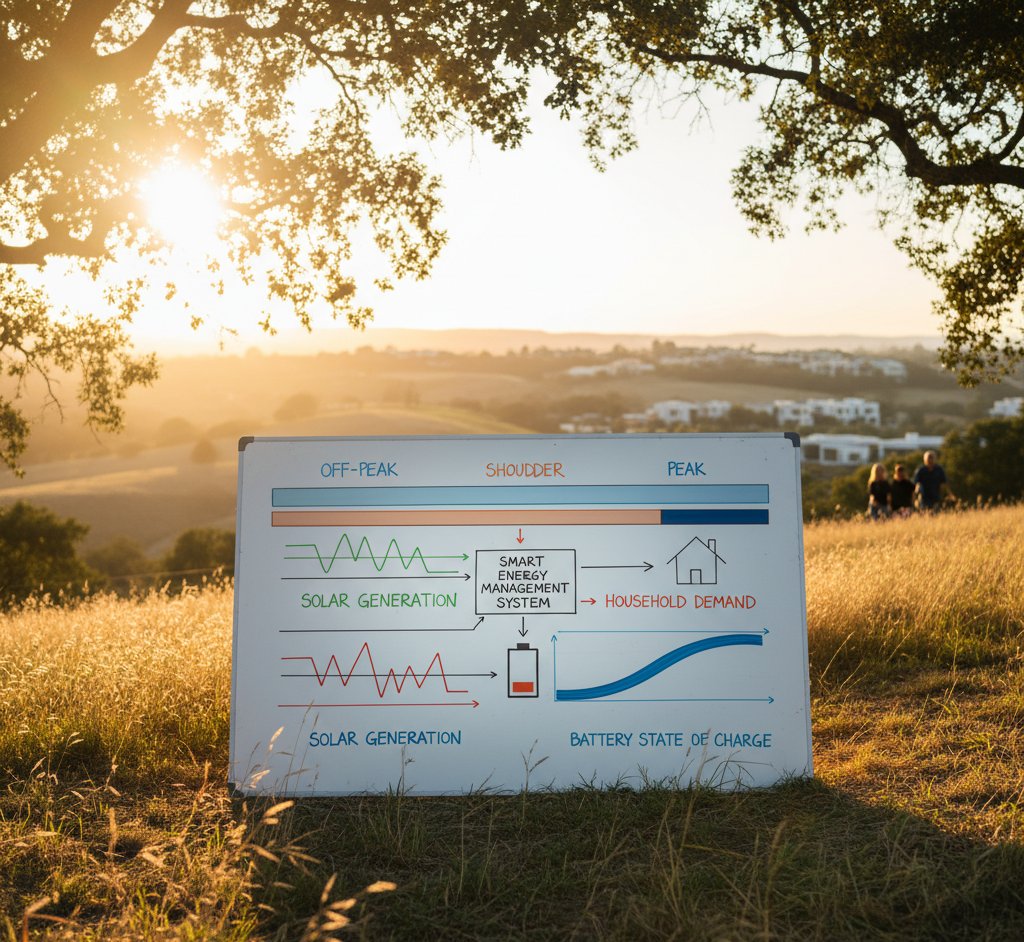
Best Smart Tariffs for Battery Storage in 2026: Head-to-Head Comparison
The best tariff for battery storage in the UK compared side by side — Octopus Go, Agile, Flux, Cosy, E.ON Drive, and Tesla Energy Plan rated for 2026.


Switch to Octopus Energy
Get 50 credit when you switch. We get 50 too — win-win.
What does this mean for YOUR home?
Design your perfect solar setup in under 3 minutes. Free, no sign-up required.
Build Your Solar System