This page contains affiliate links. If you purchase through them we may earn a small commission at no extra cost to you. Learn more
Solar Panels on a Bungalow: Your Complete Guide

If you live in a bungalow and are thinking about solar, you may be in a better position than you realise. Single-storey homes often have a disproportionately large roof area relative to their floor plan, good accessibility, and lower installation costs than two-storey houses. This guide covers everything specific to bungalow solar installations.
Why bungalows suit solar particularly well
The fundamental advantage of a bungalow is the roof-to-floor ratio. A typical two-storey house has a roof footprint of perhaps 50--70m2 serving two floors of living space. A bungalow with the same floor area has that same 50--70m2 roof serving just one floor -- meaning more roof per occupant, and potentially more panel space than you need.
For solar, more usable roof area means more choice: you can fit a larger system, orient panels to multiple aspects if the south-facing slope is smaller than ideal, or simply have more flexibility in panel positioning.
Scaffolding savings are another bungalow advantage. Scaffolding is one of the more significant costs in a solar installation, and its price scales with the height and complexity of access needed. A single-storey building is simpler and cheaper to scaffold than a two-storey one. In some cases, particularly for bungalows with a low eaves height, installers can work safely from ladders with minimal scaffolding, reducing this cost further.
How much roof space do you have?
A standard bungalow in the UK might have a total roof area of 60--100m2, but not all of that is usable for solar:
- Hipped roofs (sloping on all four sides) have no vertical gable ends and the triangular sections at the sides are inefficient for panels -- usable area may be 30--50% of total roof area
- Gable-end roofs (sloping on two sides, vertical gable ends) have better usable area per slope -- typically 50--70% of total roof area is practical
- Obstacles such as chimneys, roof lights, velux windows, and vents reduce usable area further
A rough rule of thumb: a modern solar panel is approximately 1.7m x 1.1m (around 1.87m2). With typical panel spacing for airflow and edge clearance:
- 30m2 of usable south-facing roof can fit around 10--12 panels (4--5kWp)
- 20m2 of usable roof can fit around 6--8 panels (2.4--3.2kWp)
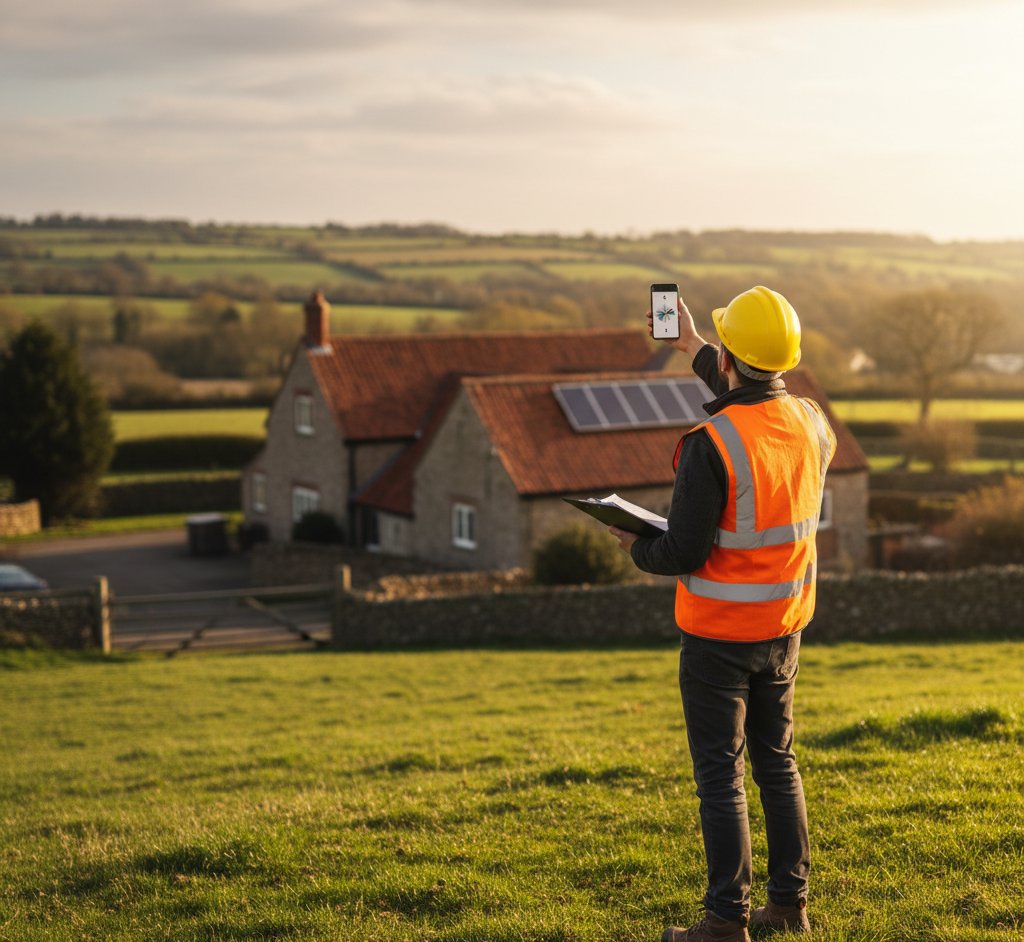
An MCS-certified installer will assess your specific roof geometry as part of any survey.
Does a lower roof pitch matter?
Bungalows often have roof pitches in the 20--35-degree range. The theoretically optimal angle for solar panels in the UK is around 35 degrees, which maximises annual yield. But the difference between 20 degrees and 35 degrees is smaller than many people expect.
A roof pitched at 20 degrees produces roughly 2--4% less annual generation than one at 35 degrees. Over a 25-year panel lifetime, this is a modest difference -- fully justified by the practical and structural advantages of the building.
Very shallow pitches (below 10 degrees) do start to present challenges: self-cleaning of panels becomes less effective (dust and debris do not wash off as readily), and ponding water can be an issue. Pitches below 10 degrees are unusual on traditional UK bungalows but are worth checking if your property has a flat or near-flat section.
For genuinely flat roofs, there are tilted mounting systems that angle panels at 10--20 degrees. See the flat roof solar guide for more detail.
Sizing a system for a bungalow
The right system size depends on your electricity consumption, not just your roof space. A bungalow occupied by one or two people might use 2,000--3,000kWh per year; a family of four in the same building might use 4,000--5,000kWh.
As a rough guide:
- 3kWp system (6--8 panels): suitable for smaller households or limited roof space; generates around 2,600--2,900kWh per year in most of England
- 4kWp system (8--10 panels): the most common size for a typical bungalow; generates around 3,400--3,800kWh
- 5--6kWp system (10--14 panels): for larger roofs or households with higher consumption, an EV, or a heat pump
For the current installed costs by system size, see the solar panel costs article, which uses up-to-date pricing data.
Hipped roofs: the main bungalow complication
The most common architectural challenge for bungalow solar is the hipped roof -- one that slopes on all four sides rather than just two. Hipped roofs are common in traditional British bungalow design and present two issues:
- Reduced south-facing area. The triangular hip sections on the east and west slopes are awkward to panel efficiently, and the south-facing slope itself may be narrower than expected.
- Fewer full rows of panels. Because the roof narrows toward the ridge at the hipped ends, you cannot fit complete rows of panels across the full width, which complicates layout.
None of this makes solar impossible on a hipped roof -- many bungalows with hipped roofs have excellent solar installations. But it does mean your usable area calculations should be conservative, and your installer's survey is particularly important.
East-west splits can work well on bungalows
If your south-facing slope is limited by a hip or by obstacles, fitting panels across both east and west slopes is worth considering. An east-west split generates slightly less than south-facing in total, but produces a broader generation curve across the day -- more generation in the morning and evening when you may be home. Some bungalows with wide east and west slopes do very well with this approach.
Maintenance advantages of single-storey solar
One underrated benefit of bungalow solar is long-term maintenance. Over a 25-year panel lifetime you may need to:
- Clean panels during periods of low rainfall (particularly useful for spring pollen and autumn leaf debris)
- Have an installer inspect fixings and flashings every 5--10 years
- Replace an inverter (most inverters last 10--15 years)
All of these are simpler and cheaper on a single-storey building. Some bungalow owners with low eaves heights can even access their panels safely from an extension ladder -- though any work on the roof itself should still involve appropriate safety equipment and ideally a professional.
Easy maintenance, long-term
Before installation, ask your installer to position panels with future access in mind. Panels at the bottom of a row are easier to clean from the eaves; panels near a Velux or access hatch are reachable without scaffolding for inspection. A small amount of planning at installation time pays off over decades.
Planning permission
Solar panels on bungalows fall under the same Permitted Development rules as any other dwelling -- no planning permission is needed in most cases, provided:
- Panels do not protrude more than 200mm above the roof plane
- The installation does not extend above the highest point of the roof
- The property is not a listed building
- The property is not in a designated area with specific restrictions (some Conservation Areas and National Parks have additional requirements)
If your bungalow is in such an area, your installer will advise you on whether permitted development applies or whether a prior approval application is needed.
Summary
Bungalows are often ideal candidates for solar. Large roof area, low scaffolding costs, accessible maintenance, and a forgiving pitch range all work in your favour. The main thing to watch is the hipped roof, which can reduce usable south-facing area. A proper survey from an MCS-certified installer -- which should always be the first step -- will tell you exactly what is possible on your specific building and help you size the system to match your consumption.
Share this article

Energy-saving LED lighting — make the most of your solar electricity with efficient bulbs and fixtures
Affiliate link — we may earn a small commission at no extra cost to you
Stay informed
Get free solar updates direct to your inbox
Related reading
Is My Roof Suitable for Solar Panels?
Find out if your roof can take solar panels — covering direction, angle, shading, structural condition, and options for tricky roofs.

How Many Solar Panels Do I Need? UK Guide
Work out how many solar panels your UK home needs. Simple formula based on your electricity usage, roof space, and budget.
How Much Do Solar Panels Cost in the UK in 2026?
UK solar panel costs 2026: realistic prices by system size, what is included, and what to push back on in your quote.


Switch to Octopus Energy
Get 50 credit when you switch. We get 50 too — win-win.
What does this mean for YOUR home?
Design your perfect solar setup in under 3 minutes. Free, no sign-up required.
Build Your Solar System