This page contains affiliate links. If you purchase through them we may earn a small commission at no extra cost to you. Learn more
String Inverters vs Microinverters vs Optimisers: Which Architecture Suits Your Roof?
When a solar installer quotes you a system, they'll mention an inverter brand. What they might not explain clearly is which architecture they're proposing — string, micro, or optimised — and why that choice matters more than the brand name on the box.
This guide explains all three from first principles. No assumed knowledge needed.
What Does an Inverter Actually Do?
Solar panels produce DC (direct current). Your home, and the National Grid, run on AC (alternating current). An inverter is the device that converts DC from your panels into usable AC electricity.
Beyond conversion, inverters also handle:
- Finding the maximum power point (MPPT) — the sweet spot of voltage and current where panels produce most power
- Grid synchronisation — matching the AC output to the grid's frequency and voltage
- Safety shutdowns — disconnecting automatically if the grid goes down or detects a fault
- Monitoring — logging how much your system generates
The three architectures differ in where and how many inverter units you have in the system.
Architecture 1: String Inverter
How It Works
In a string system, your solar panels are wired together in a series chain — a "string" — like old-fashioned Christmas tree lights. All the DC power from that string flows into a single inverter mounted on your wall (usually in the garage, utility room, or outside on a north-facing wall).
The inverter converts the combined DC to AC and feeds it into your consumer unit.
If you have more panels than one string can handle, or panels facing different directions, a modern string inverter will have two or more MPPT inputs — allowing it to manage two independent strings separately.
Common UK Brands
- GivEnergy — popular UK brand, strong local support and monitoring app
- Solis — widely installed across the UK, good reliability record
- Fox ESS — competitive pricing, solid monitoring platform
- SolaX — established brand with a broad product range
- Growatt — budget-friendly option with a wide installer network
The Shading Problem
Here's the critical limitation. In a string, panels are electrically linked in series. If one panel underperforms — because a chimney shadow falls across it, a bird sits on it, or it's just dirtier than the others — every other panel in the string is dragged down to match.
Think of it like a hosepipe with a kink. The water flow through the whole pipe is limited by the narrowest point.
On a completely unshaded, single-orientation roof, this doesn't matter at all. On a roof with any shading, it can be costly.
Pros
- Lowest upfront cost (single inverter unit, no per-panel hardware)
- Easy to service — one accessible box on your wall
- Proven technology with long track records
- Wide choice of brands and installers
- Hybrid variants available for future battery integration
Cons
- Shading on one panel reduces output from the whole string
- Less granular monitoring (you see total system output, not per-panel data)
- Single point of failure — if the inverter fails, the whole system goes down
Architecture 2: Microinverters
How It Works
A microinverter is a small inverter unit — roughly the size of a thick paperback book — fitted behind each individual solar panel. Each panel converts its own DC to AC right on the roof. Only AC wiring runs from the roof to your consumer unit.
There is no central string inverter at all.
Common UK Products
- Enphase IQ8 — the dominant microinverter in the UK market. The IQ8 series can operate in "grid-forming" mode, meaning it can power your home during a grid outage if paired with an Enphase battery. Well-established with a 25-year warranty.
How Shading Is Handled
Because each panel has its own inverter operating independently, a shadow falling on one panel has no effect on any other. Each panel operates at its own maximum power point, regardless of what its neighbours are doing.
This is the strongest argument for microinverters on shaded or complex roofs.
Pros
- No single point of failure — one failed microinverter affects only that panel
- Best performance on shaded or multi-orientation roofs
- Panel-level monitoring as standard — you can see exactly how each panel is performing
- No high-voltage DC anywhere on the roof (AC only — a safety benefit)
- Easy to expand — add panels one at a time without worrying about inverter capacity
- Enphase IQ8 offers 25-year warranty covering the full system life
Cons
- Highest upfront cost — a microinverter for each panel adds up
- All units are on the roof — if one fails, accessing it means scaffolding
- Slightly lower peak efficiency than the best central inverters at full output
- More components overall means more potential failure points, even if each failure is contained
Microinverters and Battery Storage
If you want battery storage alongside Enphase microinverters, you need an Enphase battery (IQ Battery range) — you cannot simply plug in a GivEnergy or Solis battery. The Enphase ecosystem is self-contained. This is worth understanding before committing, particularly if you have a preferred battery product in mind.
Architecture 3: Power Optimisers + Central Inverter
How It Works
Power optimisers sit in the middle ground between the other two. A small DC-DC converter is fitted behind each panel — similar to a microinverter in size — but instead of converting to AC on the roof, it optimises the DC output from that panel before sending it down to a central string inverter.
The central inverter still handles the DC-to-AC conversion, but each panel's power is independently maximised before reaching it.
The dominant system of this type in the UK is SolarEdge: SolarEdge optimisers (such as the P801) paired with a SolarEdge string inverter.
How Shading Is Handled
Because each panel is independently optimised, a shadow on one panel doesn't affect the others. The optimiser for the shaded panel adjusts its output independently, while all other panels continue at full power.
This gives most of the shading benefit of microinverters, with a central inverter that's easier to service.
Pros
- Per-panel monitoring and shading mitigation
- Central inverter is indoors and accessible — easier to replace than roof-mounted units
- Lower cost than full microinverters
- Rapid shutdown capability (safety feature for fire services)
- SolarEdge P801 optimisers carry a 25-year warranty
Cons
- The central inverter is still a single point of failure for the whole system
- SolarEdge optimisers only work with SolarEdge inverters — a proprietary pairing
- SolarEdge string inverters typically carry a 12-year warranty (extendable), so you may need one inverter replacement over the system's 25-year life
- Slightly higher cost than a plain string inverter
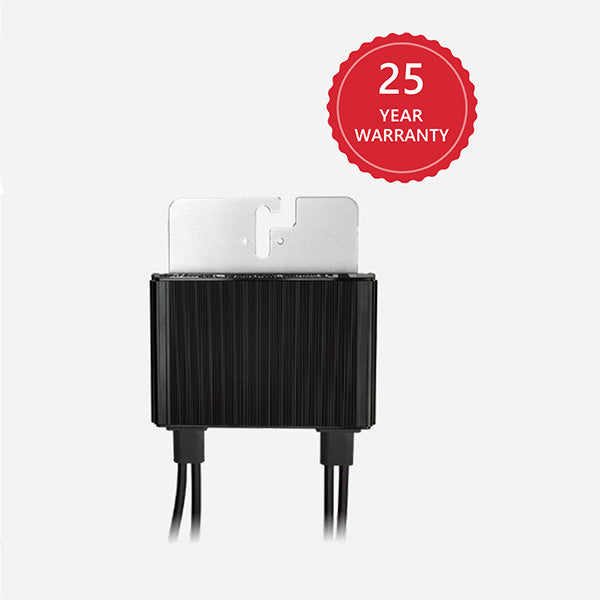
SolarEdge P801 Power Optimiser
£54DC optimiser
SolarEdge inverters only
Module-level
800
Affiliate link — we may earn a small commission at no extra cost to you
Head-to-Head Comparison
Cost in Pounds: What to Expect
For a 10-panel (approx. 4 kW) system, rough additional hardware costs compared to a basic string inverter:
These are indicative ranges — actual quotes will vary by region, roof complexity, and installer. The solar panel costs guide covers total system pricing in more detail.
The Shading Test Before You Decide
Before choosing your architecture, do a simple shading check. Stand at your roof's location at midday in December (when the sun is lowest). If any chimney stack, dormer window, tree, or neighbouring roof casts a shadow across the panels, shading is a real factor. If the roof is clear sky all the way to the horizon, a standard string inverter will serve you well.
Which Architecture Suits Which Roof?
A Standard String Inverter Is the Right Starting Point If:
- Your roof is unshaded throughout the year (or shading only affects one edge panel briefly)
- All panels face the same direction on a single roof slope
- You want the lowest upfront cost
- You plan to add a battery — choose a hybrid string inverter (GivEnergy, Solis, Fox ESS, SolaX, Growatt all make hybrid variants)
Consider Optimisers If:
- You have moderate shading (a chimney shadow, a skylight, or a neighbouring wall affects 1–3 panels)
- Your panels span two different roof pitches or orientations
- You want panel-level monitoring to diagnose performance issues over time
- You want shading mitigation but prefer an accessible central inverter for servicing
Consider Microinverters If:
- Your roof has significant, unavoidable shading across multiple panels
- Panels face three or more different directions (e.g., an L-shaped or hipped roof)
- You want the longest warranty without planning an inverter replacement mid-system life
- You may want to expand the system panel-by-panel in future
- You're comfortable within the Enphase ecosystem for any battery storage
Failure Modes: What Happens When Things Go Wrong
This is worth thinking about before you commit.
String inverter failure: The whole system stops generating. You'll notice immediately because your monitoring app will flatline. Replacement involves one unit on your wall — typically straightforward for an MCS installer, and covered by warranty in the first 5–12 years depending on brand.
Optimiser failure (SolarEdge): One panel underperforms, but the rest of the system keeps going. Your monitoring app will flag the specific unit. Accessing it means getting onto the roof, but the SolarEdge app makes it easy to identify exactly which optimiser has failed.
Microinverter failure (Enphase): One panel stops contributing. The rest of the system is completely unaffected. Enphase's monitoring system identifies the failed unit by serial number. Replacement requires roof access but is covered by the 25-year warranty.
A Note on Monitoring
All three architectures now offer monitoring apps, but the granularity differs:
- String inverter: You see total system output — generation vs. consumption, export, historical charts. You don't see individual panel output.
- Optimised system: Per-panel data. You can see if one panel is underperforming versus the array average — useful for identifying faults, bird droppings, or shading problems.
- Microinverters: Per-panel data. Same level of detail as optimisers.
If understanding exactly how your system performs at panel level matters to you — for troubleshooting, or just peace of mind — optimisers or microinverters both deliver that visibility.
Summary
There is no universally "best" architecture. The right choice depends on your specific roof:
- Unshaded, single-orientation roof: A string inverter from a reputable brand (GivEnergy, Solis, Fox ESS, SolaX, Growatt) is entirely appropriate and gives you the best value.
- Partial shading or mixed orientations: Power optimisers (SolarEdge) give you meaningful performance recovery without the full cost of microinverters.
- Complex or heavily shaded roof: Microinverters (Enphase IQ8) are worth exploring — the per-panel independence is genuinely valuable here.
When getting quotes, ask the installer which architecture they're proposing and why. If they're proposing optimisers or microinverters for a clear south-facing roof with no shading, it's worth asking whether the additional cost is justified for your situation.
Share this article

OVO has carefully selected trusted teams across the UK to install solar panels and heat pumps. Enjoy the personal touch of a local expert with the peace of mind of a household name.
Affiliate link — we may earn a small commission at no extra cost to you
Stay informed
Get free solar updates direct to your inbox
Related reading
Solar Inverters Explained: Types, Sizing, and Real-World Limits
String, micro, and hybrid inverters explained — plus the critical G98/G99 threshold at 3.68kW and what it means for what you can run simultaneously.
Enphase Microinverters UK Review: IQ8 Series, Costs, and Who They Suit
Enphase IQ8 microinverter review for UK homes. How they compare to string inverters, costs, monitoring, and when microinverters make sense.
SolarEdge Inverter Review UK: Optimisers, Monitoring, and Value Assessment
SolarEdge inverter and power optimiser review for UK homes. Panel-level optimisation, monitoring, costs, and honest comparison with alternatives.

Switch to Octopus Energy
Get 50 credit when you switch. We get 50 too — win-win.
What does this mean for YOUR home?
Design your perfect solar setup in under 3 minutes. Free, no sign-up required.
Build Your Solar System