This page contains affiliate links. If you purchase through them we may earn a small commission at no extra cost to you. Learn more
Solar for Sheds, Garden Offices and Summer Houses
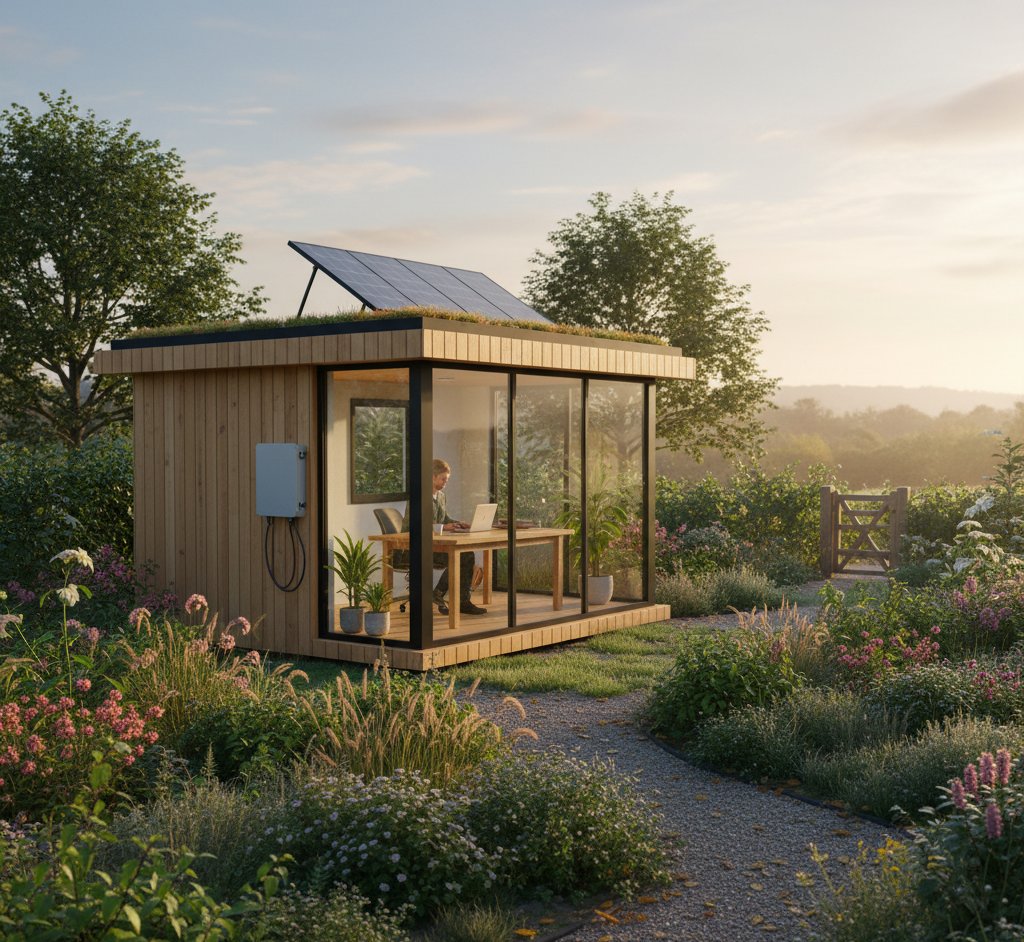
A garden office or shed with its own solar power is a genuinely useful setup — no trenching cables across the garden, no need to extend your home's consumer unit, and free daytime electricity for everything you need to work. Solar panels on an outbuilding are often simpler than people expect, and planning permission is rarely needed.
Is Solar the Right Solution for Your Shed?
Before jumping to solar, it's worth being clear about what it can and can't do.
Solar works well for:
- Garden offices with laptops, monitors, and lighting
- Hobby sheds with power tools used occasionally
- Summer houses with lighting and a mini-fridge
- Workshops with low-to-medium power needs during daytime hours
Solar is impractical or insufficient for:
- Electric fan heaters (2,000–3,000W) — the panel and battery size required is huge
- Tumble dryers, washing machines, or other high-draw appliances
- Full-time use through UK winters when generation drops significantly
If your main load is an electric heater, running a proper armoured cable from the house is almost certainly better value than solar. A 2.5 kWh battery and 400W of panels would cost £600–£1,000 and might power two hours of heating. An armoured cable installation runs £300–£700 and gives you unrestricted mains power.
Working Out Your Power Needs
A typical garden office:
| Load | Watts | Hours/Day | Wh/Day |
|---|---|---|---|
| LED lighting (3 fittings) | 15W | 6 | 90 |
| Laptop (modern, power-efficient) | 45W | 7 | 315 |
| Monitor (27" LED) | 30W | 7 | 210 |
| Wi-Fi router/mesh node | 10W | 10 | 100 |
| Phone charging | 10W | 1 | 10 |
| Total | ~725 Wh/day |
This is a moderate garden office load. You'd need a system capable of generating and storing around 725 Wh/day for reliable year-round use — though note that in winter, generation often falls short of this in the UK.
A simpler summer house might need only:
| Load | Watts | Hours/Day | Wh/Day |
|---|---|---|---|
| LED lighting | 10W | 4 | 40 |
| Phone/tablet charging | 10W | 1 | 10 |
| Small radio | 5W | 3 | 15 |
| Total | ~65 Wh/day |
This is trivial — even a 100W panel and a small LiFePO4 battery easily covers it.
System Options
Option 1: Plug-In Solar Power Station
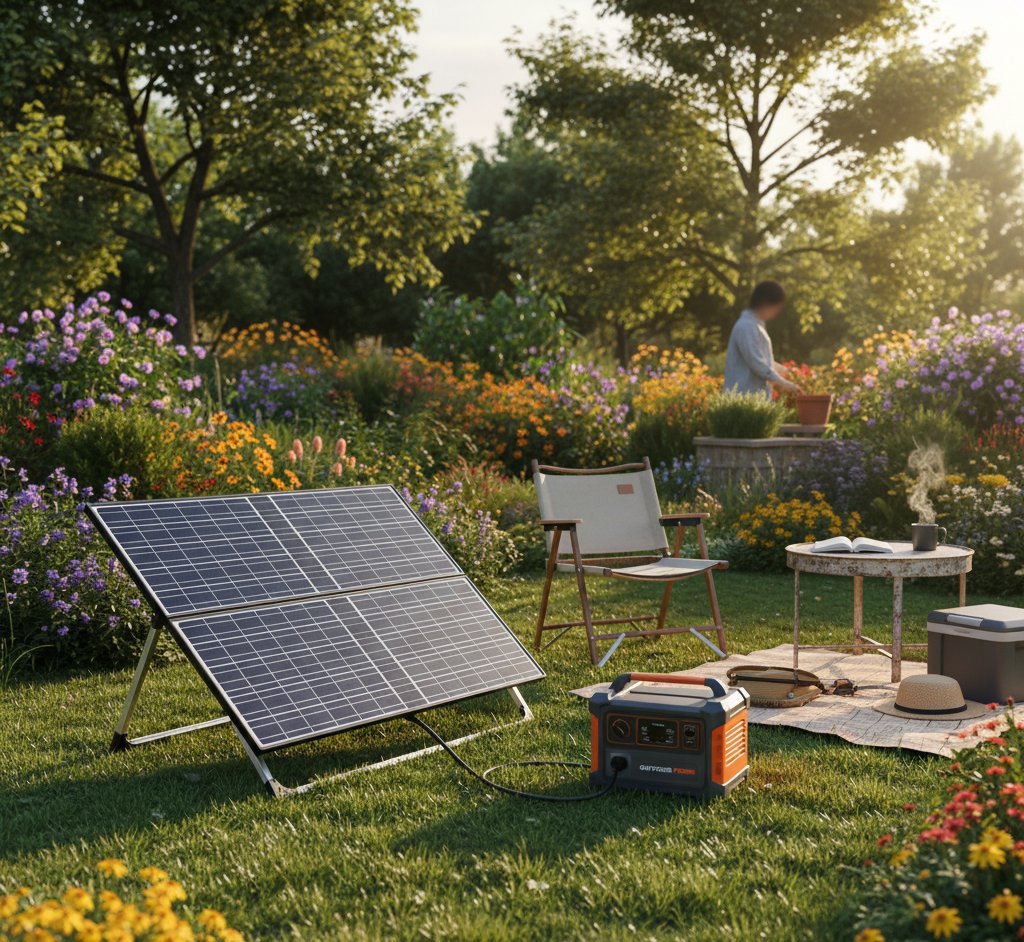
The simplest approach. A portable solar power station (like the EcoFlow RIVER 2 or DELTA 2) combined with a foldable or roof-mounted panel gives you:
- No installation or wiring expertise required
- AC sockets and USB ports built in
- Can be taken inside when not needed
- Works immediately out of the box
An EcoFlow DELTA 2 (1,024 Wh, 1,200W AC output) with a 220W panel costs roughly £700–£900. It will comfortably power a garden office through a sunny day with capacity to spare.
The downside: it's an all-in-one product at a premium price. A DIY system with panels, charge controller, and LiFePO4 battery provides more capacity for the same money, but requires installation knowledge.
Start with a Power Station, Upgrade Later
If you're unsure how much power your garden office actually needs, start with a portable power station. Run it for a season and see how much battery you're using. You'll have real data to design a proper fixed system — and you'll have the portable station as backup or for camping trips.
Option 2: Standalone Off-Grid Solar System
A properly designed off-grid system for a garden building typically includes:
| Component | Typical Spec | Approx Cost |
|---|---|---|
| Solar panels (roof-mounted) | 200–400W | £150–£300 |
| MPPT charge controller | 20–30A, e.g., Victron SmartSolar | £70–£130 |
| LiFePO4 battery | 100–200Ah 12V | £200–£400 |
| Pure sine wave inverter | 500–2,000W | £80–£250 |
| Fuse box, wiring, connectors | Various | £50–£100 |
| Panel mounting brackets | Various | £40–£80 |
| Total | £590–£1,260 |
This gives you a complete system with 12V DC and 240V AC outputs. You can run standard UK plugs and switches inside the shed.
Option 3: Extend from the House
For high-load applications or year-round reliability regardless of weather, running an armoured cable from your home is often the most practical solution. An electrician can install a sub-consumer unit in the shed with proper RCD protection. This gives you full mains capacity.
Costs vary based on distance and cable routing:
- Up to 20m: £300–£500 installed
- 20–40m: £500–£900 installed
- Over 40m: £800–£1,500 installed
You could also combine approaches: extend a cable for heavy loads (kettle, fan heater) while running solar for daytime lighting and device charging.
Planning Permission for Shed Solar
Planning permission is almost never required for solar panels on a garden outbuilding, provided:
- The outbuilding is within the curtilage of a dwelling house (i.e., your garden)
- The panels do not project more than 200mm from the roof surface
- The building is not listed
- You're not in a conservation area (extra care needed)
- The panels don't face a highway
Under Schedule 2, Part 14 of the Town and Country Planning (General Permitted Development) Order, solar panels on outbuildings benefit from the same permitted development rights as those on a house. The 50 sqm floor area is relevant to the outbuilding itself needing permitted development (not to the panels).
Conservation Areas and Listed Buildings
If your property is in a conservation area or is listed, permitted development rights for solar may be restricted or removed entirely. Check with your local planning authority before installing anything. Conservation area rules apply to what's visible from public roads — rear garden buildings are often acceptable even in conservation areas, but always verify first.
Wiring Inside the Shed
For a proper installation, you'll want:
12V DC distribution: A small 12V fuse box (DIN rail or blade fuse type) distributes power to individual circuits — lighting, USB charging points, and so on. Runs directly off the battery.
240V AC distribution: An inverter connected to the battery, with a small consumer unit or RCD socket strip protecting the AC circuits. Powers standard UK sockets.
Earth bonding: Metal shed frames should be earthed. An electrician can advise on earthing requirements for off-grid systems.
Cable routing: Use appropriate cable for outdoor and underground runs. Any cable going underground should be armoured or protected in conduit.
For anything involving mains AC wiring inside a building (consumer units, fixed AC sockets), the work should be done by a Part P registered electrician or notified to building control.
Sizing for the UK's Variable Weather
UK solar generation is highly seasonal:
| Season | Generation from 200W Panel |
|---|---|
| Summer (June–August) | 800–1,000 Wh/day |
| Spring/Autumn | 500–700 Wh/day |
| Winter (Nov–Jan) | 150–350 Wh/day |
If you need the garden office to work reliably year-round, you have several options:
- Oversize the solar — 400W instead of 200W means more generation on marginal days
- Add battery capacity — a larger battery banks excess summer generation but doesn't help in cloudy winter stretches
- Add a DC-DC charger from the house — an armoured cable and charger to top up the battery from grid power when solar is insufficient
- Accept limitations — many garden offices are used heavily in spring/summer/autumn when solar is more than adequate, and occasionally in winter when lower power is fine
Overnight Charging from the House
A simple approach for winter shortfalls: run a single socket extension or armoured cable from the house to the shed, connected to a 12V battery charger or DC-DC charger. Run it overnight on cheap-rate electricity (Octopus Go is ~5.5p/kWh overnight) to top up the battery. This hybrid approach gives you the best of both worlds without full grid connection.
Real-World Example: Garden Office Build
A 4×3m insulated garden office on a south-facing pitch roof:
- 2× 200W monocrystalline panels mounted flush on the roof: £240
- Victron SmartSolar MPPT 75/15: £80
- Fogstar 100Ah LiFePO4 battery: £220 — Fogstar stocks quality UK-supplied LFP batteries in various sizes
- Victron Phoenix 12/375 pure sine inverter: £120
- 4-way 12V fuse box + wiring: £60
- 2× 12V LED strip lights + 4× UK sockets: £80
- Total: ~£800
This system runs the office comfortably through spring, summer, and autumn. In winter, the owner tops up via a standard extension lead on Octopus Go rate overnight when needed. Total charging cost in winter: roughly £2–£5/month.
Putting It Together
Solar for a shed or garden room is one of the more achievable DIY projects in the solar world. The voltages involved in a 12V system are safe to work with, components are readily available, and there's a large online community sharing builds and advice.
The main decisions are:
- How much power do you actually need? Measure or estimate carefully.
- Do you need year-round reliability? If yes, plan for winter too.
- DIY or all-in-one? Power stations are easier; DIY systems give better value per kWh.
- Are you connecting AC sockets? If yes, involve a qualified electrician for the fixed wiring.
Get those decisions right and you'll have a garden office that runs entirely on free daytime sunshine — and costs nothing to power on most summer days.
Share this article

OVO has carefully selected trusted teams across the UK to install solar panels and heat pumps. Enjoy the personal touch of a local expert with the peace of mind of a household name.
Affiliate link — we may earn a small commission at no extra cost to you
Stay informed
Get free solar updates direct to your inbox
Related reading
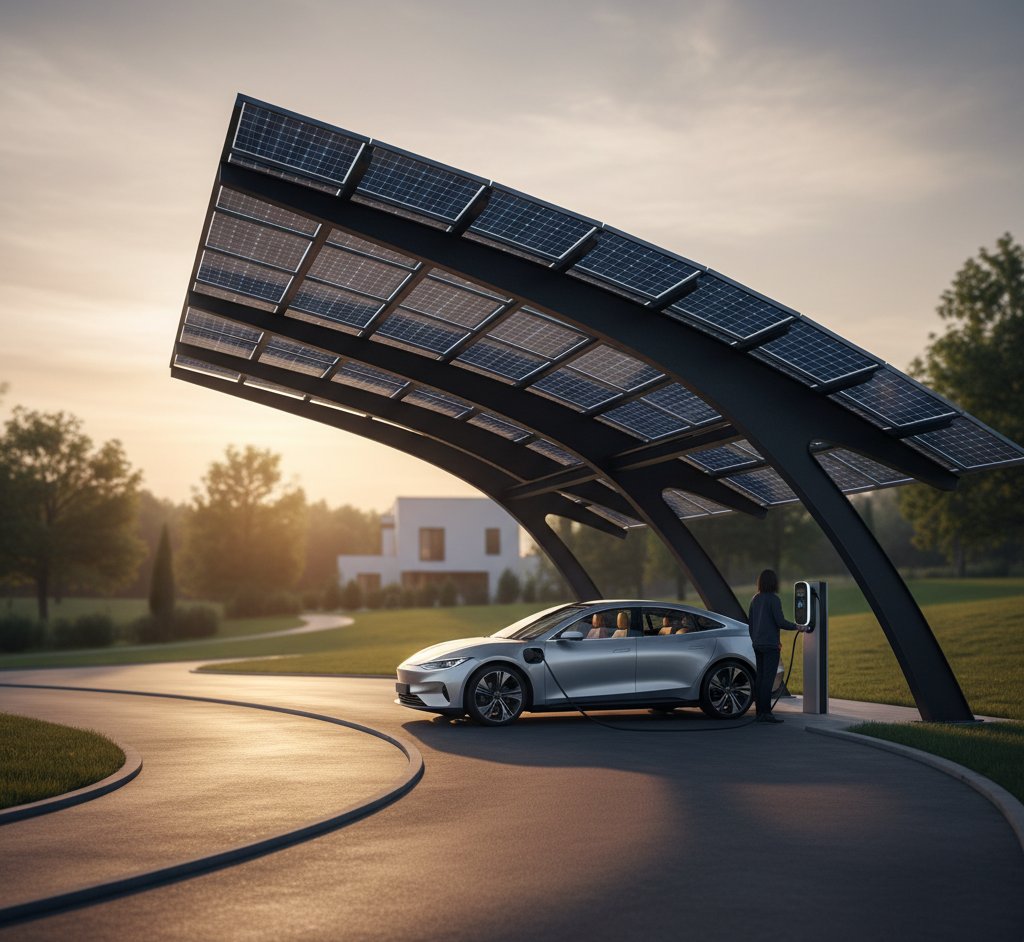
Solar Carports and Solar Pergolas: What You Need to Know
Solar carports and pergolas as dual-purpose structures. Costs, planning permission, output potential, EV charging integration, and the difference between residential and commercial.
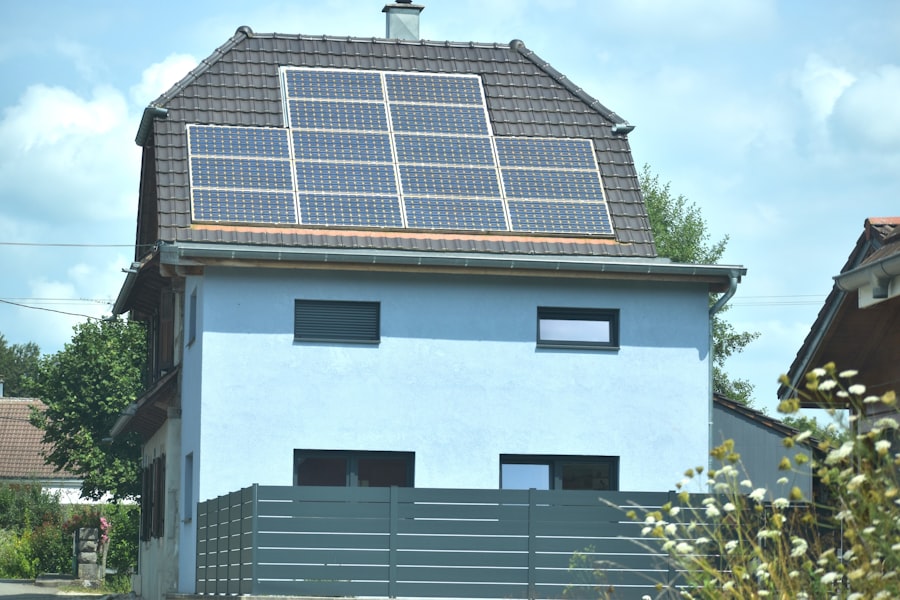
Balcony Solar Panels UK: A Practical Guide
Balcony solar panels for UK flats and apartments. What's possible, what's legal, how much they generate, and whether they're worth the investment in 2026.
Solar for Campervans, Motorhomes and Camping: A Complete Guide
How to set up solar for a campervan, motorhome, or camping. Panel types, sizing, charge controllers, battery choices, and wiring basics explained.


Switch to Octopus Energy
Get 50 credit when you switch. We get 50 too — win-win.
What does this mean for YOUR home?
Design your perfect solar setup in under 3 minutes. Free, no sign-up required.
Build Your Solar System