This page contains affiliate links. If you purchase through them we may earn a small commission at no extra cost to you. Learn more
Solar Tracking Systems: Do They Make Sense in the UK?

Solar tracking systems — motorised mounts that follow the sun's movement — look like an obvious win on paper. More sun hits the panels, more electricity flows. So why don't most UK installations use them?
The short answer: the economics don't work for most sites. Understanding why requires looking at what the UK's weather actually does to solar generation.
What a solar tracker does
A tracker replaces a fixed mounting frame with a motorised structure that adjusts the panel angle throughout the day to maximise direct sunlight on the cell surface.
Single-axis trackers rotate east to west, following the sun's daily arc across the sky. They're the more common type in commercial installations.
Dual-axis trackers add a second movement — tilting north-south to account for the sun's changing altitude through the seasons. They can track the sun precisely year-round but are mechanically more complex.
Both types require:
- A motor and control system
- Power supply for the motor (typically parasitic from the array itself)
- Structural foundations capable of bearing the torque forces
- Regular maintenance — bearings, motors, and sensors all wear
The yield improvement numbers
In a location with abundant direct (beam) sunlight, trackers deliver meaningful gains:
| Tracker type | Yield improvement vs fixed optimal |
|---|---|
| Single-axis | 25–30% |
| Dual-axis | 35–40% |
These figures come from locations where the sun is often strong and the sky often clear — southern Spain, Morocco, California, Australia.
In the UK, the gains are substantially lower.
Why the UK is different
The UK receives roughly 50% of its solar irradiance as diffuse light — that is, light scattered across the whole sky rather than coming directly from the solar disc. On overcast days (which constitute most of autumn and winter), diffuse light is essentially the only light available.
Trackers optimise for direct beam radiation. They're pointing at the sun — which is useful when there is a sun to point at. Diffuse light arrives from all directions, so the angle of the panel makes relatively little difference to how much is captured.
The result: in the UK, a single-axis tracker might add 15–20% to annual yield compared with a well-positioned fixed array, not the 25–30% you'd see in sunnier climates. And a well-angled fixed array — south-facing at 35° — already captures around 95% of what a dual-axis tracker achieves in the UK's light conditions.
~5%
extra yield from a tracker — A well-angled fixed array at 35° south captures roughly 95% of what a dual-axis tracker achieves in
Learn moreThe cost problem
Trackers add significant cost:
- Single-axis tracker: £2,000–£5,000 per array (installation inclusive)
- Dual-axis tracker: £5,000–£10,000+ per array
For a typical residential ground-mount of 4 kWp, a single-axis tracker costing £3,000 would need to generate additional value to justify itself. At current electricity prices (approximately 24p/kWh), a 15% yield improvement on a 4 kWp system in the UK adds roughly 300–400 kWh per year — worth around £70–£95 annually.
At that rate, the tracker pays back in 30–40 years — far beyond its mechanical lifespan.
The same £3,000 spent on additional panels (which have no moving parts, no maintenance, and no failure risk) would add approximately 2 kWp to the system — delivering far more additional generation over the long term.
When trackers do make sense
There are circumstances where the economics shift enough to make tracking worthwhile.
Large commercial ground-mount farms (100 kW+). At scale, the per-panel cost of tracking infrastructure falls substantially. A 500 kW farm can spread the cost of a tracking system across thousands of panels. The cumulative additional generation — even at UK diffuse-light levels — becomes meaningful revenue.
Remote off-grid sites. When you cannot add more panels (logistics, structural limits, cost of extending the array), squeezing more from existing panels via tracking may be the only option. The calculation changes when the alternative is expensive diesel generation.
Agrivoltaic dual-use land. Some agricultural tracking installations are designed to allow crops or grazing underneath by tilting panels steeply in one axis. The tracker isn't purely about yield here — it's about land-use compatibility.
Locations with unusually high direct beam fraction. A site in the far south of England with a sheltered, unshaded exposure and a long run of clear summer days will see larger tracker gains than the UK average. Still unlikely to shift the economics decisively, but worth modelling.
Moving parts fail
Unlike a fixed solar array, a tracking system has motors, bearings, sensors, and control electronics — all of which can fail. Motor failures, sensor drift, and bearing wear are the most common maintenance issues. Factor in the cost of a service visit or replacement motor (often £200–£500) when comparing tracker economics. Fixed panels have no moving parts and can run for 25+ years with essentially zero mechanical maintenance.
For residential UK installations
The conclusion for most homeowners is clear: a tracker is not worth the cost.
If you have a ground-mount installation and you're tempted by trackers, the better investment is almost always more panels. A 4 kWp fixed array becomes a 6 kWp fixed array for a similar cost to a tracked 4 kWp array — and delivers significantly more electricity over its lifetime with no maintenance risk.
Fixed panels at the right angle and orientation are the dominant choice for residential UK solar because they offer the best return. Trackers are an engineering solution to a problem that UK homeowners don't actually have.
For ground-mount installations specifically, understanding orientation optimisation — which is free — achieves far more practical gain than mechanical tracking. A south-facing 35° pitch captures close to the theoretical maximum for UK latitudes.
If you're exploring a ground-mount system for your home, the ground mount solar guide covers orientation, tilt, shading analysis, and planning considerations in detail.
Share this article

Smart home energy monitoring and automation — track your solar generation and control your home with Wi-Fi devices
Affiliate link — we may earn a small commission at no extra cost to you
Stay informed
Get free solar updates direct to your inbox
Related reading
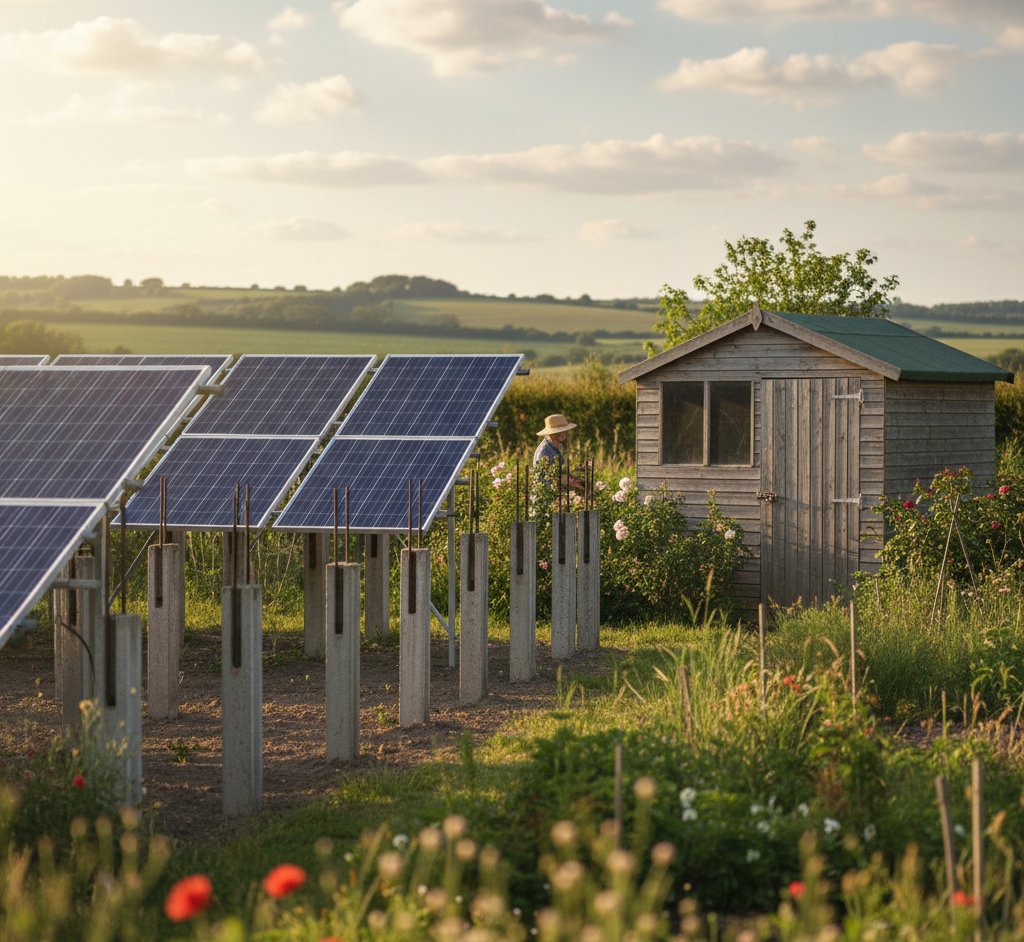
Ground-Mounted Solar Panels UK: When and Why
Ground-mounted solar panels explained for UK homeowners. When ground mount makes sense, costs, planning permission rules, and practical considerations.
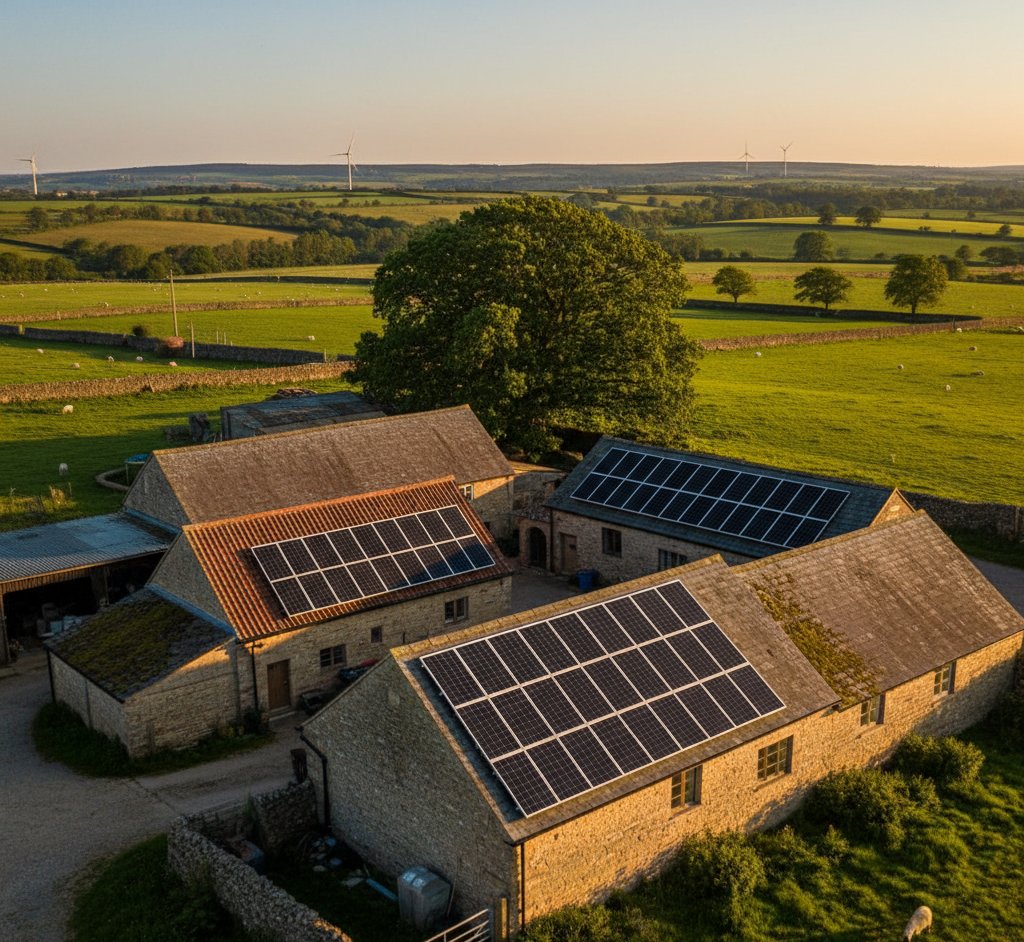
Roof Orientation and Solar: Direction Trade-Offs
How roof orientation affects solar performance in the UK. South, east, west, and north-facing output compared, plus split-orientation strategies.
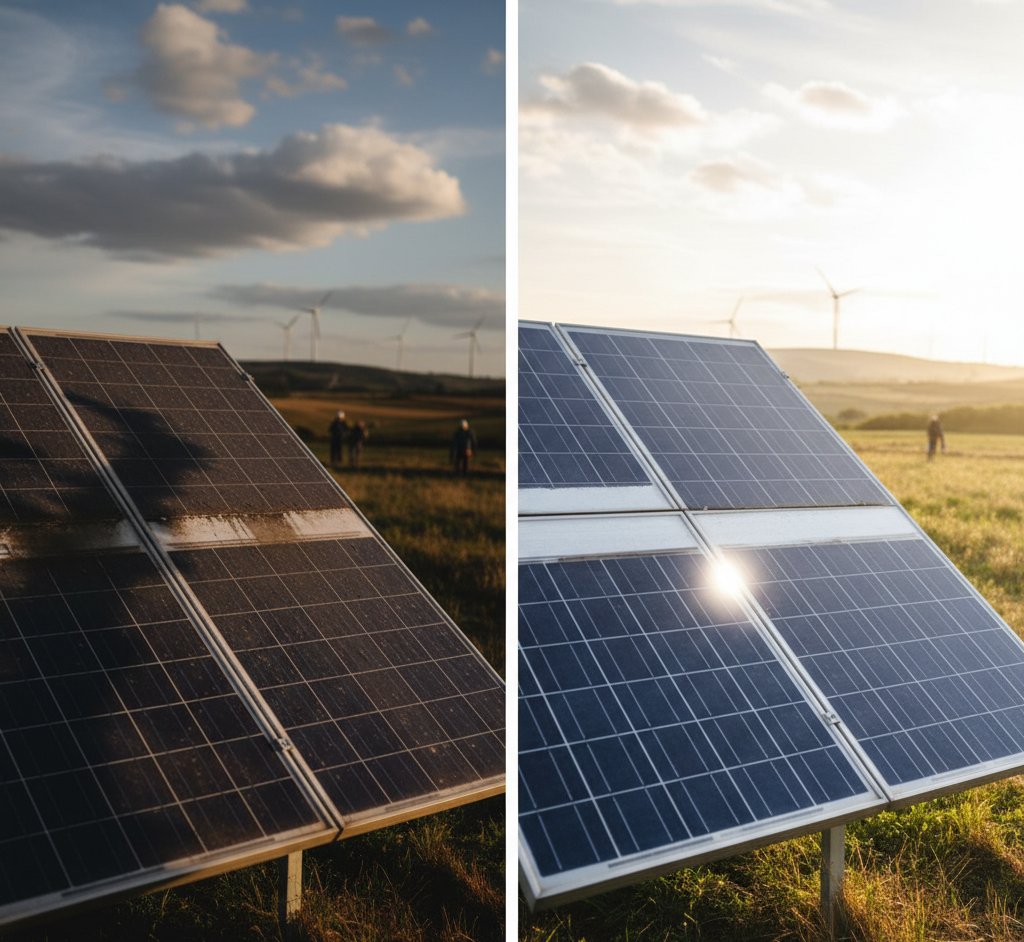
Solar Panel Efficiency: What It Means and Why It's Not Everything
Panel efficiency explained plainly — what the percentage means, why 20% vs 22% barely matters for UK homes, and what you should actually be comparing.


Switch to Octopus Energy
Get 50 credit when you switch. We get 50 too — win-win.
What does this mean for YOUR home?
Design your perfect solar setup in under 3 minutes. Free, no sign-up required.
Build Your Solar System