This page contains affiliate links. If you purchase through them we may earn a small commission at no extra cost to you. Learn more
Buying a House with Solar Panels: The Complete Checklist
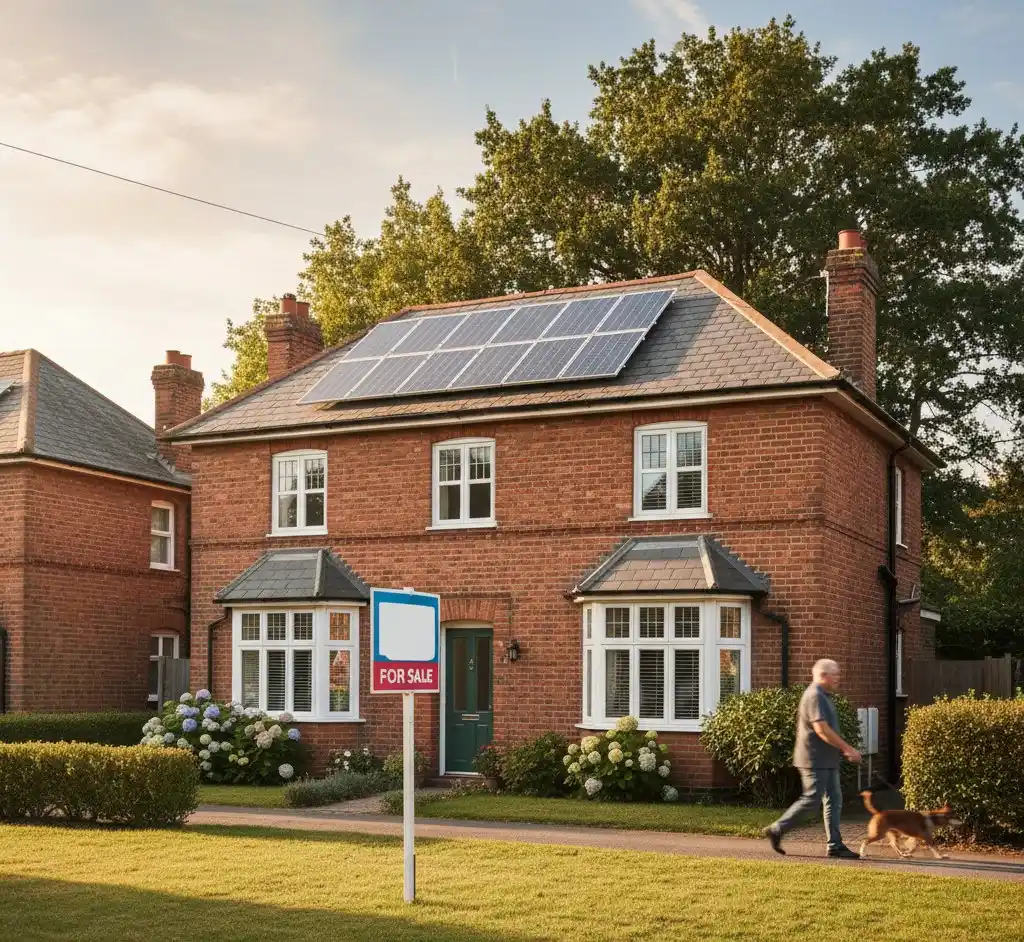
Buying a house with solar panels already fitted can be a genuine financial advantage — lower electricity bills from day one, potential export income, and a better EPC rating. But there are important legal and practical questions to resolve before you exchange contracts. Getting these wrong can delay your purchase, complicate your mortgage, or leave you inheriting a system you cannot properly maintain.
Owned vs leased: the critical distinction
The first thing to establish is who actually owns the solar panels. The answer shapes every other decision you make.
Owned outright: The seller bought the system, paid for the installation, and owns the panels, inverter, and all associated equipment. When the property transfers to you, ownership of the system transfers too. This is the straightforward scenario. You inherit the panels, the warranties (where assignable), and any FiT or SEG income entitlement.
Leased panels (rent-a-roof / PPA): A third-party company owns the panels. The seller entered into a lease or power purchase agreement — often 20–25 years — allowing the company to install panels on their roof in exchange for free or discounted electricity. The owner of the panels is not the seller. The lease is a legal interest in the property, which complicates the sale significantly.
The majority of leased panel schemes were sold between 2010 and 2015, when Feed-in Tariff returns were generous enough to make it commercially attractive for lease companies. If the house you are buying was built or re-roofed after 2016, leased panels are less common but not impossible.
Ask the seller directly: "Do you own the solar panels?" Get the answer confirmed in writing through solicitors.
Leased panels require careful legal review before exchange
If the panels are leased, your conveyancer must review the lease agreement before exchange. Leased solar panels are the most common cause of delay in UK property transactions involving renewable energy. Some mortgage lenders will not lend on properties with certain types of lease, and others require specific wording changes to the lease before they will proceed.
The leased panel problem
A lease or power purchase agreement gives the panel company a legal interest in the property — sometimes registered as a charge at Land Registry, sometimes as a licence or covenant in the title deeds. Either way, it attaches to the property, not the person. When the house sells, the lease does not disappear. The buyer inherits it.
Why does this matter?
Mortgage complications. Lenders have their own policies on acceptable lease terms. Halifax, Nationwide, and many other high-street lenders have published guidance stating that they will only lend where the lease meets certain criteria — typically that it does not prevent the lender from repossessing and selling the property freely, that removal of the panels is possible, and that the lease terms are not unduly onerous. If the existing lease does not meet these criteria, the lender may refuse to lend, or require the seller to renegotiate the lease terms before exchange. This takes time — sometimes months.
Restricted access. Lease agreements often give the panel company the right to access the roof for maintenance and inspection. Understand what access rights you are agreeing to.
End-of-term questions. What happens at the end of the lease? Is removal the panel company's responsibility? Who pays for roof repairs if the panels caused damage? These questions should be answered in the lease document itself.
Panel company health. Some of the companies that ran rent-a-roof schemes in the early 2010s have since gone into administration. If the company no longer exists, the lease may still be registered against the title. Your solicitor needs to establish who the current lease holder is and whether the lease can be released or renegotiated.
If you are buying a property with leased panels, engage a solicitor with specific experience in solar lease conveyancing. This is not a standard residential conveyance.
What to ask the seller
Before instructing a survey or proceeding with your offer, ask the seller or their estate agent to provide the following. You need all of these to properly evaluate what you are buying.
- MCS installation certificate — confirms the system was installed by a certified contractor under the Microgeneration Certification Scheme. Without this, FiT and SEG registration is not possible, and warranties may be void.
- Panel manufacturer warranty — typically 10–15 years for the product, 25–30 years for performance. Check whether it is still in force and whether it is assignable to a new owner.
- Inverter warranty — usually 5–10 years from the manufacturer. Inverters are the most likely component to need replacing in an older system.
- IBG (Insurance-Backed Guarantee) certificate — covers the installation workmanship if the original installer has ceased trading. Not all installations have one; if yours does, check it transfers to you.
- DNO notification or G98/G99 approval — confirmation that the Distribution Network Operator was notified of the installation and gave the necessary approval to connect to the grid.
- FiT registration documents — if the system was registered for the Feed-in Tariff (available for installations before April 2019), the registration reference and payment history.
- SEG registration details — if the seller is currently registered with a Smart Export Guarantee supplier, which one and what rate they are receiving.
- Lease agreement — if the panels are leased, the full original agreement including any variations.
- Monitoring app access or generation history — 12 months of generation data if available.
- Planning permission or permitted development confirmation — most domestic solar installations fall under permitted development, but listed buildings, conservation areas, and flat roofs may have required specific consent. Ask for confirmation either way.
Ask for 12 months of generation data
Ask the seller for 12 months of generation data from their monitoring app — GivEnergy, Solis, SolarEdge, and most modern inverters have cloud monitoring that logs daily output. This gives you real-world evidence of system performance — far more useful than manufacturer claims. A healthy 4kW south-facing system in England should generate around 3,400–3,800 kWh per year.
MCS certificate and warranties
The MCS (Microgeneration Certification Scheme) certificate is the foundational document for any UK solar installation. It records the system capacity, the installer details, the installation date, and the equipment used. Without it, you cannot register for the SEG, you cannot evidence FiT eligibility, and you may struggle to claim under manufacturer warranties.
To verify an MCS certificate is genuine, search the MCS installation database at mcscertified.com. You can search by address or certificate number.
Panel performance warranties typically last 25–30 years but are subject to conditions. Check whether the warranty is manufacturer-direct or through the installer. If it is installer-dependent, and the installer has gone bust, the warranty may not be enforceable without an IBG. The warranty usually guarantees that the panels will produce at least 80% of their rated output at year 25 — degradation below that threshold is a warranty claim.
Inverter warranties are more time-sensitive. Most string inverters carry 5 or 10-year manufacturer warranties. An inverter installed in 2012 is now 14 years old — well outside any original warranty. Budget for replacement. A new string inverter typically costs £500–£1,200 supplied and fitted. If a hybrid inverter is installed, check its age carefully; hybrid inverters are more complex and more expensive to replace.
IBG certificates are issued by insurance-backed guarantee providers such as RECC (Renewable Energy Consumer Code) or individual insurance schemes. If one was issued, it is typically for 10 years of workmanship cover. Many older installations do not have one.
Feed-in Tariff transfer
The Feed-in Tariff (FiT) scheme closed to new applicants in April 2019, but existing registrations continue to pay out for 20 years from the original registration date. If the house you are buying has a system registered before April 2019, FiT payments may still be active and worth several hundred pounds per year.
The FiT stays with the property, but it must be formally reassigned to you.
The process:
- Your solicitor confirms the FiT registration as part of the conveyancing searches.
- After completion, you contact Ofgem's FiT team (or the relevant licensed electricity supplier if the FiT is administered through them) to notify them of the change of ownership.
- You provide proof of property ownership and complete the reassignment paperwork.
- FiT payments then transfer to your name.
This is not automatic. If you do not complete the reassignment, the previous owner's bank account may continue to receive payments, and you may not be able to claim them retrospectively. Do not leave this until after completion — ask your solicitor to flag this as part of their completion checklist.
FiT rates vary by installation date. Systems registered in 2010–2012 typically receive generation tariffs of 30–43p per kWh, which can amount to £500–£1,500 per year for a typical system. This income is a meaningful financial asset that should be factored into the property valuation.
SEG registration
The Smart Export Guarantee (SEG) is the current mechanism for earning money from electricity exported to the grid. Unlike the FiT, it does not transfer automatically.
What happens at completion: The seller's SEG agreement terminates with their energy supply at that address. You need to set up your own SEG agreement.
What you need to do:
- Confirm that the system has a half-hourly smart meter or an appropriate export meter (required for SEG registration).
- Choose an SEG-licensed supplier. Not all suppliers offer the same rate. As of April 2026, fixed export rates range from around 3.3p to 15p per kWh depending on the supplier and tariff.
- Apply directly through your chosen supplier's website.
- You will need the MCS certificate number and system details.
There is no time limit on when you must register, but you will not receive any export payments during the period between completion and registration. It is worth registering promptly once you have moved in and transferred your electricity supply.
If you are interested in time-of-use export tariffs such as Octopus Flux (peak export rate of 24p/kWh), or Agile Outgoing (variable export rates that can reach 8–12p/kWh), these require a compatible smart meter and a compatible inverter setup. Check whether the existing inverter can interface with the required metering.
Mortgage lender requirements
If you are buying with a mortgage, your lender has its own requirements relating to solar panels. These vary by lender.
For owned panels: Most lenders are straightforward about owned solar panels. The panels are a fixture that transfers with the property. The main thing lenders check is that the installation was properly certified and that it does not affect the structural integrity of the building.
For leased panels: This is where lender requirements become material. The UK Finance Mortgage Lenders' Handbook (which most lenders adopt) specifies conditions for leased solar panel agreements. Key conditions typically include:
- The lease must not prevent or hinder possession and sale of the property.
- The panel company cannot take priority over the mortgage lender's charge.
- There must be provisions for removal of the panels if required.
- The lease must have been approved by the original lender (if there was a mortgage when the panels were installed).
Halifax, Nationwide, Barclays, NatWest, and Santander all have specific guidance on solar leases. Before proceeding with a mortgage application on a property with leased panels, check the lender's published requirements directly or ask your mortgage broker to confirm eligibility. If your preferred lender will not accept the existing lease terms, you may need to approach a different lender — or require the seller to renegotiate the lease as a condition of sale.
How to value the solar system
A solar system is an asset, and it should factor into your offer and negotiation. Here is how to think about its value.
Age and remaining warranty life. A system installed in 2016 is now 10 years old. The panels themselves are likely still within their performance warranty period (most are 25 years), but the inverter may be approaching end of life. A system installed in 2012 has a 14-year-old inverter — assume replacement is likely within the next few years and budget accordingly (typically £500–£1,200 for a string inverter replacement).
Generation history. If you have 12 months of real data, you can calculate the system's annual electricity value. Multiply annual generation (kWh) by the current unit rate (24p/kWh as of Q2 2026) to get the self-consumption value. Add any export income on top. A 4kW system generating 3,500 kWh per year and consuming all of it saves around £840 per year at current rates.
FiT income. If still active, calculate the remaining FiT payment period. A system registered in 2012 receives 20 years of FiT payments — so payments run until 2032. If the generation tariff is, say, 36p per kWh and the system generates 3,500 kWh per year, that is £1,260 per year in FiT income. Six years of remaining payments = approximately £7,500 in future income. This is a meaningful number that is worth factoring into the offer.
Equipment quality. Check the panel brand and model. Panels from tier-one manufacturers (JA Solar, LONGi, Trina, Canadian Solar) have strong reputations for reliability and long-term support. Panels from manufacturers that have since ceased trading may have no viable warranty recourse. The inverter brand matters too — established brands such as SolarEdge, Fronius, Solis, and GivEnergy have active UK service networks.
System size relative to your needs. Consider whether the system is appropriately sized for your household. A 2kW system on a 5-bedroom house will cover a fraction of consumption; a 6kW system on a 2-bedroom flat may produce more than you can use. Neither is a dealbreaker, but it affects the financial case.
What to check on survey day
If you proceed to a survey, ensure your surveyor is aware of the solar installation. A standard RICS homebuyer survey will note the panels but may not assess the electrical components. For a system that is more than 5 years old, it is worth commissioning a specialist solar inspection from a MCS-certified solar installer.
Physical checks:
- Panel condition: Look for cracked glass, delamination, discolouration, or micro-cracks (the last require a thermal imaging camera to detect properly). Minor soiling is normal and can be cleaned.
- Mounting and racking: Check for any signs of movement, rust on metal fittings, or damaged roof tiles around the mounting points. Roof penetrations should be properly sealed and weatherproofed.
- Inverter location and condition: The inverter is usually in the loft, garage, or utility room. Check for warning lights or error codes on the display. Listen for abnormal noise during operation.
- Inverter age: Check the installation date on the inverter label. Most string inverters have a design life of 10–15 years.
- DC isolator: There should be a DC isolator accessible on the roof or at the point of entry into the building. Check it is labelled, accessible, and in working order.
- Cabling: DC cables should be properly routed and secured. Loose or UV-degraded cabling is a fire risk.
- Bird nesting: Check the underside of the array for signs of bird nesting. Pigeons frequently nest beneath panels, which can cause wiring damage, reduce generation, and create bio-hazard issues. Bird-proofing measures typically cost £200–£400 but are well worth it.
- Monitoring system: Ask for the monitoring app credentials or confirm that monitoring access can be transferred to you.
Red flags
The following situations warrant extra caution — in some cases, they should affect your willingness to proceed or the price you pay.
No MCS certificate. This is a significant problem. Without an MCS certificate, you cannot register for SEG, FiT eligibility is likely void, and the installation may not comply with Part P of the Building Regulations. Systems installed without MCS certification before the FiT closed are sometimes called "non-MCS installs." Getting one retrospectively is not possible; you would need a new installation certificate, which requires an inspection by an MCS-certified installer.
No paperwork at all. If the seller cannot produce any documentation — no MCS certificate, no warranty, no DNO notification — treat this as a serious red flag. You have no way of knowing whether the installation was done to a safe standard.
Liquidated installer. If the original installer has gone bust, workmanship warranties are worthless unless an IBG was issued. Check the RECC or MCS database. If the installer is no longer trading and there is no IBG, the only recourse for installation defects is your own insurance or a new installer assessment. See our guide on what to do when your solar installer has gone bust.
Very old inverter with no remaining warranty. An inverter installed in 2010 or 2011 is now 15 years old. Some will still be running; many will not. Factor in replacement cost, and check whether the existing cabling and consumer unit are compatible with a modern replacement inverter.
Unresolved FiT or lease disputes. If the seller has an ongoing dispute with the FiT administrator, or if a lease company is claiming arrears or disputing access, these issues transfer with the property. Your conveyancer should confirm there are no outstanding disputes before exchange.
Panels on a listed building or in a conservation area. Solar panels on listed buildings almost always require listed building consent. If consent was not obtained, the installation is unauthorised. This creates a legal liability that transfers to you. Check the planning history at the local authority before proceeding. See our guides on listed buildings and conservation areas.
Buying a house with solar panels is, in most cases, a positive thing — you gain a working system without the disruption of installation, at a point in time when electricity costs make solar economics attractive. The key is doing your due diligence properly. Confirm ownership, gather the paperwork, engage a solicitor who understands solar leases if relevant, and commission a specialist inspection if the system is more than five years old. Get those steps right and you will start enjoying the benefits from day one.
Share this article
Order your Energy Performance Certificate online — see how solar improves your home's energy rating. Required before selling or renting. All assessors are fully accredited.
Affiliate link — we may earn a small commission at no extra cost to you
Stay informed
Get free solar updates direct to your inbox
Related reading

Moving House with Solar Panels: What Happens?
What happens to solar panels when you sell your house? Ownership, warranties, SEG transfers, Feed-in Tariff, and what buyers need to know.
Do Solar Panels Increase Property Value?
Do solar panels add value to your home in the UK? What the research says, how much they add, and when they might actually reduce value.

Solar Panel Insurance: What You Need to Know
Is your solar system covered by home insurance? What to check, what to tell your insurer, and when you might need specialist solar panel insurance.


Switch to Octopus Energy
Get 50 credit when you switch. We get 50 too — win-win.
What does this mean for YOUR home?
Design your perfect solar setup in under 3 minutes. Free, no sign-up required.
Build Your Solar System