This page contains affiliate links. If you purchase through them we may earn a small commission at no extra cost to you. Learn more
EcoWorthy 5.12kWh Battery Review: Budget LiFePO4 Tested
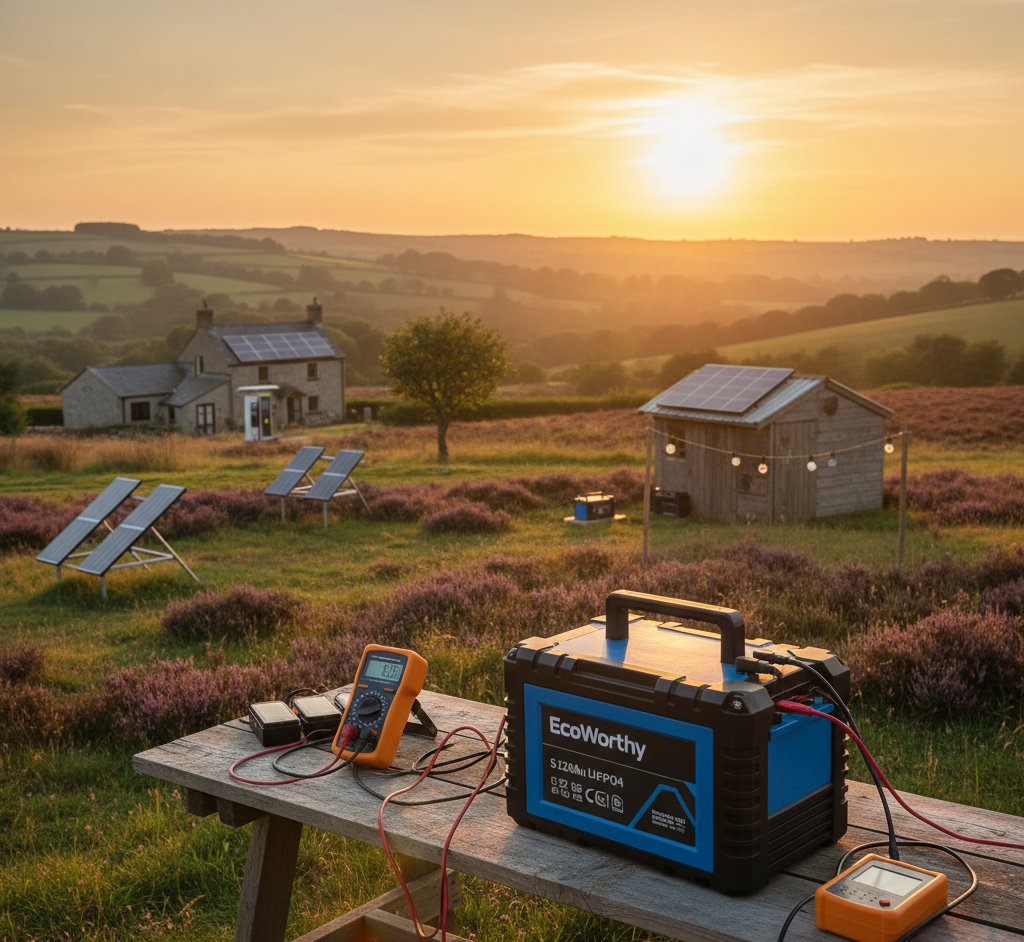
What is the EcoWorthy battery?
EcoWorthy (often styled ECO-WORTHY) is a Chinese manufacturer selling solar components directly to consumers via Amazon UK and their own website. Their 5.12kWh server-rack LiFePO4 battery has become popular in UK DIY circles purely because of its price — at roughly £137/kWh, it's significantly cheaper than a Fogstar Drift and a fraction of any professional install system.
The question isn't whether it's cheap. It obviously is. The question is whether it's reliable enough to trust in a home energy storage system.
Specifications
| Spec | EcoWorthy 5.12kWh |
|---|---|
| Chemistry | LiFePO4 (LFP) |
| Nominal voltage | 51.2V (16S) |
| Capacity | 100Ah / 5.12kWh |
| Usable capacity | ~4.6kWh (90% DoD) |
| Cells | Unbranded LFP prismatic |
| BMS | Integrated (basic) |
| Communication | CAN bus, RS485 |
| Max continuous discharge | 100A (5.12kW) |
| Cycle life | 4,000 cycles to 80% capacity |
| Warranty | 5 years |
| Weight | ~48kg |
| Format | 19-inch server rack (3U) |
Build quality: honest assessment
The enclosure is functional but noticeably cheaper than premium alternatives. The sheet metal is thinner, the powder coating is less even, and the bus bar connections feel less robust. None of this is necessarily a problem for a battery sitting in a rack, but it tells you something about the manufacturing tolerances.
The cells are the bigger question mark. EcoWorthy doesn't publish cell manufacturer or grade information. Community teardowns suggest they use generic Chinese prismatic cells — not necessarily bad, but without published grading data, you don't know how well-matched the cells in your specific unit are. Mismatched cells lead to imbalanced packs and reduced effective capacity over time.
The BMS is basic. It handles the essential protection functions (over/under voltage, overcurrent, temperature) but the balancing current is low (typically 60–80mA passive). This means a pack that arrives slightly imbalanced may take weeks of cycling to balance fully.
CAN bus communication
The EcoWorthy does support CAN bus communication, which is a step up from truly bottom-tier batteries that only offer voltage-based integration. However, the available profiles are more limited than the Fogstar/Seplos ecosystem.
Users have reported successful communication with:
- Victron (via compatible CAN profile)
- Some GivEnergy models (with manual protocol selection)
- Deye inverters
It's less plug-and-play than premium batteries. Expect to spend some time on forums working out the correct CAN profile and DIP switch settings for your specific inverter. Our CAN bus guide covers the fundamentals.
Check inverter compatibility before you buy
Not all hybrid inverters recognise the EcoWorthy's CAN protocol automatically. If you're pairing with a GivEnergy inverter, search the community forums for your specific inverter model + EcoWorthy combination first. Some users have had to use RS485 instead of CAN, and others have fallen back to voltage-only mode (which works but loses SoC accuracy).
Real-world performance
Community feedback on the EcoWorthy is mixed but generally positive for what it is:
Capacity: Most users report 4.3–4.8kWh of usable capacity. This is slightly below the theoretical 4.6kWh (90% DoD), which suggests some cell mismatch in certain units. Not disastrous, but worth noting.
Reliability: The majority of units work fine for months and years. However, the failure rate appears higher than premium alternatives — scattered reports of BMS failures and capacity drop-off within the first 18 months. The 5-year warranty covers this, but warranty claims through Amazon can be frustrating.
Efficiency: Round-trip efficiency of around 93–94%. Slightly lower than premium alternatives, likely due to the BMS and connection losses.
Temperature: Similar operating range to other LFP batteries. Works fine in UK garages. Charging cuts off below 0°C as expected.
The bulk-buy strategy

Where the EcoWorthy really shines is in large-capacity builds. If you want 20kWh of storage:
- 4x EcoWorthy 5.12kWh = ~£2,800
- 4x Fogstar Drift 5.12kWh = ~£6,000
- Tesla Powerwall 3 (13.5kWh, not even 20kWh) = ~£9,000 installed
The cost difference is enormous. For an experienced DIYer building a large system, four EcoWorthy units in a rack with a Victron inverter is a compelling proposition — even accounting for the lower warranty and slightly higher failure risk.
See our full analysis of cheap 20kWh battery builds.
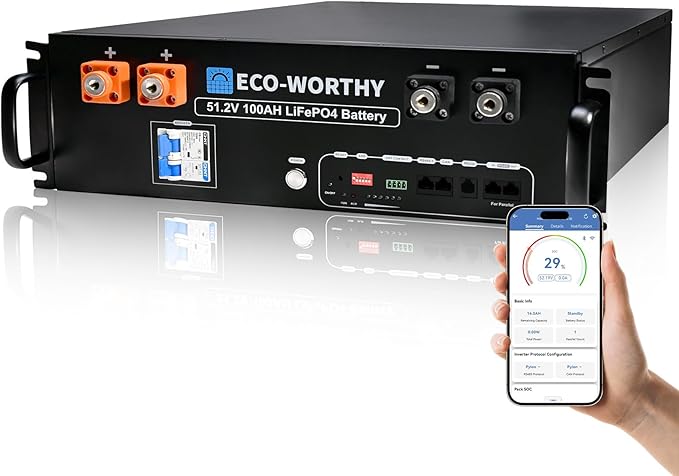
ECO-WORTHY 5.12kWh LiFePO4 Battery Module
£7005.12
4.9
LFP
4000
Affiliate link — we may earn a small commission at no extra cost to you
For a budget-friendly inverter to pair with EcoWorthy batteries:
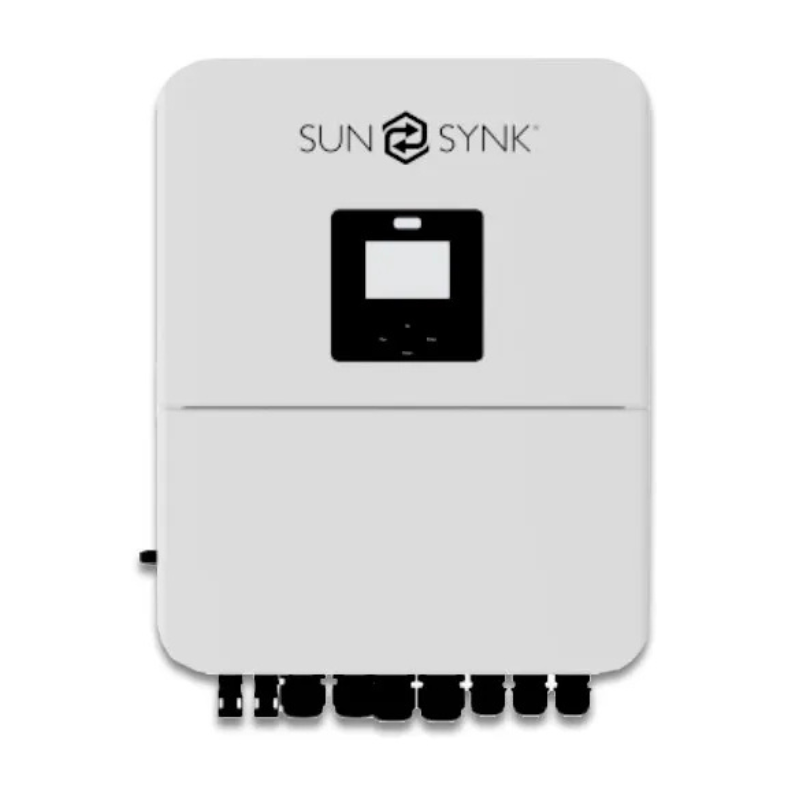
SunSynk 5kW Hybrid Inverter
£1,1505
7.5
2
48V
Affiliate link — we may earn a small commission at no extra cost to you
Who should buy the EcoWorthy?
Good fit:
- Budget-conscious DIY builders with electrical experience
- Off-grid projects (sheds, workshops, camper conversions) where cost matters more than warranty
- Large capacity builds (15kWh+) where premium battery costs become prohibitive
- Second or third battery in an existing system where you want to add capacity cheaply
Poor fit:
- First-time DIY builders who want a painless setup experience
- Anyone who values long warranty and UK-based support
- Systems where CAN bus communication is critical (grid-tied with time-of-use tariff optimisation)
- People who want to "set and forget" without occasional monitoring
EcoWorthy vs Fogstar Drift
This is the comparison everyone asks about:
| Factor | EcoWorthy 5.12kWh | Fogstar Drift 5.12kWh |
|---|---|---|
| Price | ~£700 | ~£1,500 |
| Cost per kWh | ~£137 | ~£293 |
| Cells | Unbranded | EVE LF280K Grade-A |
| BMS | Basic | Seplos V3 |
| Warranty | 5 years | 10 years |
| Cycles | 4,000 | 6,000 |
| CAN bus | Limited profiles | Broad compatibility |
| Build quality | Adequate | Excellent |
The Fogstar is a better battery. The EcoWorthy is a cheaper battery. They're not competing for the same customer. If reliability and longevity are your priority, the Fogstar is worth the premium. If you're building a large system on a strict budget and you're comfortable with the trade-offs, the EcoWorthy is genuinely viable.
A pragmatic middle ground
Some builders use a Fogstar Drift as the master battery (for reliable CAN bus communication with the inverter) and add EcoWorthy units as parallel slaves for additional capacity. The Fogstar handles the smart communication while the EcoWorthy units just add bulk storage. This gives you the best of both worlds at a moderate total cost.
Share this article

OVO has carefully selected trusted teams across the UK to install solar panels and heat pumps. Enjoy the personal touch of a local expert with the peace of mind of a household name.
Affiliate link — we may earn a small commission at no extra cost to you
Stay informed
Get free solar updates direct to your inbox
Related reading
Solar Battery Storage: Complete UK Guide 2026
Everything you need to know about adding battery storage to a UK solar installation — types, sizing, costs, and which products are worth considering in 2026.

Fogstar Drift Battery Review: Is It Worth the Premium?
Honest review of the Fogstar Drift LiFePO4 battery — specs, real-world performance, compatibility, and whether it justifies the price for UK DIY solar setups.

Cheapest 20kWh Battery Storage Options in the UK (2026)
The cheapest ways to build a 20kWh home battery storage system in the UK — comparing DIY, budget modules, and professional install options with real 2026 prices.


Switch to Octopus Energy
Get 50 credit when you switch. We get 50 too — win-win.
What does this mean for YOUR home?
Design your perfect solar setup in under 3 minutes. Free, no sign-up required.
Build Your Solar System