This page contains affiliate links. If you purchase through them we may earn a small commission at no extra cost to you. Learn more
How to Get the Most from Your Solar Panels: 12 Practical Tips

Getting the most from solar panels does not have to mean a big investment. Some of the most effective improvements cost nothing — just a change to when you run appliances. Others are one-off hardware additions that pay back quickly. A few require changing your energy tariff.
These 12 tips are grouped into three tiers so you can focus on what applies to your situation.
For everyone: the three fundamentals
Tip 1 — Check your orientation and tilt
South-facing at 35° pitch is the UK optimum. If your panels face south and sit at roughly roof pitch angle, they are already close to maximum potential.
If your roof faces east or west, do not despair: an east- or west-facing array at the same pitch delivers approximately 80% of the south-facing yield — still commercially viable and often the only option for terraced houses. What changes is the profile: east panels peak in the morning, west panels in the afternoon.
If you have an east-west roof and have not yet installed, a split array — panels on both faces — can nearly double your usable roof area while producing a more consistent generation curve across the day.
For yield penalty tables by orientation and tilt angle, see is my roof suitable?.
Tip 2 — Minimise shading
A single shaded panel can drag down an entire string in a conventional string inverter setup. This is because all panels in a string are wired in series — like old-style Christmas lights, where one dim bulb dims them all. A bypass diode limits the worst effects, but shading still reduces output disproportionately.
Key shading sources to review:
- Trees: assess the shade cast at mature height, not current height. Deciduous trees lose their leaves in winter but create significant shading in summer when output matters most
- Satellite dishes and aerials: often overlooked and frequently cast a moving shadow as the sun tracks across the sky
- New development nearby: planning applications for neighbouring buildings are worth monitoring
If you have unavoidable shading and a string inverter, panel-level optimisers (SolarEdge, Tigo) or microinverters (Enphase) can dramatically reduce the string-drag effect. The payback depends on the severity of your shading.
Tip 3 — Keep panels clean
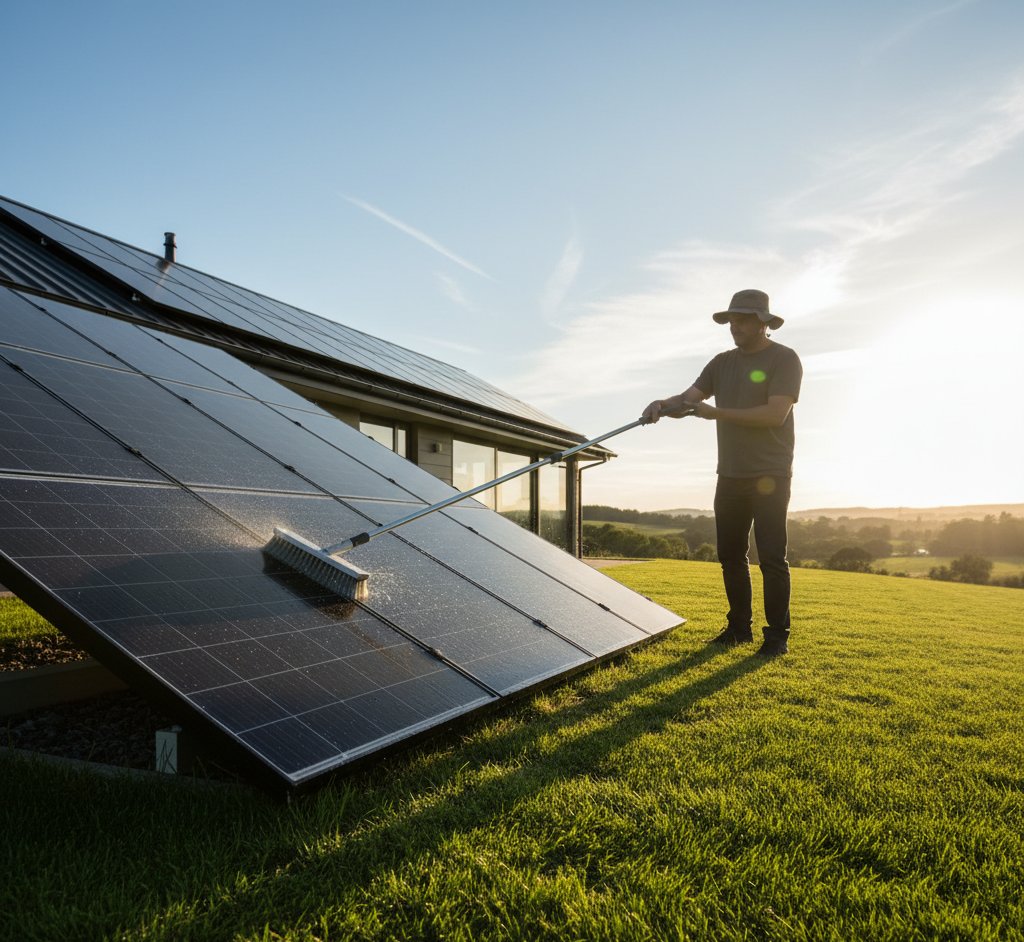
Soiling losses for a typical UK site are 2–7% per year. Rainfall clears general dust in most UK regions, but bird droppings are different — a concentrated dropping on a single panel in a string system can cause 20–30% output loss on that panel alone, due to the bypass diode behaviour described above.
How to clean safely:
- Water only — no detergent (residue attracts more soiling)
- Soft cloth or long-handled brush; no abrasives
- One to two times per year — typically spring (post-winter roosting) and autumn
- Do not clean in strong sunlight — thermal shock risk to the glass panel
If you are uncomfortable accessing the roof, professional panel cleaning services are available and typically charge £50–150 for a standard residential array.
For financial return: five upgrades that pay back
Tip 4 — Run appliances during solar hours
This is the single biggest behavioural change for improving your financial returns — and it costs nothing.
Shifting your washing machine, dishwasher, and tumble dryer to the 10am–2pm window means you are using solar-generated electricity rather than importing from the grid. At a standard rate of around 24p/kWh, each kWh you self-consume instead of import saves you 24p. Each kWh you export earns you 3–15p depending on your SEG tariff. The gap between those two figures is your incentive to consume rather than export.
Use the timer or delay-start function on your appliances. Many modern dishwashers and washing machines have a 24-hour delay-start option — set it the night before and it runs during solar generation hours.
Tip 5 — Add a solar diverter
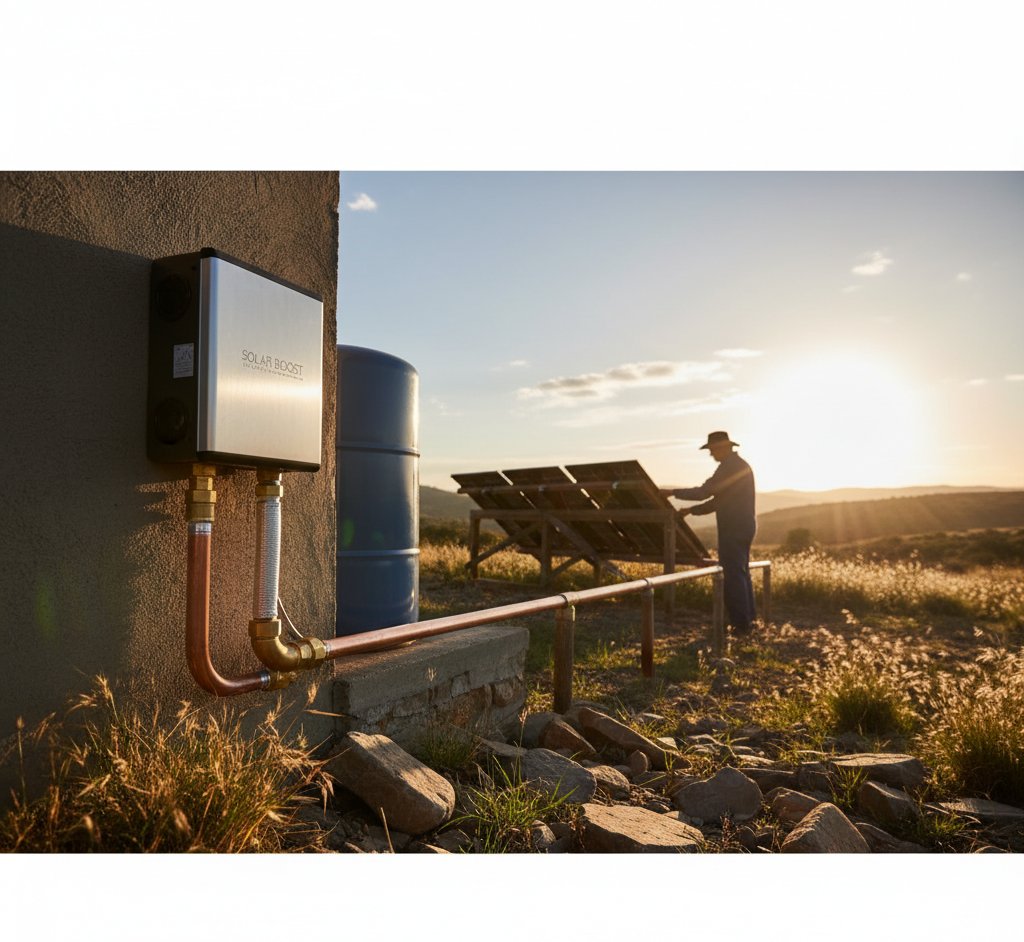
A solar diverter (such as the myenergi Eddi or Solar iBoost+) connects via a current transformer (CT) clamp and monitors your generation in real time. When your solar output exceeds your household consumption, instead of exporting the surplus to the grid at a low SEG rate, the diverter redirects it to your hot water immersion heater.
- Cost: £150–600 installed
- Payback: 1–3 years depending on hot water usage and your current SEG export rate
- No internet connection required; no tariff changes needed
- 0% VAT applies as of 2026 (to March 2027)
If your household uses a lot of hot water — family of four, power shower, daily baths — the payback is typically faster. For full product detail and installation notes, see solar diverters explained.
Tip 6 — Add battery storage
60–80%
vs 25–35% without — A 5–10 kWh battery stores surplus solar generation for use in the evening, when the sun has gone dow
Learn moreThe financial case rests on the import/export rate gap. At a standard tariff (~24p/kWh import, ~5p/kWh export on a basic SEG), storing and using 1 kWh saves you roughly 19p. Over a year, with a 5–10 kWh battery cycling once daily through summer and charging on cheap overnight rates in winter, the savings add up significantly.
For battery costs, chemistry comparison, and full payback analysis, see battery payback analysis.
Tip 7 — Switch to a time-of-use tariff
If you have battery storage, you can make it work considerably harder with a time-of-use (ToU) tariff.
The core strategy is:
- Charge your battery cheaply overnight (Octopus Go: currently 5.5p/kWh, 00:30–05:30)
- Use that stored energy during the day instead of importing at ~24p/kWh
- Export during Agile peak periods when grid demand is high (export rates can exceed 24p/kWh during evening peaks on Flux)
The gap between the overnight cheap rate and the standard daytime rate is where the savings come from. Without battery storage, a ToU tariff is less useful — you end up paying a higher rate for electricity used outside the cheap window.
For a comparison of current UK ToU tariffs and which works best for solar households, see best tariffs for battery storage.
Tip 8 — Join a Virtual Power Plant (VPP)
A Virtual Power Plant (VPP) programme pays you to dispatch stored energy from your battery in response to signals from the grid — typically during periods of high demand when balancing services are needed. You agree to occasional short events (15–60 minutes) where your battery exports energy or adjusts consumption.
- Estimated additional income: £200–400 per year
- Compatible inverter brands include GivEnergy (Octopus/Kraken integration), SunSynk, and Tesla Powerwall
- Opt-out clauses are available on all major schemes — you are not locked in to every event
- Events are typically brief and cause minimal disruption to household use
This is passive income from hardware you already have. If your inverter is compatible, it is worth exploring.
For maintenance: four things that protect long-term output
Tip 9 — Monitor your system monthly
Generation faults often go unnoticed for weeks or months, costing hundreds of pounds in lost output before anyone notices. Monthly checks are the minimum.
What to check:
- Monthly generation (kWh) vs the expected figure from your MCS estimate or a PVGIS model
- Inverter error codes and alarm states — most inverter apps show these clearly
- Export vs self-consumption ratio — a sudden drop in self-consumption with unchanged generation can indicate a monitoring or meter issue
Tools: GivEnergy portal, SolarEdge Monitoring, SMA Sunny Portal, Fronius Solar.web. For CT-clamp energy monitors that work alongside any inverter, see solar monitoring apps.
Tip 10 — Ensure adequate ventilation
Solar panels lose approximately 0.35% efficiency per degree Celsius above 25°C (the standard test condition temperature). A hot UK summer day at 35°C ambient can push panel surface temperatures to 50–65°C — a loss of around 10% from heat alone.
This is unavoidable physics. But what you can control is whether the panels can cool themselves efficiently. MIS 3002 specifies a minimum 50–100mm clear gap between the back of the panel and the roof surface for natural convective airflow.
If you have recently had roof work done or had additional panels added, confirm that the ventilation gap beneath the array has not been obstructed. In-roof (BIPV) systems run hotter by design — this should be factored into your energy yield estimate by the installer.
Tip 11 — Check your inverter firmware and settings
Modern inverters improve over time through firmware updates. Updates typically improve:
- MPPT (Maximum Power Point Tracking) algorithm responsiveness — the speed at which the inverter finds peak power output as conditions change
- Shading compensation algorithms (Fronius DynamicPeak Manager, SMA ShadeFix)
- Battery charging profiles and grid export setpoints
Log into your inverter's web interface or the manufacturer's portal. Check the currently installed firmware version against the latest release. Most updates can be applied remotely. This is a five-minute job that some inverter owners have never done. If your inverter firmware is several years old, the improvement in MPPT behaviour alone may be measurable.
Tip 12 — Bird-proof your panels
Bird nesting under solar panels causes two types of damage: accumulated droppings that create sustained soiling losses, and mechanical damage to wiring and mounting components from nesting activity over time.
The important detail: installation timing is legally constrained.
Under the Wildlife and Countryside Act 1981, it is a criminal offence to intentionally disturb or destroy an active bird nest. This means bird proofing mesh cannot be installed between March and August — the nesting season. The installation window is September through February only.
- Cost: approximately £50 per panel for mesh installation
- A typical 10-panel system: £500–600 installed
- Check for nesting activity before instructing an installer — RSPCA guidance applies
If you noticed pigeons or starlings under your array last summer, September is your earliest opportunity to act. Do not leave it until spring, when you will have to wait another six months.
How the 12 tips fit together
| Tier | Tips | What they require |
|---|---|---|
| For everyone | 1–3 | No cost or minor behaviour change |
| For financial return | 4–8 | Free (tip 4) to ~£3,000–5,000 for battery + tariff |
| For maintenance | 9–12 | Occasional time; tip 12 has a one-off cost |
You do not need to implement all 12 at once. Start with tip 4 (shift appliance timing — free, immediate effect). Then explore tip 5 (diverter) or tip 6 (battery) based on your household's specific hot water usage and electricity consumption pattern. The maintenance tips (9–12) are running habits rather than one-off decisions.
For a full seasonal breakdown of when to act on each of these, see solar panel monthly calendar.
Share this article

Smart home energy monitoring and automation — track your solar generation and control your home with Wi-Fi devices
Affiliate link — we may earn a small commission at no extra cost to you
Stay informed
Get free solar updates direct to your inbox
Related reading
Annual Solar Panel Maintenance Checklist
A simple annual maintenance checklist for UK solar panel owners. What to check, when to check it, and when to call a professional.
Solar Diverters: Sending Surplus Power to Hot Water
Solar diverters send surplus electricity to your immersion heater for free hot water. How they work, top products, costs, and whether they're worth it.

Battery Storage Payback: Is It Worth the Extra Cost?
Honest analysis of battery storage payback in the UK. When batteries pay for themselves, when they don't, and the factors that change the calculation.


Switch to Octopus Energy
Get 50 credit when you switch. We get 50 too — win-win.
What does this mean for YOUR home?
Design your perfect solar setup in under 3 minutes. Free, no sign-up required.
Build Your Solar System