This page contains affiliate links. If you purchase through them we may earn a small commission at no extra cost to you. Learn more
Underfloor and Pool Heating with Solar

The concept: heating things with free electricity
Once your solar battery is full and your hot water cylinder is up to temperature, surplus electricity still flows. If you have an underfloor heating system or a swimming pool, directing that surplus to heating makes a lot of sense — in theory.
The practical reality depends heavily on when you need the heat versus when you have surplus solar. Let's break down both applications honestly.
Underfloor heating with solar
Electric underfloor heating
Electric UFH uses resistive heating mats or cables embedded in or under your floor. They draw significant power — a typical room might need 1–2kW, a whole-house system 4–8kW or more.
The timing problem: You need floor heating most in winter mornings and evenings. Solar surplus peaks in summer midday. This is almost perfectly misaligned.
In summer, you don't need UFH at all. In winter, your solar panels produce minimal surplus — a 4kW system might generate only 3–5 kWh total on a December day, most of which you'll consume directly.
Can a diverter help? Yes, but with limitations:
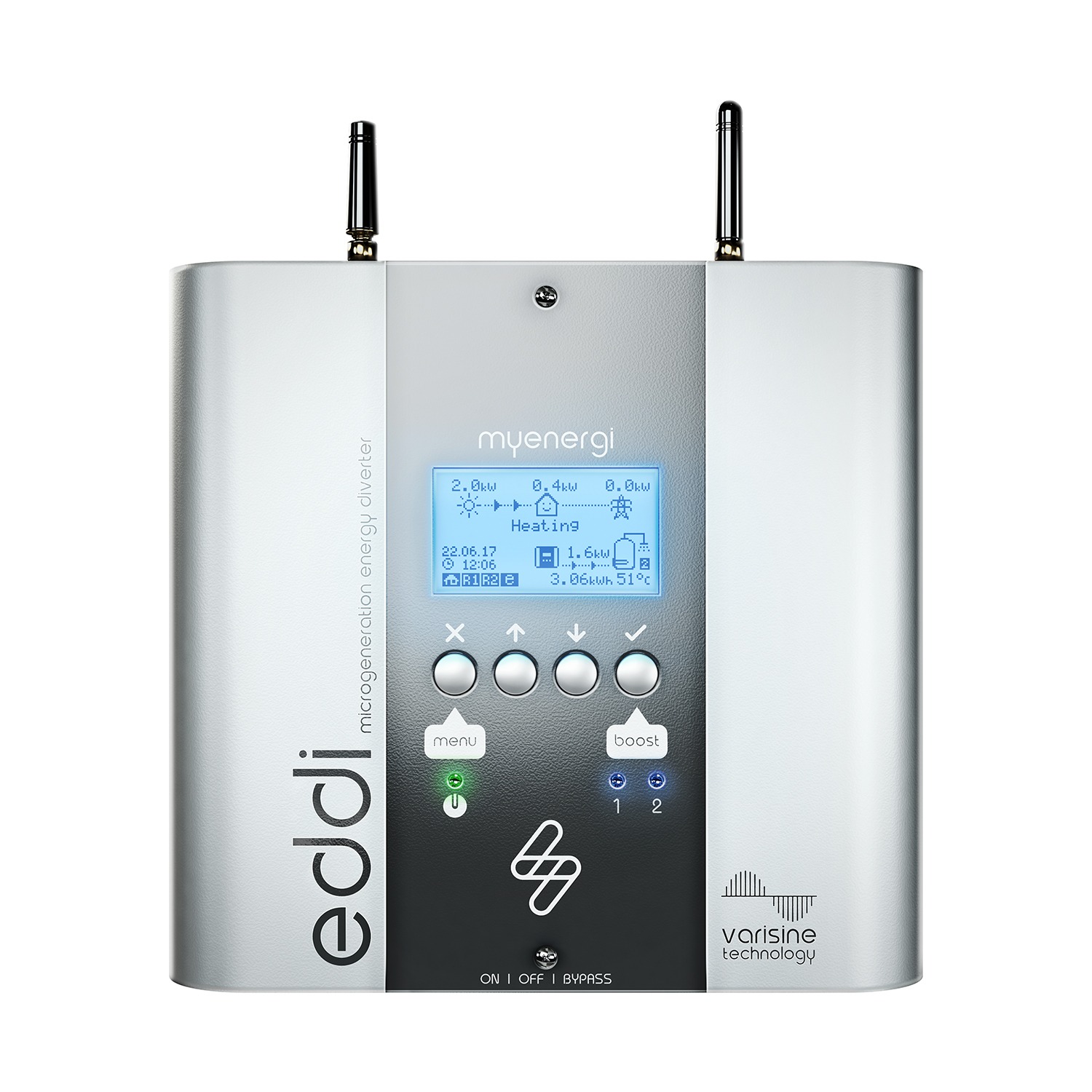
- The myenergi Eddi has a second heater output that can control an electric UFH zone
- In spring and autumn shoulder months, there may be cool mornings where surplus solar in the middle of the day could pre-heat the thermal mass of a concrete floor
- Concrete screed floors have good thermal mass — heating them at midday can keep a room warm into the evening
Realistic value: Perhaps 200–400 kWh diverted to UFH per year in the shoulder months, saving £50–£100. Not transformative, but a useful secondary dump load if you already have the diverter.
Wet underfloor heating with a heat pump
This is where it gets more interesting. A wet UFH system uses warm water circulated through pipes in the floor, typically heated by a heat pump. If your heat pump runs on surplus solar electricity, the economics improve dramatically because of the heat pump's coefficient of performance (COP).
Every 1 kWh of surplus electricity fed to a heat pump produces 2.5–3.5 kWh of heat. So your surplus goes three times further than with resistive electric heating.
Integration approach:
- Some hybrid inverters can signal a heat pump to run when surplus is available
- Smart controllers like the myenergi ecosystem can trigger the heat pump relay
- This is more complex to set up than simple immersion diversion
Thermal mass is your friend
Concrete slab floors with wet UFH are essentially thermal batteries. Pre-heating the slab with midday solar surplus can provide warmth that lasts 6–8 hours into the evening. This works best in well-insulated homes where heat loss is slow. If your home is draughty, the stored heat dissipates too quickly to be useful.
Swimming pool heating with solar
This is one of the most cost-effective uses for surplus solar, and the reason is simple: seasonal alignment.
Swimming pools in the UK need heating from May to September. Solar panels produce their maximum surplus from May to September. The timing matches almost perfectly.
How pool heating works with solar
There are two approaches:
1. Direct electric heating An electric pool heater (essentially a large immersion element) can be connected via a solar diverter. When surplus is available, the diverter sends power directly to the pool heater.
- Pool heaters are typically 3–18kW
- A diverter can modulate power to a 3kW element proportionally
- Larger heaters may need a relay/contactor setup rather than proportional control
2. Pool heat pump powered by solar A pool heat pump draws 1–2kW of electricity but delivers 5–10kW of heating thanks to COP of 4–6 (pool heat pumps are very efficient because the temperature lift is small — ambient air to 28°C pool water).
Running a pool heat pump from solar surplus is arguably the single best use of surplus solar electricity. Every surplus kWh produces 4–6 kWh of pool heating.
The numbers for pool heating

A typical outdoor pool (4m × 8m) needs roughly 5,000–8,000 kWh of heating over the UK swimming season to maintain 28°C.
Without solar: Running a pool heat pump on grid electricity at 24p/kWh costs £250–£480 per season (the heat pump uses about 1,000–2,000 kWh of electricity to deliver the required heat).
With solar surplus: If you can cover 60–80% of the heat pump's electricity with surplus solar, you save £150–£380 per season.
Over a 4kW solar system's lifetime, that's thousands of pounds — and it's arguably the most enjoyable way to use your solar surplus.
Practical setup for pool heating
A common configuration:
- Hybrid inverter charges the house battery as first priority
- Eddi diverter heats the hot water cylinder as second priority
- Eddi second output or a relay switches on the pool heat pump as third priority
- Any remaining surplus exports to the grid
During peak summer, a 4kW system might produce 20–25 kWh per day. After home consumption (8–10 kWh) and battery charging (5 kWh), you might have 5–10 kWh of surplus — enough to run the pool heat pump for several hours.
Pool heat pumps need continuous run time
Unlike immersion heaters, pool heat pumps don't respond well to highly variable power. They're either on or off — you can't proportionally modulate them like an immersion element. The best approach is a relay that switches the heat pump on when surplus exceeds the pump's draw (typically 1–2kW) and off when it drops below. Some installers use a time delay to prevent rapid cycling, which can damage the compressor.

Other heating dump loads
Beyond UFH and pools, people have connected solar diverters to:
- Electric towel rails — Eddi's second output works well for this. Low power draw (100–400W), and warm towels are always welcome.
- Hot tubs — similar to pools but smaller volume. A 1.5–3kW heater can be diverter-controlled effectively.
- Greenhouse heaters — keeping a greenhouse frost-free in spring using surplus solar has a certain elegance.
- Storage heaters — older night storage heaters can be charged with midday solar surplus instead of overnight grid electricity, but the control integration is often clunky.
Is it worth the investment?
Pool heating: absolutely
If you have a swimming pool and a solar PV system, connecting the pool heat pump to run on surplus solar is one of the highest-value modifications you can make. The seasonal alignment is perfect, the savings are significant, and the setup is relatively straightforward.
Underfloor heating: marginal
Electric UFH as a dump load provides modest savings in the shoulder months. It's worth configuring if you already have a dual-output diverter, but it's not worth installing a diverter specifically for this purpose.
Wet UFH with a heat pump is more compelling, but the integration complexity and cost are higher. It works best as part of a whole-house energy design rather than a bolt-on addition.
General principle
The best dump loads are ones where you need the heat at the same time as you have surplus solar. Pools win. Hot water wins. Winter heating loses — at least until the day we can store summer solar for winter use.
myenergi Eddi Solar Diverter
£1853000
power_divert,timed_boost
2
configurable
Affiliate link — we may earn a small commission at no extra cost to you
Solar iBoost+ Immersion Heater Controller
£1503000
auto_divert,manual_boost
1
true
Affiliate link — we may earn a small commission at no extra cost to you
Share this article

The UK's fastest boiler installation service — from quote to fitted in as little as 24 hours. Award-winning, Trustpilot rated, with no pushy salesmen.
Affiliate link — we may earn a small commission at no extra cost to you
Stay informed
Get free solar updates direct to your inbox
Related reading

Solar Immersion Heating: Using Surplus Power for Hot Water
How solar immersion diverters send surplus electricity to your hot water tank, cutting gas bills. UK costs, setup requirements, and realistic savings.

Diverter Priority Chains: Optimising Surplus Solar
How to set up a priority chain for surplus solar energy — battery, hot water, EV charging, and more. Maximise self-consumption with smart load ordering.
Solar Battery Storage: Complete UK Guide 2026
Everything you need to know about adding battery storage to a UK solar installation — types, sizing, costs, and which products are worth considering in 2026.


Switch to Octopus Energy
Get 50 credit when you switch. We get 50 too — win-win.
What does this mean for YOUR home?
Design your perfect solar setup in under 3 minutes. Free, no sign-up required.
Build Your Solar System