This page contains affiliate links. If you purchase through them we may earn a small commission at no extra cost to you. Learn more
Export Limiting and DNO Caps: Why Your System Might Be Capped
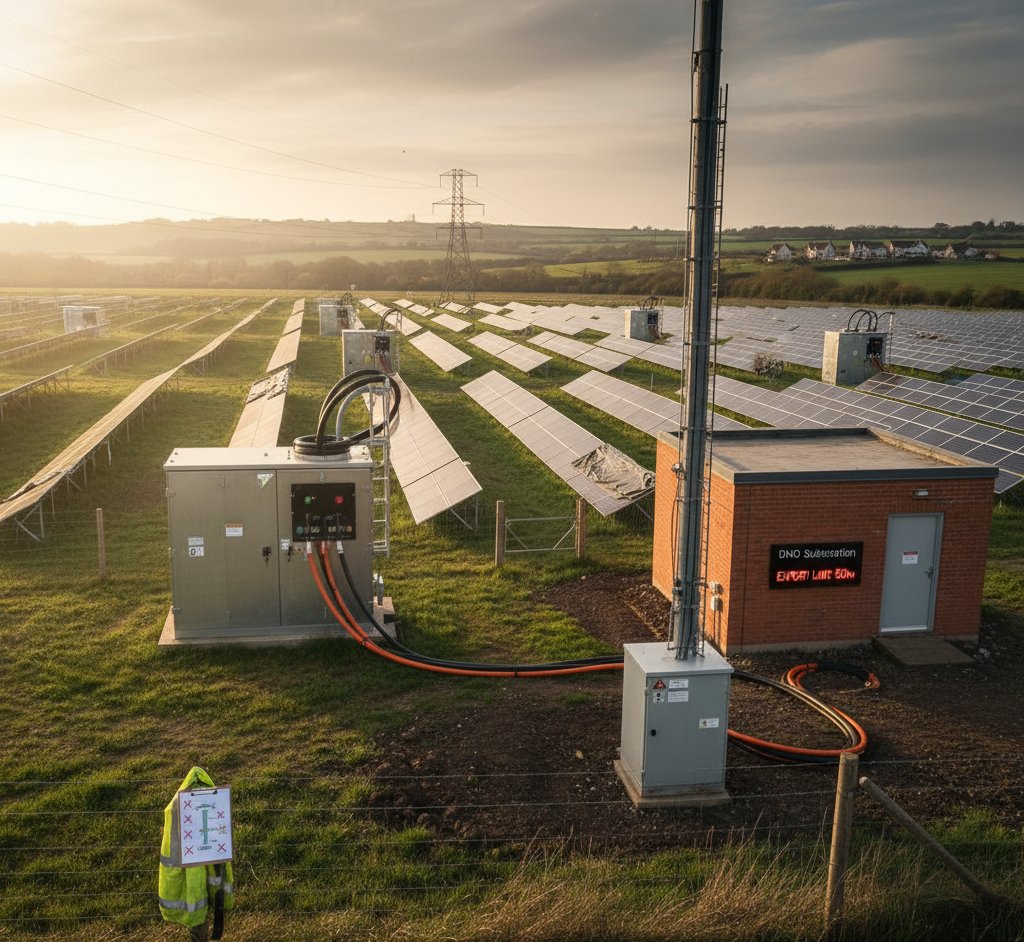
You have installed a solar system larger than 3.68kW, expecting to earn decent export payments from your surplus generation. Then your installer tells you the DNO has capped your export. What does that mean, and should you be worried?
What Is Export Limiting?
Your Distribution Network Operator (DNO) is responsible for managing the local electricity grid in your area. The cables, transformers, and substations that deliver power to your street were designed decades ago for one-way flow: electricity comes from the power station, travels through the grid, and arrives at your home.
Solar changes that equation. When your panels generate more than you need, the surplus flows backwards through the grid. One home doing this is fine. But when dozens of homes on the same street are all exporting simultaneously on a sunny July afternoon, the local transformer can become overloaded. Voltages rise, equipment overheats, and the grid becomes unstable.
Export limiting is the DNO's solution. Rather than refusing solar installations outright or spending millions upgrading infrastructure, they allow the installation but cap how much electricity you can send back to the grid. Your inverter is configured with a maximum export threshold, and it automatically throttles output when that limit would be exceeded.
The critical point: export limiting does not restrict your generation or self-consumption. If your panels are producing 5kW and your home is using 4kW, only 1kW is heading to the grid. No curtailment occurs. The limit only kicks in when your surplus exceeds the cap.
The Six UK DNOs
The UK is divided into six DNO regions, each with its own policies on export limits and grid constraints:
- UK Power Networks (UKPN) -- South East England, East England, and London. Covers a high-density population area with significant solar uptake, particularly in Essex and Kent.
- National Grid Electricity Distribution (formerly Western Power Distribution) -- Midlands, South West England, and South Wales. Cornwall and Devon are particularly constrained due to high solar penetration.
- Scottish Power Energy Networks (SPEN) -- Central and Southern Scotland, North Wales, Merseyside, and North West England. Mixed constraint levels depending on urban versus rural areas.
- Northern Powergrid -- North East England and Yorkshire. Generally less constrained than southern regions, though rural areas can be affected.
- Electricity North West (ENWL) -- Greater Manchester, Lancashire, and Cumbria. A relatively compact network with fewer constraint issues in urban areas.
- Scottish and Southern Electricity Networks (SSEN) -- North of Scotland and a large swathe of Southern England (Hampshire, Berkshire, Oxfordshire, and surrounding areas). Wide geographic spread with significant variation in grid capacity.
Each DNO publishes constraint information and has different processes for handling export limit applications. Some are more restrictive than others. UKPN and National Grid ED tend to impose limits more frequently, reflecting the higher density of solar installations in their regions.
Check Your DNO's Heat Map
Most DNOs publish online maps showing grid capacity and constraint levels by area. UKPN's "flexibility map" is particularly useful, highlighting areas where export limits are likely. Your installer should check these before designing your system, but you can look yourself to get a sense of what to expect.
When Does Export Limiting Apply?
Export limits are not applied to every solar installation. They are triggered by specific circumstances:
G99 Systems (Above 3.68kW)
The most common trigger. Systems with inverter capacity above 3.68kW on a single-phase supply require a G99 application to the DNO before installation. During this process, the DNO assesses whether the local grid can handle the additional export. If it cannot, they approve the installation with an export limit condition.
High Solar Penetration Areas
Streets or neighbourhoods where many homes already have solar panels are more likely to face constraints. The local transformer may already be handling significant reverse power flow, leaving little headroom for additional generation.
Weak or Ageing Grid Infrastructure
Rural areas are particularly vulnerable. Long cable runs to small, older transformers mean the grid has limited capacity for reverse flow. A single farm or rural property with a large system can hit the local limit.
G98 Systems (Under 3.68kW)
Systems at or below 3.68kW per phase only need a G98 notification, not an application. Export limits are rarely imposed on G98 systems. The 3.68kW threshold was specifically chosen as the level the grid can almost always accommodate without issue.
What Export Limiting Looks Like in Practice
Fixed Export Cap at 3.68kW
The most common scenario. Your system might be rated at 5kW or 6kW, but the DNO requires your inverter to limit export to 3.68kW. In practice, this only causes curtailment during peak generation hours when your home consumption is low. For most households, the actual energy lost is relatively modest -- typically 3 to 8 percent of annual generation for a 5kW system.
Lower Fixed Caps
Some areas face tighter restrictions. A 2kW export cap is more impactful, particularly on sunny days. Annual curtailment for a 5kW system with a 2kW limit could reach 10 to 15 percent without a battery.
Zero Export
The most restrictive condition. The DNO requires that no electricity whatsoever flows back to the grid. This is rare for domestic installations but does occur in severely constrained areas. Without a battery, a zero-export order can waste 30 to 50 percent of your annual generation.
Zero Export Orders Are Negotiable
If your DNO imposes a zero-export condition, your installer should push back. Zero export is a last resort, and DNOs will sometimes accept a low fixed export limit (such as 1kW or 2kW) instead if the installer makes a reasonable case. Some DNOs will also accept a "managed connection" where the export limit can be adjusted dynamically. Do not simply accept zero export without questioning it.
How to Check Whether You Will Be Affected
There are several ways to find out if export limiting might apply to your installation:
Your installer should check. Any competent installer will assess DNO constraints as part of the system design process. For G99 applications, this happens automatically because the DNO must respond with conditions. For G98 systems, a good installer will still check the local grid capacity.
DNO online portals. Most DNOs offer online tools where you can enter your postcode and see available grid capacity. UKPN's portal is the most developed, but all six DNOs provide some form of capacity information.
Energy Networks Association. The ENA's "connected data" portal provides a national view of grid capacity and generation already connected in each area.
Your neighbours. If several homes on your street already have solar, ask whether they faced export limits. Constraints are local -- if your neighbour was limited, you likely will be too.
Impact on Your Business Case
The financial impact of an export limit depends entirely on whether you have a battery:
With a Battery: Minimal Impact
A battery stores the electricity you cannot export, releasing it later when the sun drops or during evening peak hours. Instead of losing the export value (typically 12 to 15p/kWh under the Smart Export Guarantee), you gain the self-consumption value (avoiding buying electricity at ~24p/kWh). In many cases, an export limit actually improves the financial case for a battery because the alternative to storing is wasting, not just exporting at a lower rate.
Without a Battery: Noticeable but Not Catastrophic
For a typical 3.68kW export cap on a 5kW system, you might lose 200 to 400kWh of export per year. At SEG rates, that is roughly 25 to 60 pounds annually. Not ideal, but unlikely to fundamentally change whether solar makes financial sense.
For zero export without a battery, the picture is different. Losing 30 to 50 percent of your potential generation significantly weakens the payback calculation. In this scenario, adding a battery is not optional -- it is essential to making the system viable.
System Design Considerations
If you know an export limit is likely:
- Consider a battery from the start. Retrofitting one later works, but planning for it at installation is more cost-effective.
- Oversizing panels still makes sense. Even with an export cap, more panels mean more self-consumption during shoulder hours (morning and evening). The curtailment only hits during peak midday generation.
- A solar diverter is a cost-effective complement. Sending surplus to your immersion heater is better than wasting it, and costs a fraction of a battery.
Export Limits and Smart Tariffs
If you are on an export tariff like Octopus Flux or SEG, an export limit reduces what you can earn during high-export periods. But smart tariffs that pay more for evening export (when solar is not generating anyway) are largely unaffected because your battery handles the time-shifting. The limit matters less than you might initially think if you have storage and a smart tariff.
The Direction of Travel
Export limits are becoming more common as solar deployment accelerates across the UK. But three trends are working in homeowners' favour:
Grid investment. DNOs are spending billions upgrading infrastructure under the RIIO-ED2 price control period. Constraints that exist today may be resolved within a few years as transformers are upgraded and cables replaced.
Dynamic export limiting. Rather than fixed caps, newer systems can vary the export limit in real time based on actual grid conditions. On days when fewer neighbours are exporting, you might be allowed full export. This technology is being rolled out gradually and will reduce unnecessary curtailment.
Falling battery costs. As battery prices continue to decline, the practical impact of export limits diminishes. If every solar home has a battery, export limits become largely academic -- the electricity is stored and used locally rather than exported anyway.
The bottom line: an export limit is an inconvenience, not a dealbreaker. With sensible system design -- particularly including a battery -- most homeowners will barely notice the impact on their overall solar economics.
Share this article

OVO has carefully selected trusted teams across the UK to install solar panels and heat pumps. Enjoy the personal touch of a local expert with the peace of mind of a household name.
Affiliate link — we may earn a small commission at no extra cost to you
Stay informed
Get free solar updates direct to your inbox
Related reading
G100 Export Limitation: What It Is and How It Affects You
G100 export limitation caps how much solar electricity you can send to the grid. What it means, when it applies, and strategies to minimise the impact.
DNO Issues with Solar: G98, G99, and Export Limits
Understanding DNO requirements for solar panels in the UK. G98 notification, G99 applications, export limits, and what happens if the grid can't accept your power.
Why Your Inverter Limit Matters More Than Your Panel Capacity
Your panels might be rated at 5kW but your inverter only outputs 3.6kW. Here's why that's normal, when it's a problem, and what 'clipping' actually costs you.


Switch to Octopus Energy
Get 50 credit when you switch. We get 50 too — win-win.
What does this mean for YOUR home?
Design your perfect solar setup in under 3 minutes. Free, no sign-up required.
Build Your Solar System